
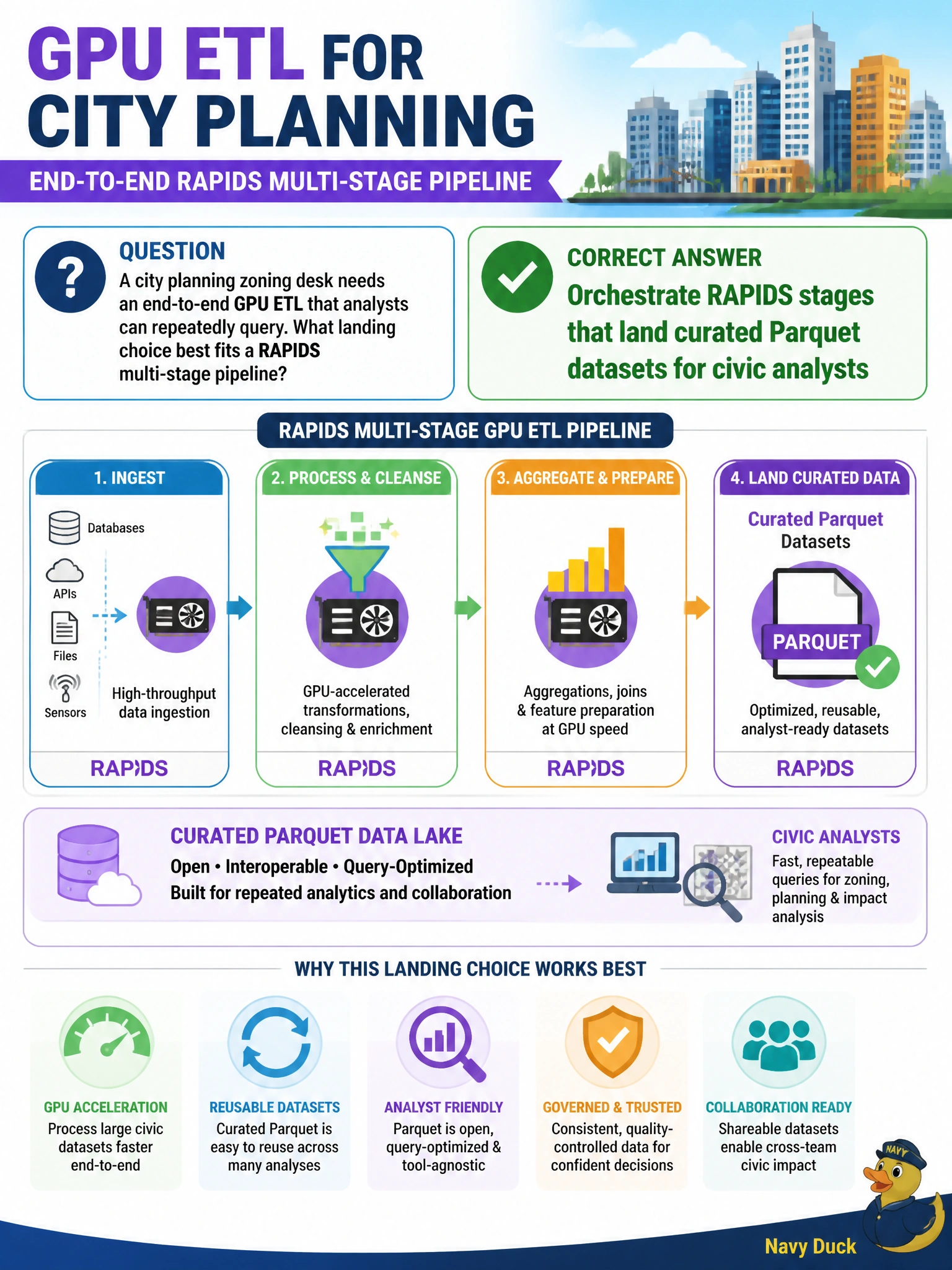
A city planning zoning desk needs an end-to-end GPU ETL that analysts can repeatedly query. What landing choice best fits a RAPIDS multi-stage pipeline?
Select an answer to reveal the explanation.
Short Explanation
Curated Parquet is the zoning team's clean map drawer—ETL washes the data, then parks it where analysts can pull it again tomorrow. Ephemeral GPU memory vanishes when the job ends. Making people re-parse raw CSV forever is the opposite of a landing zone.
Full Explanation
A RAPIDS multi-stage GPU ETL for city planning and zoning analysts should land curated Parquet (or similar columnar) datasets as a durable analytics zone. Orchestrating stages that clean on the GPU and then write curated Parquet gives analysts repeatable, query-friendly inputs without re-parsing raw CSV every session. Columnar landing also fits later RAPIDS or CPU BI consumers and preserves schema for civic governance reviews of zoning extracts.
Leaving results only in ephemeral GPU memory provides no durable landing zone—when the job ends, analysts have nothing to requery for map overlays or board packets. Publishing unclean intermediate spikes as the only long-term store freezes half-cleaned data as if it were authoritative and invites conflicting ad hoc fixes. Requiring analysts to re-run every raw CSV parse from scratch with no curated layer wastes GPU cycles and guarantees inconsistent cleaning across desks.
Exam caveat: curated does not mean immutable forever; version partitions and document schema evolution so zoning metrics remain comparable across publishes. Operational check: after ETL, open the Parquet landing with a fresh session (CPU or GPU), verify row counts and key zoning columns, and confirm the standard analyst workbook references the curated path rather than raw CSV.