
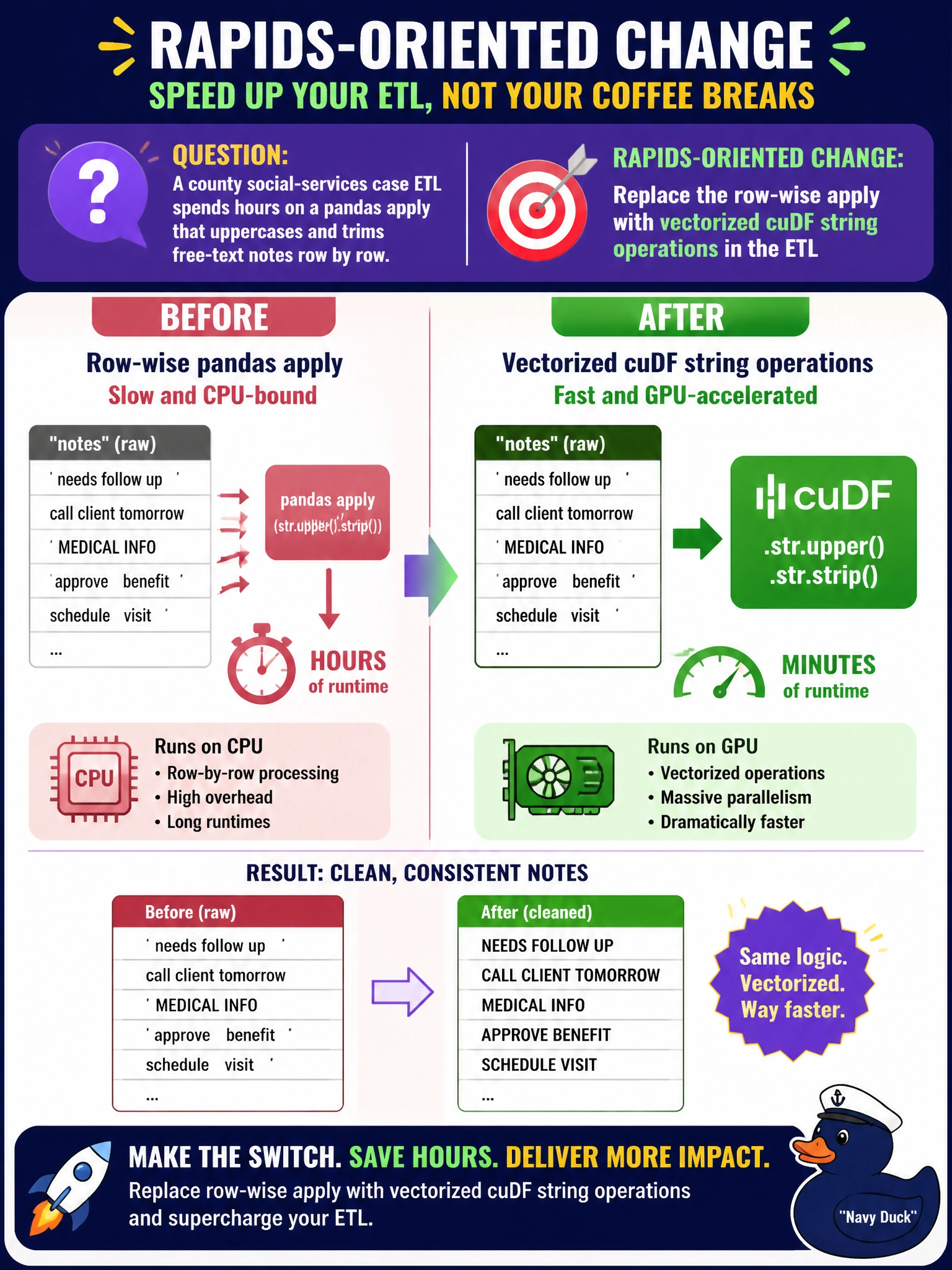
A county social-services case ETL spends hours on a pandas apply that uppercases and trims free-text notes row by row. What RAPIDS-oriented change should they make?
Select an answer to reveal the explanation.
Short Explanation
You can replace the row-by-row work with vectorized cuDF string operations, which uppercase and trim the notes across the column on the GPU. Adding nested loops or moving the unchanged pandas apply to a nightly batch keeps its CPU bottleneck, while OCR is an unnecessary detour for text that is already available as characters.
Full Explanation
Row-wise pandas apply that uppercases and trims free-text case notes is a CPU bottleneck in county social-services ETL. Replacing it with vectorized cuDF string operations applies the same cleaning across the column on the GPU in bulk, making this the RAPIDS-oriented change. Vectorization keeps the transform in device kernels instead of making one Python call per row, helping nightly case-note cleaning finish within municipal batch windows. Adding nested Python loops around the same apply deepens the slow path: it does not remove the row-wise CPU work and still serializes processing through the interpreter. Scheduling the unchanged pandas apply as a nightly batch only changes when it runs; its row-wise CPU processing remains, so the bottleneck is not addressed. Converting notes to images and running OCR is an expensive computer-vision detour for text already stored as characters, with added error modes irrelevant to uppercase and trim. Exam caveat: some genuinely irregular note cleanups may need custom logic, so keep any residual row-wise work minimal and measured while using vectorized string operations by default. Practical check: time cuDF string uppercase and strip against the pandas apply on a production-sized notes sample, verify identical normalized outputs for a hashed row sample, and then swap the ETL stage.