
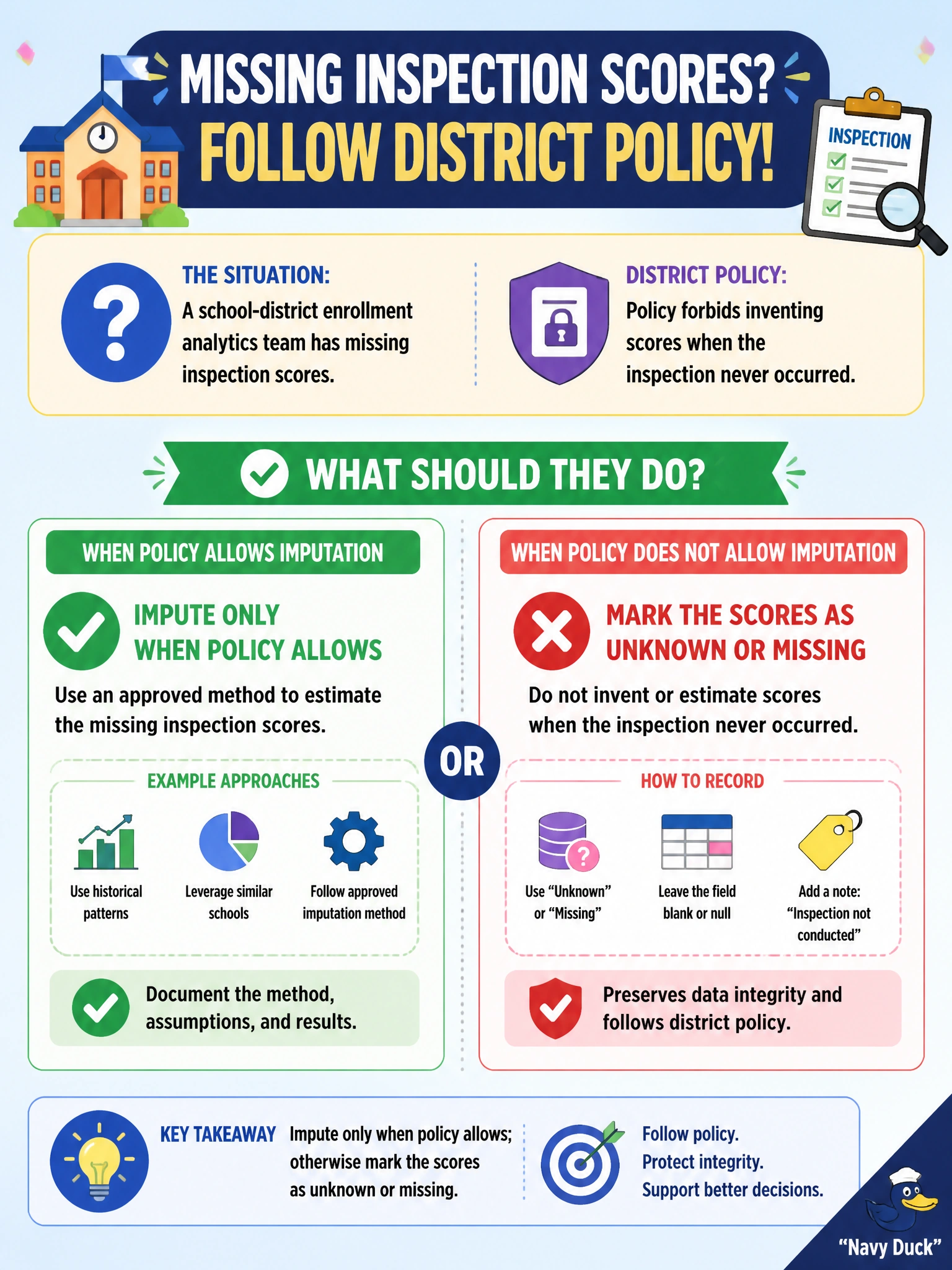
A school-district enrollment analytics team has missing inspection scores. District policy forbids inventing scores when the inspection never occurred. What should they do?
Select an answer to reveal the explanation.
Short Explanation
If the inspector never showed up, inventing a score is like grading a test nobody took. Follow district policy: impute only when allowed, otherwise mark unknown. Quiet copies from neighbors and blanket mean-fills create fake certainty.
Full Explanation
Governance-compliant cleaning for school inspection scores separates allowed statistical imputation from fabricating values that imply an inspection occurred. When district policy forbids inventing scores for inspections that never happened, the correct action is to impute only when policy explicitly allows it; otherwise mark scores as unknown or missing and carry that state into models and reports. Explicit missingness preserves truth for enrollment and facilities analytics and avoids false compliance narratives.
Always mean-imputing every missing score so the model never sees nulls creates artificial certainty and can imply inspections that did not occur—directly conflicting with the stated policy. Copying neighboring schools’ scores into blanks without documentation is undocumented fabrication and spatial leakage of another site’s conditions. Dropping the inspection score column from every historical year discards legitimate measured scores along with gaps and throws away a key facilities signal.
Exam caveat: "mark unknown" may mean a null, a sentinel, and/or a separate missingness indicator feature; align the representation with how the model and public reports treat absence. Operational check: tag rows with a policy reason code for missing scores, confirm no silent fill in the curated extract, and review a sample with facilities staff before any approved imputation is enabled behind a feature flag.