
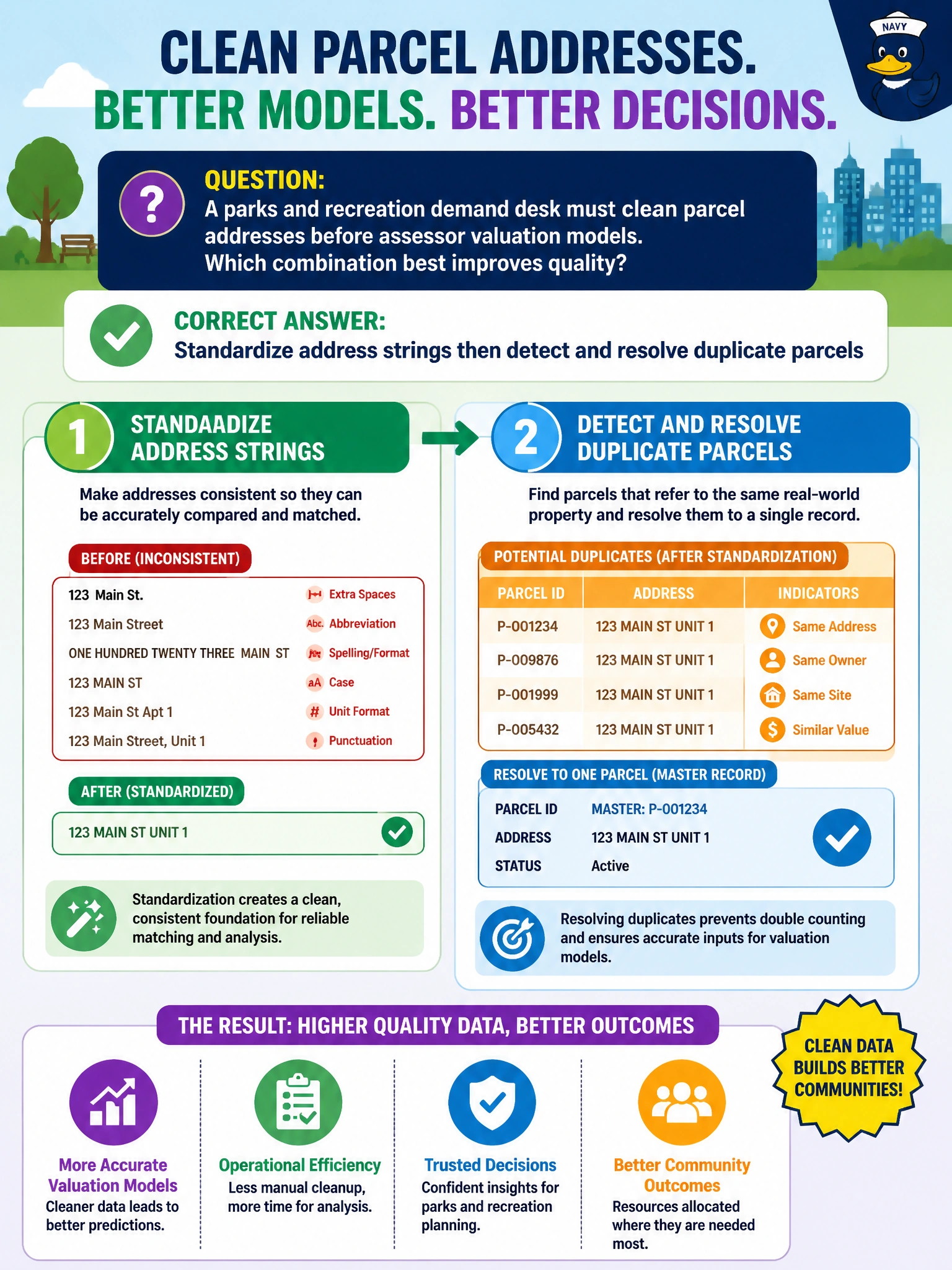
A parks and recreation demand desk must clean parcel addresses before assessor valuation models. Which combination best improves quality?
Select an answer to reveal the explanation.
Short Explanation
Messy addresses are like writing the same park entrance three different ways—dedup never sees they match. Normalize casing and punctuation first, then find duplicate parcels. Hashing everything away or blanking to UNKNOWN throws out the signal you need.
Full Explanation
Parcel and address quality for parks and recreation demand modeling improves when you standardize address strings—casing, punctuation, abbreviations—then detect and resolve duplicate parcels. Normalization collapses superficial variants of the same civic location so deduplication and assessor valuation joins see one logical parcel instead of many false uniques. That sequence is a standard data-quality pattern before geospatial or valuation features are engineered.
Leaving casing and punctuation inconsistent so duplicates look unique sabotages dedup by design and inflates parcel counts. Hashing every address into an irreversible token before any dedup check removes the human-comparable string needed to decide whether two records are the same parcel; hashing can support privacy later, but not as the first step before matching. Replacing all addresses with UNKNOWN forces a single bogus group and destroys the location signal valuation models require.
Exam caveat: standardization rules must match local addressing conventions (directional prefixes, unit designators, ZIP+4); over-aggressive stripping can falsely merge distinct units. Operational check: apply the normalizer to a labeled duplicate set from the assessor, measure precision/recall of duplicate pairs, resolve with a surviving parcel_id rule, and only then feed the cleaned table to valuation feature pipelines.