
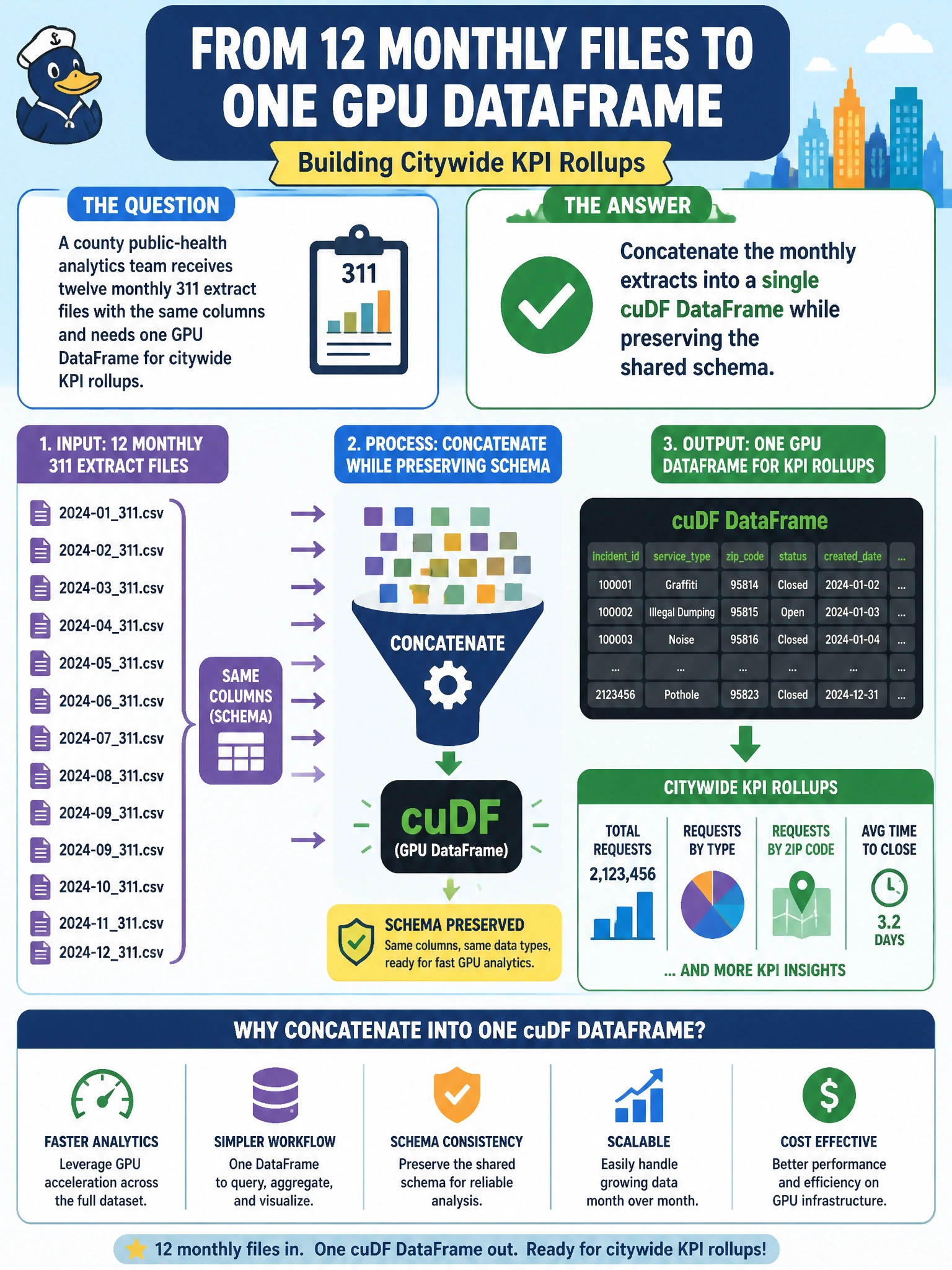
A county public-health analytics team receives twelve monthly 311 extract files with the same columns and needs one GPU DataFrame for citywide KPI rollups. What should they do?
Select an answer to reveal the explanation.
Short Explanation
Stacking twelve months of 311 tickets is like clipping monthly report pages into one binder with the same tabs. cuDF concat (or equivalent append) keeps the shared columns lined up so citywide KPIs roll up cleanly. Throwing away months or turning tables into PDFs just breaks the rollup.
Full Explanation
When twelve monthly 311 extracts share the same column schema, concatenating them into a single cuDF DataFrame is the standard RAPIDS/pandas-style approach for longitudinal civic KPI analysis. Vertical stacking preserves each month’s rows while aligning columns so groupbys, filters, and time-window metrics run once over the citywide history rather than twelve fragmented files. That single GPU frame is what public-health desks need for trend rollups, hotspot comparisons, and SLA dashboards that span a full year of resident service tickets.
Keeping each month forever isolated in separate spreadsheets blocks citywide aggregations and forces brittle manual stitching whenever leadership asks for annual totals. Overwriting eleven months with only the latest file shrinks the frame at the cost of deleting history—the KPI rollup then silently becomes a single-month snapshot and fails any year-over-year requirement. Converting tabular extracts into unstructured PDFs before analysis destroys the typed columns RAPIDS expects and turns a joinable civic dataset into documents that cannot be grouped efficiently on the GPU.
Exam caveat: concat requires compatible schemas (names and dtypes); silent column drift across monthly exports will null-fill or fail and must be caught before stacking. Operational check: validate identical column order and dtypes across the twelve files, concatenate on GPU, then verify total row count equals the sum of monthly counts and that a month key (or derived period) still partitions cleanly for KPI groupbys.