
A city open-data portal must join millions of permit applications to parcel tables on a shared parcel_id before exporting a CPU-friendly CSV. Which approach best fits GPU-accelerated tabular joining with NVIDIA RAPIDS?
Select an answer to reveal the explanation.
Short Explanation
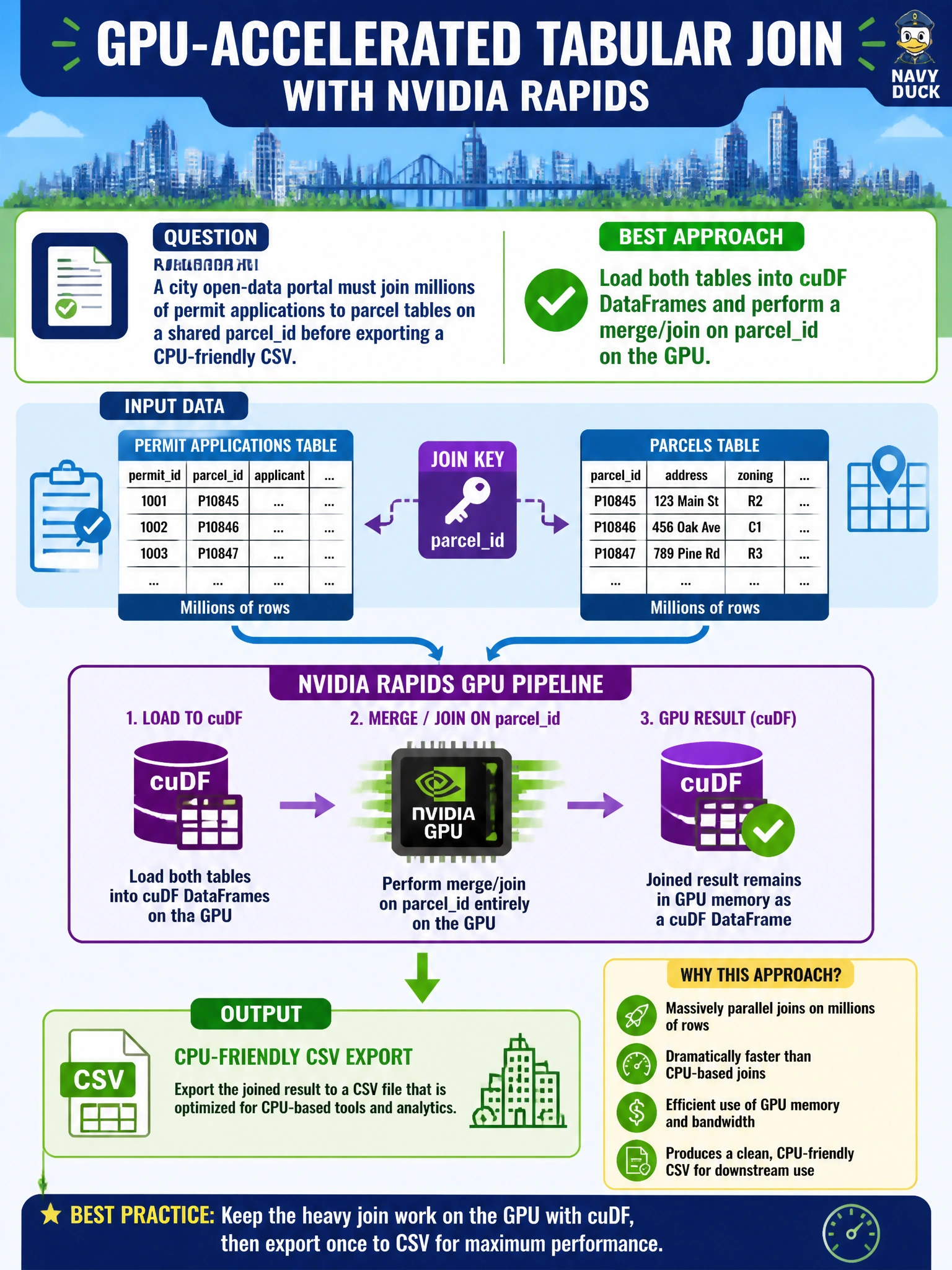
Think of it like matching every building permit to its lot on a huge city map—you want one GPU merge, not a clerk walking row by row. cuDF loads both tables and joins on parcel_id in parallel on the GPU, then you can still export to CSV for CPU tools. Hand loops and guessing skip the whole point of accelerated prep.
Full Explanation
For municipal open-data joins at city scale, the productive RAPIDS pattern is to load both permit applications and parcel tables into cuDF DataFrames and execute a merge or join on the shared parcel_id key on the GPU. cuDF mirrors familiar pandas join semantics while parallelizing the hash or sort-merge work across GPU cores, which is exactly what large civic tabular prep needs before a final CPU-friendly CSV export. Keeping the authoritative key-based join also preserves auditability: every matched permit can be traced to a parcel identifier the assessor already publishes.
Row-by-row pure-Python loops that call a REST API once per parcel_id fail conceptually because they serialize millions of network round-trips and never use GPU DataFrame join kernels; latency and rate limits dominate long before correctness is interesting. Pasting CSVs into a slide deck and highlighting rows by hand is not a data pipeline at all—it does not scale, cannot be versioned, and cannot produce reproducible open-data extracts. Training an LLM to guess parcel matches without using the shared key abandons the deterministic join the portal already has and introduces hallucination risk into a governance-sensitive spatial key.
Exam caveat: cuDF join behavior still depends on key uniqueness, nulls, and whether you choose inner, left, or outer semantics for unmatched permits; GPU speed does not erase those relational choices. Operational check: after the GPU merge, assert row counts and null rates on parcel_id against a known small fixture, sample matched rows against the assessor source, then write_csv (or equivalent) and confirm the CPU consumer can open the export without dtype surprises.