
Your team is building a new data center cluster dedicated to training large language models (LLMs) with hundreds of billions of parameters. To prevent severe bottlenecks during distributed training, which infrastructure components must you prioritize to handle the massive model states and intense node-to-node communication?
Select an answer to reveal the explanation.
Short Explanation and Infographic
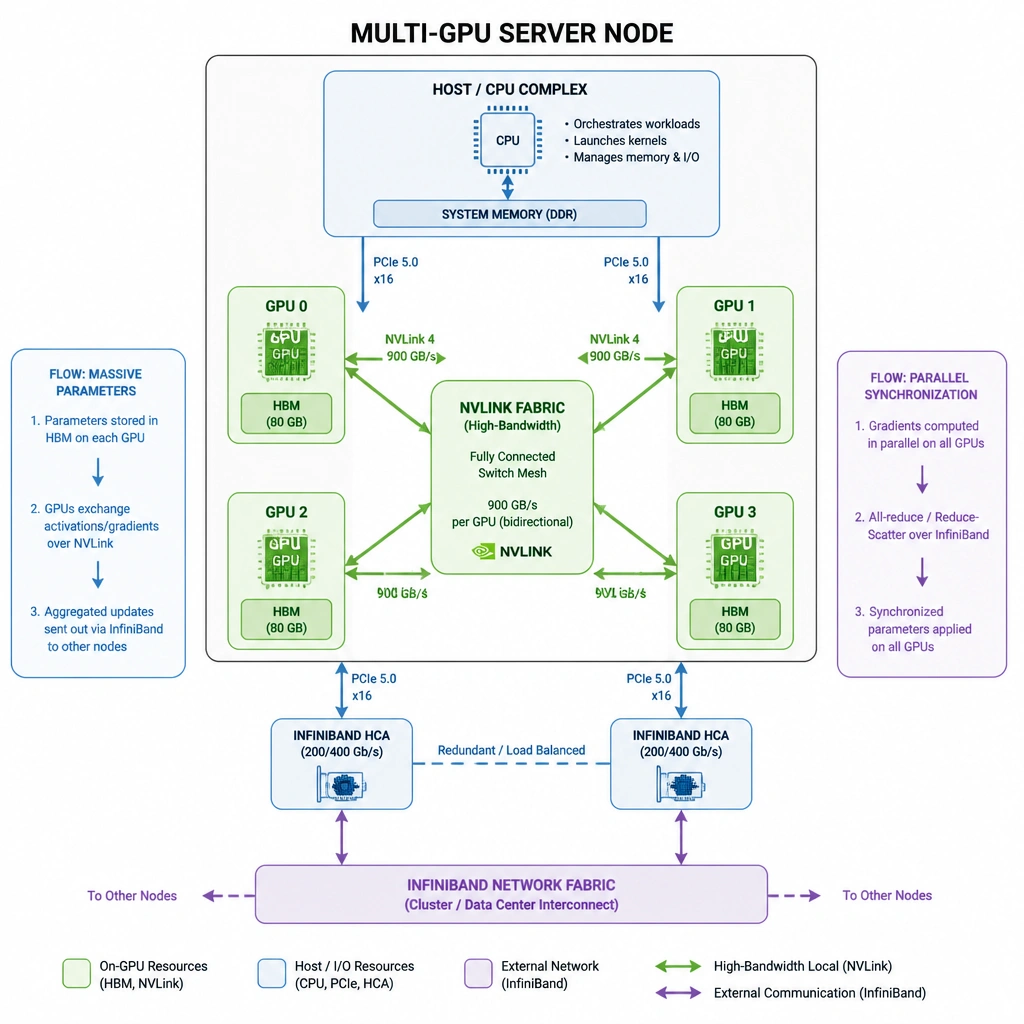
Imagine your boss walks in and says, 'We're going to train our own custom LLM, and I need you to spec out the hardware by Friday.' If you focus on buying the fastest single-core CPU or saving money with standard SATA SSDs, your training runs are going to take years. Seriously. Here's the deal: training LLMs is all about processing huge datasets across multiple GPUs simultaneously. That means you need two things above all else: high-speed, high-capacity memory like High Bandwidth Memory (HBM) to hold the massive model parameters right on the GPU, and high-bandwidth interconnects like NVLink and InfiniBand to let those GPUs talk to each other at lightning speeds. Without NVLink and InfiniBand, your GPUs will spend all their time sitting idle, waiting for data to crawl across slow connections. And without HBM, you'll constantly run out of memory (OOM) during the forward and backward passes. Focus on the memory and the interconnects—that's how you build an AI speed demon.
Full explanation below image
Full Explanation
Training large language models (LLMs) presents unique infrastructure challenges due to the sheer size of the model parameters (often hundreds of billions) and the distributed nature of the training process. The two primary hardware bottlenecks in this workload are memory capacity/bandwidth and inter-GPU communication latency. - High-speed, large-capacity memory (such as HBM and DDR5) is critical because the model weights, gradients, and optimizer states must reside in fast memory close to the processors to avoid latency. HBM (High Bandwidth Memory) stacked directly on the GPU die offers terabytes-per-second of bandwidth, which is necessary to keep GPU tensor cores fed. - High-bandwidth interconnects (such as NVLink for intra-node and InfiniBand or RoCE for inter-node communication) are equally essential. In distributed training, GPUs must constantly synchronize weight updates (via all-reduce operations). Standard Gigabit Ethernet or PCIe lanes are far too slow, causing GPUs to sit idle in a 'communication bottleneck' state. - SATA SSDs and Gigabit Ethernet (Option A), single-core CPUs (Option B), and PCIe Gen 3 bridges (Option D) represent legacy, low-throughput technologies that are wholly inadequate for the extreme data transfer rates and computational scale required by modern deep learning models.