
Imagine you're running a data science team that is training a massive, state-of-the-art object detection network on a dataset containing millions of high-resolution images. Your current setup—a single-GPU desktop workstation—is taking weeks just to run a handful of training epochs, and you're constantly running out of memory. What are the two most compelling technical reasons to migrate this training workload to a distributed, multi-GPU AI cluster? (Choose two)
Select all correct answers, then click Submit.
Short Explanation and Infographic
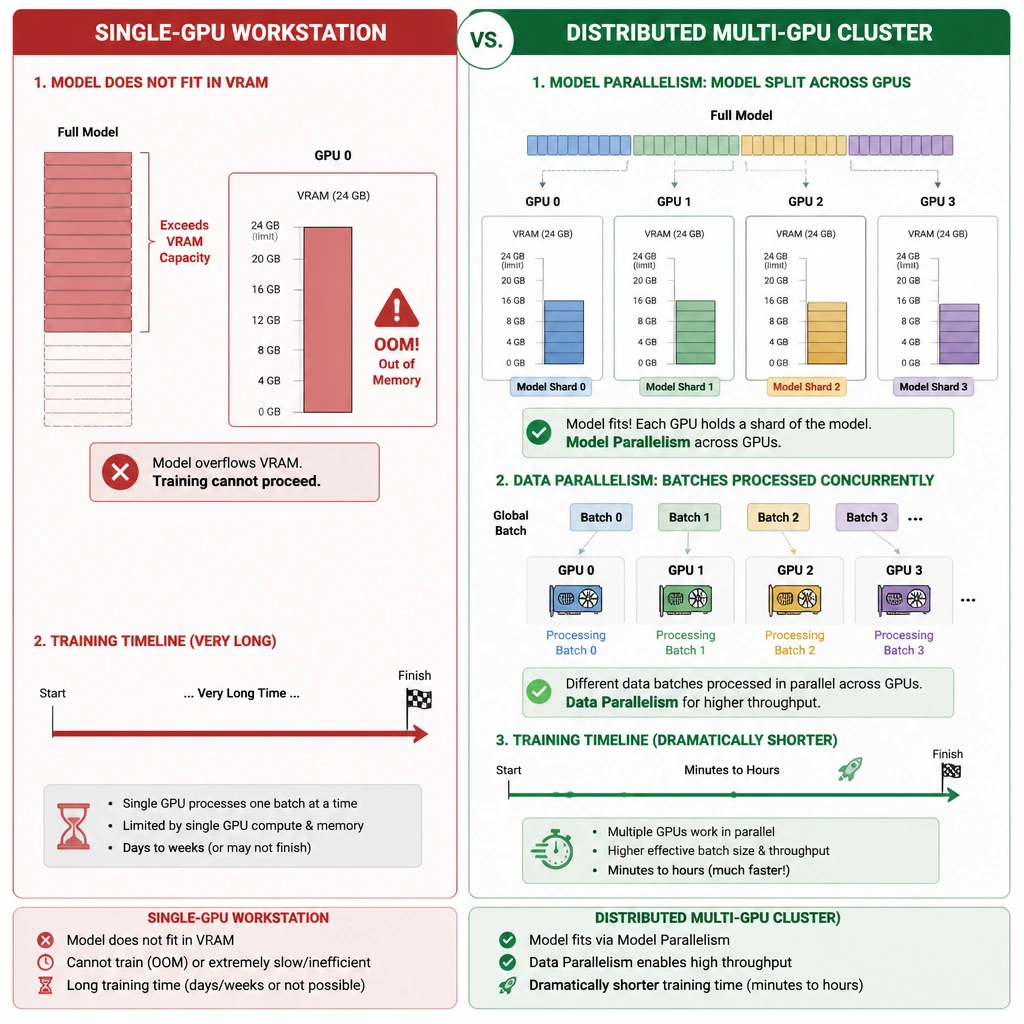
Alright, pay close attention here, because this scenario bites teams in production all the time. If you're trying to train a massive model on a single workstation, you're going to hit a wall—fast. You'll run out of Video RAM (VRAM) because the model parameters and batch data are too big, and you'll grow old waiting for training to finish. By moving to a distributed multi-GPU cluster, you get two massive wins: you can split a giant model across the memory of multiple GPUs (model parallelism), and you can split your dataset to run calculations in parallel (data parallelism), bringing training time down from weeks to hours. Trust me on this: it's not about saving money on hardware or magically finding a global optimum—it's about raw speed and memory scale.
Full explanation below image
Full Explanation
Training modern, deep neural networks requires substantial computational power and memory capacity. A distributed, multi-GPU AI cluster addresses the primary limitations of a single-GPU workstation through parallelization. First, large models with billions of parameters often exceed the memory (VRAM) capacity of a single accelerator; distributing the model across multiple GPUs (model parallelism) allows these large networks to be trained. Second, by distributing the dataset across multiple GPUs (data parallelism) and synchronizing gradients, the computational workload is split, which drastically reduces the time required to complete training epochs. Option B is incorrect because high-performance multi-GPU clusters utilize expensive enterprise-grade hardware rather than cheaper consumer options. Option D is incorrect because gradient averaging is a synchronization mechanism used to coordinate training across GPUs; it does not inherently improve the model's generalization compared to single-GPU training. Option E is incorrect because deep learning optimization is inherently non-convex, and multi-GPU training does not guarantee reaching a global minimum. Option F is incorrect because hyperparameter tuning still requires systematic experimentation, which is not simplified by the infrastructure migration itself.