
You are leading the deployment phase of a deep learning project, moving a complex recommendation model from the lab into production. Which of the following operational factors are most critical for successfully deploying and scaling this model for production users? (Select all that apply)
Select all correct answers, then click Submit.
Short Explanation and Infographic
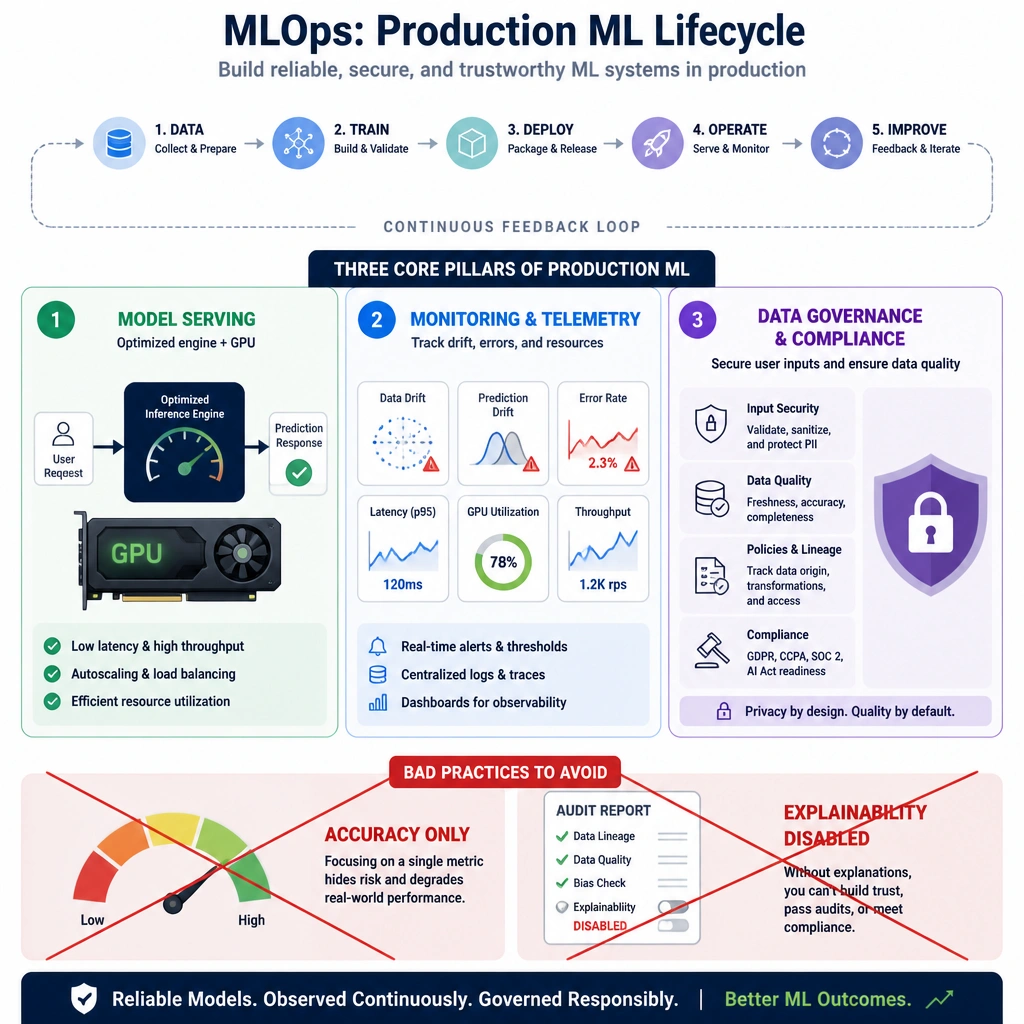
Imagine your boss walks in and says, 'The new model you built is awesome in the lab, but we need to serve it to millions of users starting Monday.' What breaks first? If you only focused on getting a high offline accuracy score and didn't think about serving latency, monitoring drift, or data compliance, you're in for a rough ride. Production deep learning is a whole different ballgame. You need optimized serving software (like Triton Inference Server) and accelerated hardware to handle user requests at scale. You need real-time monitoring and logging to catch model drift or API failures before your customers do. And you absolutely must have solid data governance to comply with privacy laws and ensure quality. Don't fall into the trap of ignoring explainability or focusing only on offline metrics!
Full explanation below image
Full Explanation
Successfully transitioning deep learning models from development to production requires a shift in focus from model training to operational scalability, reliability, and compliance. The critical factors include: - Model Serving Infrastructure (A): Deploying models at scale requires specialized serving software (such as NVIDIA Triton Inference Server) that supports dynamic batching, concurrent model execution, and model pipelining. This software must run on optimized hardware (like GPUs) to deliver high throughput and low-latency predictions. - Monitoring and Logging (B): Once a model is deployed, its performance can degrade due to data drift or concept drift. Robust observability platforms must capture telemetry (inference latency, GPU utilization, error rates) and data distributions to detect anomalies and trigger retraining cycles. - Data Governance and Compliance (C): Production environments must enforce strict data governance to ensure data lineage, security, and compliance with regulations like GDPR or HIPAA. This guarantees that model inputs are high quality and patient/user privacy is maintained.
Let's evaluate the incorrect options: - Focusing exclusively on offline training accuracy (D) is a common pitfall. In production, latency, throughput, and hardware cost are equally critical trade-offs. An extremely accurate but slow and expensive model is useless in real-time environments. - Ignoring model explainability (E) is dangerous, especially in regulated industries (finance, healthcare), as it makes auditing model bias and diagnosing unexpected predictions impossible.