
When scaling out deep learning models across multiple physical GPU nodes, network bottlenecks can severely degrade training performance. Which architectural features of InfiniBand directly address these scalability bottlenecks? (Select all that apply)
Select all correct answers, then click Submit.
Short Explanation and Infographic
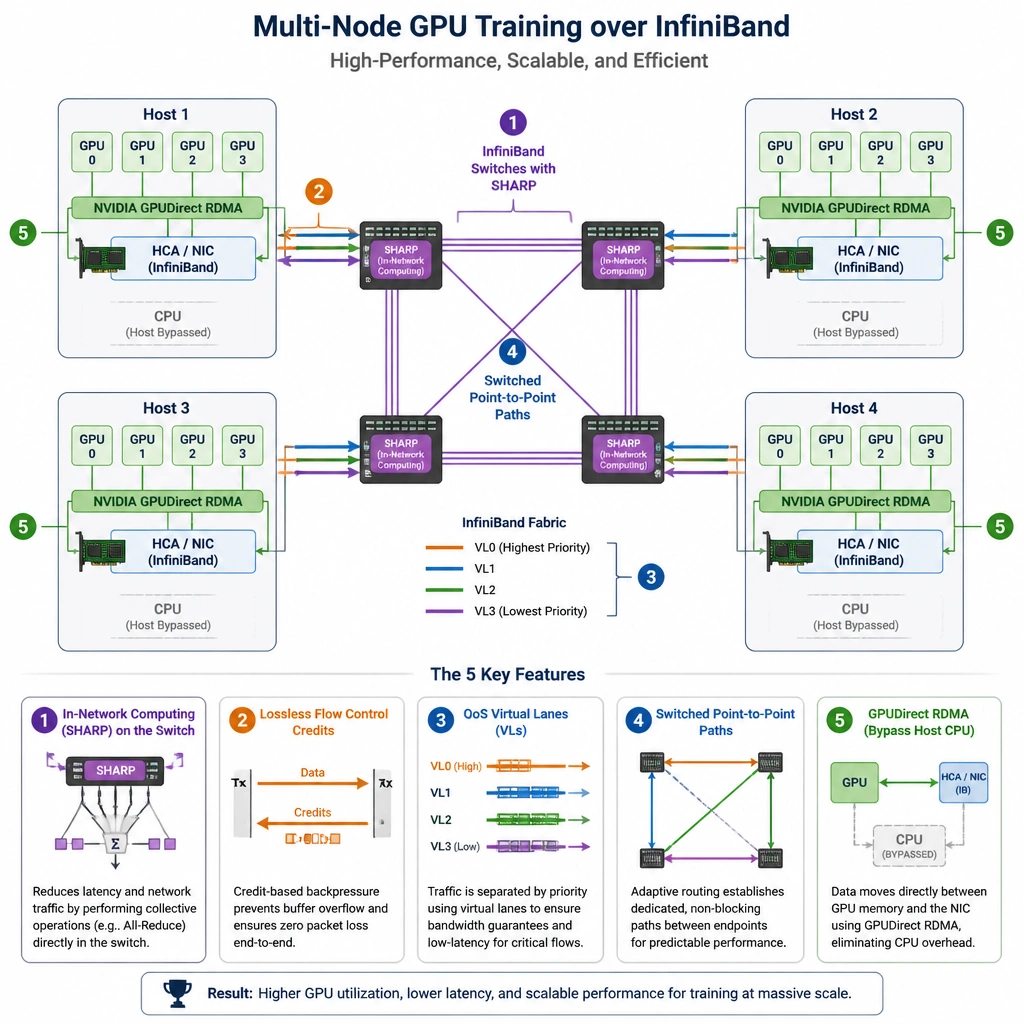
Pay close attention here, because when you scale your deep learning models, the network can easily become your biggest bottleneck. Think of it like this: if your GPUs are waiting on weight updates, they aren't computing—they're just burning power. InfiniBand solves this with some incredible built-in architecture. Instead of a cheap, shared bus-based setup that bottlenecks everyone, it uses a switched fabric topology with dedicated point-to-point paths. It utilizes native RDMA so the network adapter can pull data straight from GPU VRAM without taxing the CPU, and it's lossless so you don't lose time retransmitting lost packets. Additionally, QoS keeps the critical synchronization traffic at high priority, and In-Network Computing (specifically Mellanox SHARP) aggregates calculations directly on the switches. Got it? Let's keep rolling.
Full explanation below image
Full Explanation
Scaling deep learning training to multiple nodes requires high-bandwidth, low-latency communication to periodically sync gradients and parameters. InfiniBand provides several key architectural advantages to solve these scaling challenges: - In-Network Computing: Using technologies like NVIDIA SHARP, collective communication operations (such as AllReduce) are computed directly on the network switches rather than on the host CPUs or GPUs. This dramatically reduces the volume of data traversing the fabric. - Lossless Fabric: A link-level, credit-based flow control system ensures that switches do not drop packets during periods of heavy congestion, preventing the latency spikes associated with packet retransmission. - Quality of Service (QoS): High-priority traffic (such as MPI/NCCL synchronization messages) can be isolated from lower-priority traffic (like log collection or administrative tasks) using virtual lanes. - Switched Fabric Architecture: This topology provides dedicated point-to-point connections through a network switch, allowing multiple nodes to communicate concurrently at full line rate without collision domains. - Native RDMA: Remote Direct Memory Access enables direct memory transfers between physical nodes bypassing host CPUs and kernel network stacks, which is crucial for reducing synchronization latency.
A bus-based architecture (A) is a shared medium that would create massive contention and collisions, making it unsuitable for high-throughput cluster environments.