
When comparing networking fabrics for high-performance computing (HPC) and distributed AI training clusters, which technical characteristics distinguish InfiniBand from traditional Ethernet architectures? (Select all that apply)
Select all correct answers, then click Submit.
Short Explanation and Infographic
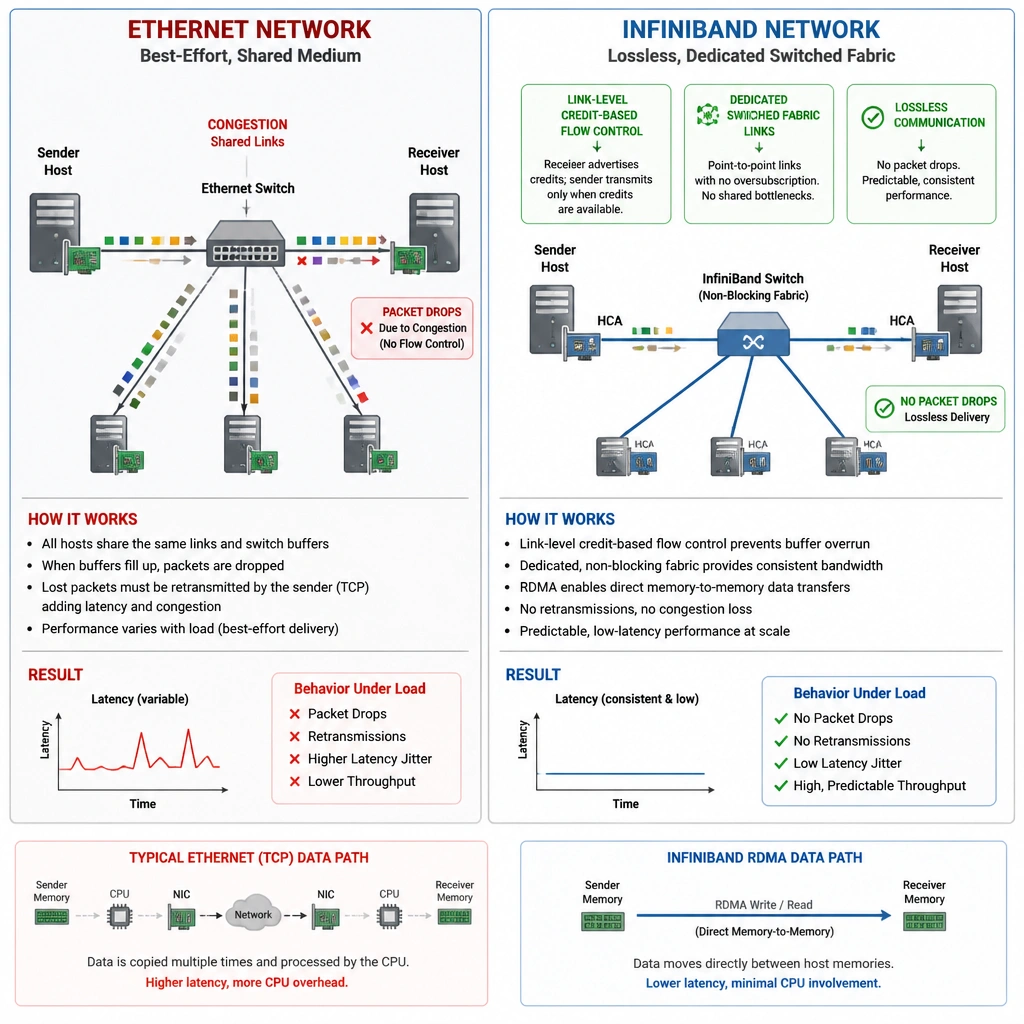
Here's the deal: if you try to train a massive AI model with billions of parameters across hundreds of GPUs using standard Ethernet, your network is going to choke on packet drops and latency spikes. InfiniBand is built specifically to solve this. It's a lossless fabric—meaning it uses credit-based flow control so switches don't send packets unless the receiver has room. No packet drops! It's a switched fabric, giving you dedicated point-to-point connections rather than sharing a bus. Plus, it has native RDMA, which lets GPUs write directly to each other's memory without bothering the CPU. And, of course, QoS lets you prioritize traffic. Distractors D and F are dead wrong because InfiniBand isn't a bus and it's ultra-low latency, not high latency. Keep those features in mind!
Full explanation below image
Full Explanation
InfiniBand is a high-bandwidth, low-latency interconnect technology widely used in HPC and AI clusters due to several key architectural features: - Lossless Fabric (Option A): Unlike Ethernet, which handles congestion by dropping packets and relying on TCP retransmissions, InfiniBand utilizes a credit-based flow control mechanism at the link layer. A transmitter only sends data if the receiver has advertised sufficient buffer space (credits), preventing buffer overflows and packet loss. - Quality of Service (Option B): InfiniBand provides virtual lanes (VLs), allowing traffic types to be segregated and prioritized (e.g., control traffic vs. compute data) to guarantee performance SLAs. - Switched Fabric (Option C): InfiniBand uses a point-to-point switched topology rather than a shared-medium or bus topology, providing dedicated bidirectional bandwidth between endpoints. - Native RDMA (Option E): Remote Direct Memory Access allows direct data transfers between the memory of different nodes without operating system kernel intervention or CPU involvement, minimizing latency and CPU overhead. In distributed training (e.g., training LLMs across thousands of GPUs), network performance is as critical as GPU speed. When GPUs run collective communication algorithms (like AllReduce or AlltoAll), they require immediate synchronization. Any packet loss leads to retransmissions, which stalls the entire cluster. By providing a lossless fabric with credit-based flow control, InfiniBand guarantees that data is not dropped due to buffer overflows. Native RDMA allows GPUs to directly read/write to remote GPU memory via the Host Channel Adapter (HCA), bypassing host OS bottlenecks. Option D is incorrect because bus-based architectures do not scale and are obsolete for high-performance clustering. Option F is incorrect because InfiniBand is specifically engineered for ultra-low sub-microsecond latency, not high latency.