
You are explaining the operational benefits of migrating a containerized machine learning workload to Kubernetes. Which two of the following represent automated infrastructure management capabilities natively provided by Kubernetes? (Choose two)
Select all correct answers, then click Submit.
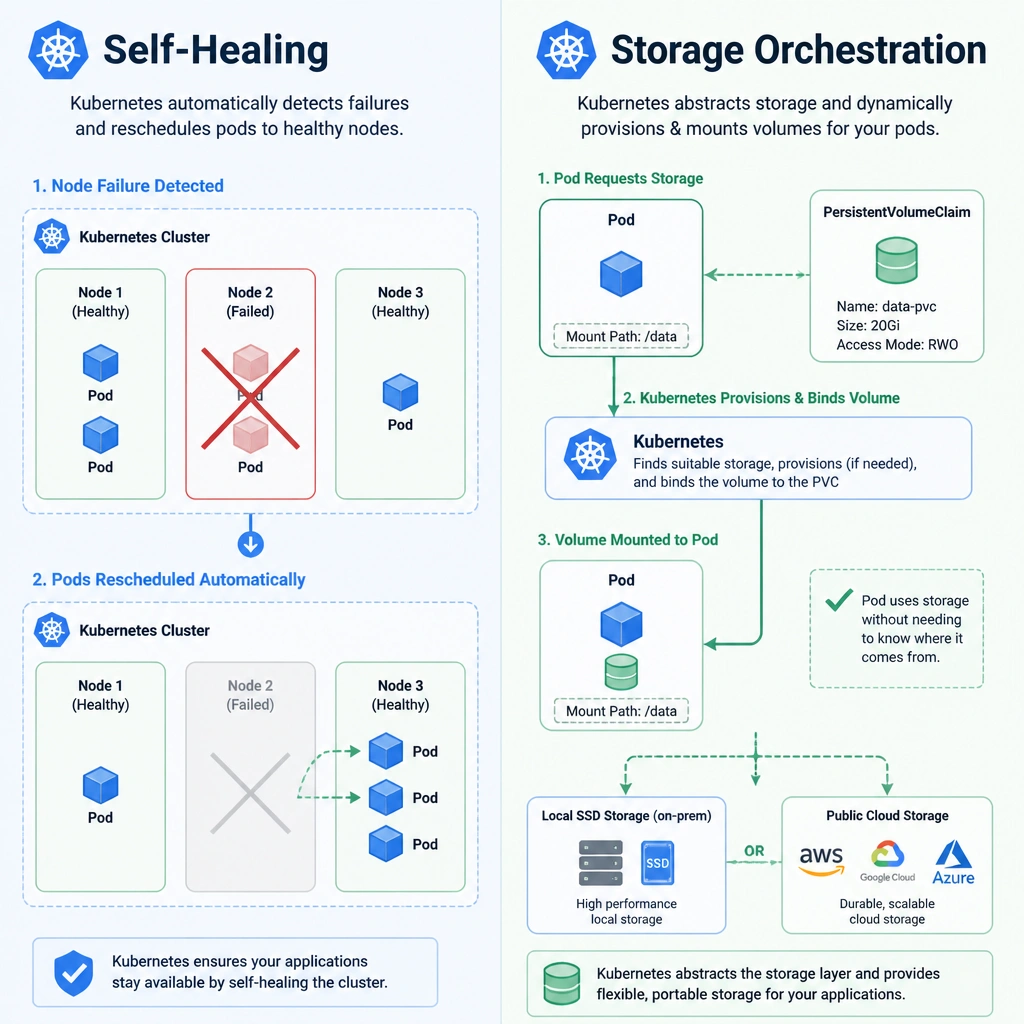
Short Explanation and Infographic
Okay, let's dive in. If you've ever had to wake up at 3 AM because a server died and your app went offline, you know how painful manual infrastructure management is. Kubernetes is designed to take that headache away. Think of it like a smart autopilot for your apps. The cool thing is that it has native self-healing. If a container crashes, Kubernetes restarts it. If an entire node drops dead, Kubernetes instantly reschedules those pods onto another healthy server. No manual intervention needed! Plus, it handles storage like a boss. You don't have to manually SSH in and mount volumes; Kubernetes automates storage orchestration so your containers get the storage they need, whether it's local NVMe drives or cloud-based block storage. Trust me, these two features alone save lives in production. Got it? Sweet.
Full explanation below image
Full Explanation
Kubernetes is a powerful container orchestration platform designed to automate the deployment, scaling, and management of containerized applications. Two of its most significant native automation capabilities are self-healing and storage orchestration: 1. Self-healing: Kubernetes continuously monitors the state of the cluster and compares it with the desired state specified in deployment manifests. If a container fails a health check (liveness probe), Kubernetes automatically restarts it. If a node fails, the control plane detects the loss of heartbeat and automatically reschedules the affected pods onto available, healthy nodes. This minimizes downtime without manual operator intervention. 2. Storage Orchestration: Kubernetes abstracts physical and cloud storage through its Persistent Volume (PV) and Persistent Volume Claim (PVC) subsystems. This allows developers to request storage resources dynamically without needing to understand the underlying infrastructure details. Kubernetes automatically mounts the requested storage system, whether it is local storage, network-attached storage (NFS, Fiber Channel), or public cloud storage (AWS EBS, Google Cloud Persistent Disk, Azure Files).
Let's review why the incorrect options are wrong: - Option B: This statement is false because Kubernetes does not require manual configuration or external scripts to restart failed containers or recover from node failures. The self-healing loop is a core, built-in feature of the Kubernetes controller manager. - Option D: This statement is incorrect because Kubernetes supports dynamic scaling. Using the Horizontal Pod Autoscaler (HPA) and Vertical Pod Autoscaler (VPA), Kubernetes can automatically scale the number of pod replicas or resource allocations up and down based on real-time metrics such as CPU utilization, memory usage, or custom Prometheus metrics.