
When designing a resilient containerized environment to manage distributed AI training and inference, you need to leverage the core features of Kubernetes. Which two of the following statements describe standard Kubernetes features that directly benefit AI infrastructure operations?
Select all correct answers, then click Submit.
Short Explanation and Infographic
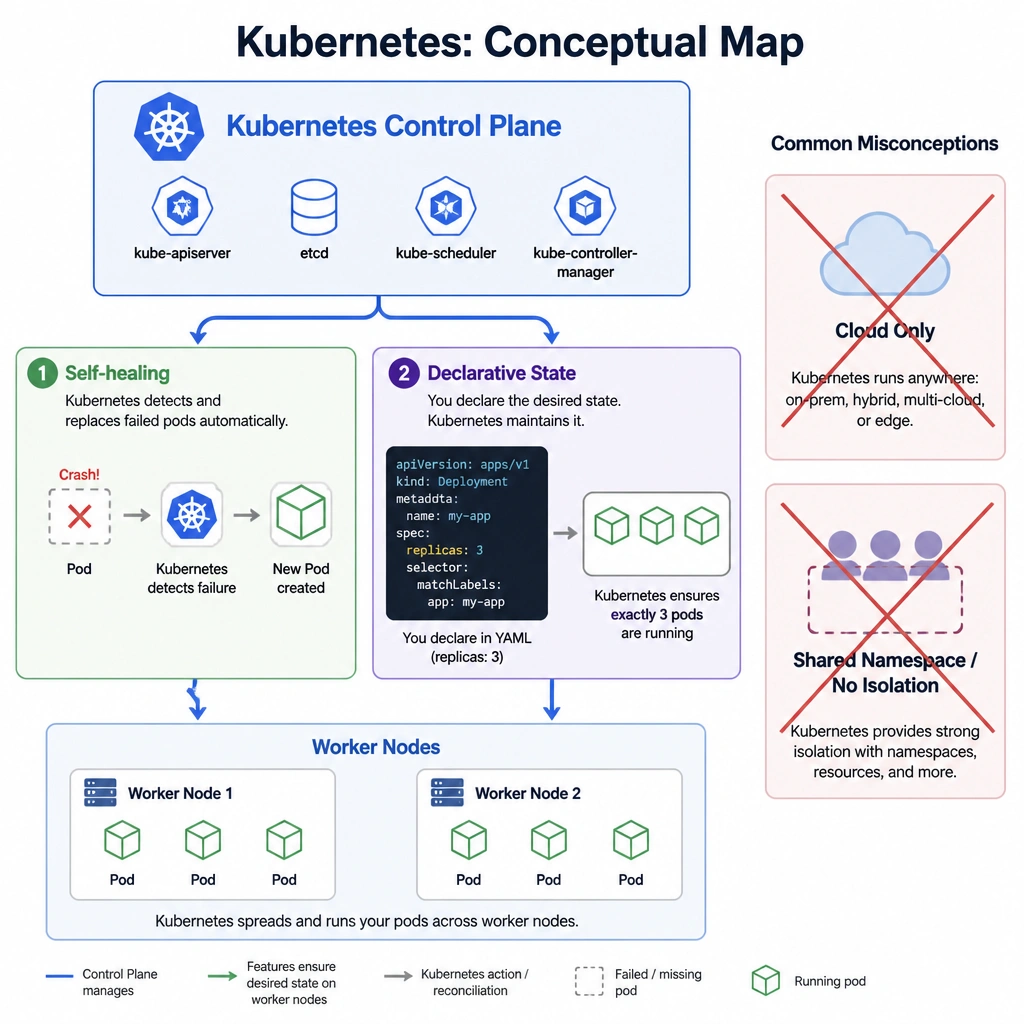
Check this out: Kubernetes is built from the ground up to keep your apps running without you having to baby them. First, it's declarative—you tell K8s what you want your cluster to look like using YAML, and it makes it happen. Second, it's got self-healing built right in. If a container crashes during a long model training run, K8s restarts it or reschedules it on a healthy node automatically. Don't fall for the trap that K8s can't handle stateful workloads or that it's cloud-only—it handles persistent storage (crucial for model checkpoints!) and runs beautifully in your local data center just like it does in the cloud.
Full explanation below image
Full Explanation
Kubernetes provides several core features that are essential for orchestrating AI and machine learning workloads: 1. Declarative Configuration: Kubernetes uses YAML or JSON manifests to define the desired state of the cluster (e.g., number of replicas, resource limits, and network policies). The control plane constantly monitors the actual state and adjusts it to match the desired state, minimizing manual configuration errors. 2. Self-Healing: If a container fails or a node goes offline, Kubernetes detects the failure and automatically restarts the container or reschedules the workload on a healthy node. This is critical for long-running AI training jobs that cannot afford to fail mid-process.
Let's address the distractors: - Infrastructure Flexibility: Kubernetes is cloud-agnostic. It can be deployed on-premises, in public clouds (EKS, GKE, AKS), or in hybrid cloud architectures. Therefore, statement C is false. - Isolation: Kubernetes isolates workloads by running them in separate namespaces and container runtimes, ensuring that libraries (like PyTorch and TensorFlow dependencies) do not conflict. Therefore, statement D is false.