
In a shared multi-tenant AI cluster where multiple data scientists submit large training jobs simultaneously, which Slurm mechanism is specifically designed to enforce resource boundaries and prevent a single user or group from monopolizing all available GPUs?
Select an answer to reveal the explanation.
Short Explanation and Infographic
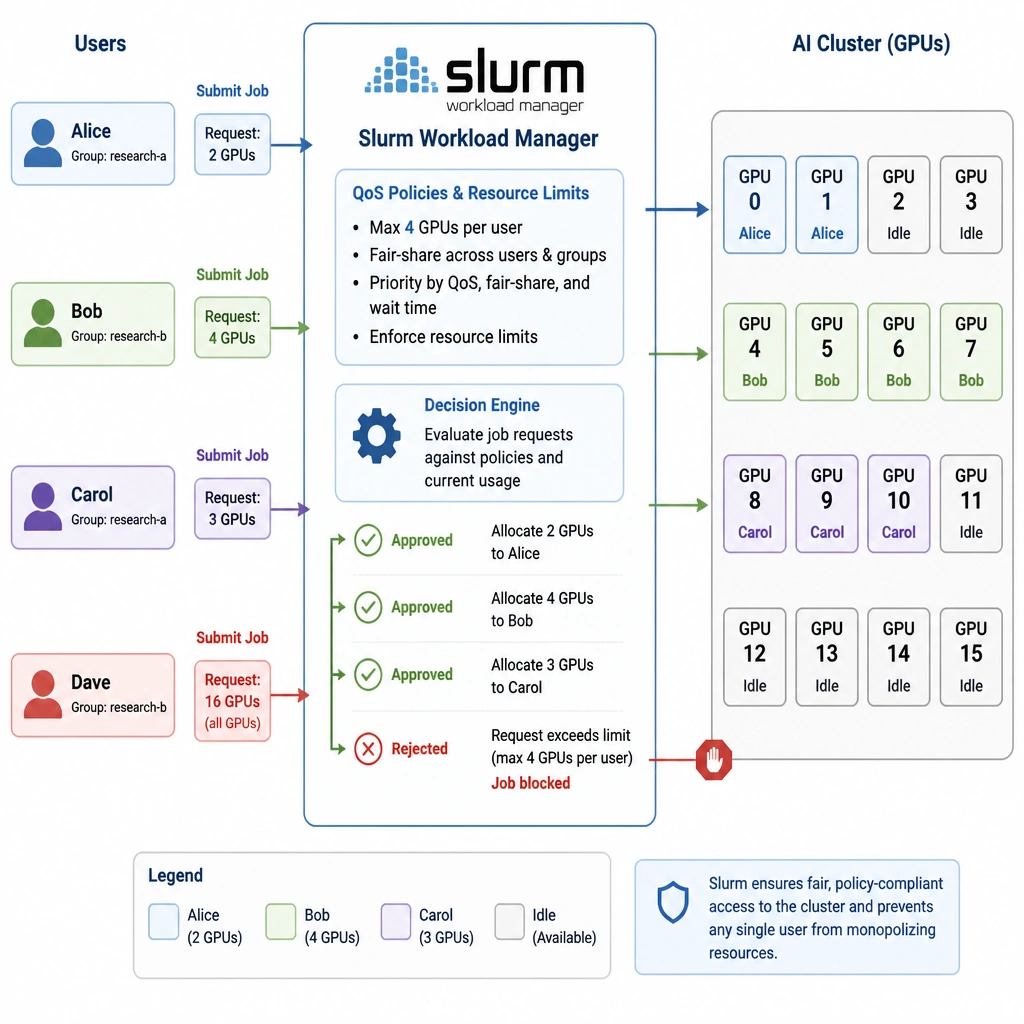
Imagine you're sharing a house with roommates, and one person drinks all the milk, eats all the food, and hogs the TV. Not a great living situation, right? Well, in a shared AI cluster, the exact same thing happens if you don't set boundaries. A single user could launch a massive training run and consume every GPU in the datacenter, leaving everyone else high and dry. That's where Slurm's Quality of Service (QoS) and resource limits come in. Think of QoS like the rules of the house. We can set hard limits on how many GPUs a single user can request, or how long their jobs can run. It ensures fair play across the board. Sure, containers like Docker keep your files and environments isolated, but they don't do a thing to stop you from grabbing resources you shouldn't have. Slurm is the traffic cop that keeps the peace!
Full explanation below image
Full Explanation
In a shared, multi-tenant AI infrastructure environment, resource contention is a major challenge. Users frequently submit resource-intensive workloads, such as deep learning training runs, that require multiple GPUs, high CPU counts, and large amounts of system memory. Without proper scheduling rules, a single user or a small group could easily exhaust the cluster's resources, starving other jobs.
Slurm Workload Manager addresses this challenge through its Quality of Service (QoS) and resource limits features. Using these mechanisms, cluster administrators can define granular policies that regulate resource consumption. For example, they can restrict the maximum number of nodes, GPUs, or CPUs a single user or project account can allocate concurrently. They can also define submission limits, run-time limits, and priority weights to ensure fair-share scheduling and prevent resource monopolization.
Let's look at the incorrect options: - Containerization technologies (such as Docker or Apptainer) provide runtime environment isolation, namespace isolation, and file system encapsulation. However, containers do not manage cluster-wide job scheduling or global resource allocation policies. A containerized job will still request as many resources as the scheduler permits. - Global file system permissions (like POSIX ACLs or NFS permissions) control access to data files, directories, and executables. They prevent users from reading or writing to unauthorized files, but they play no role in limiting GPU or memory allocation at runtime. - Manual administrator intervention is highly inefficient and does not scale in modern dynamic AI clusters. Automating these resource boundaries via scheduler rules is required to maintain cluster efficiency and reliability.