
When designing a high-performance AI cluster, you need to minimize latency and CPU overhead during node-to-node communications. Which of the following provides the direct, low-level software interface that allows applications to interact with the channel adapter hardware to execute Remote Direct Memory Access (RDMA) operations over an InfiniBand fabric?
Select an answer to reveal the explanation.
Short Explanation and Infographic
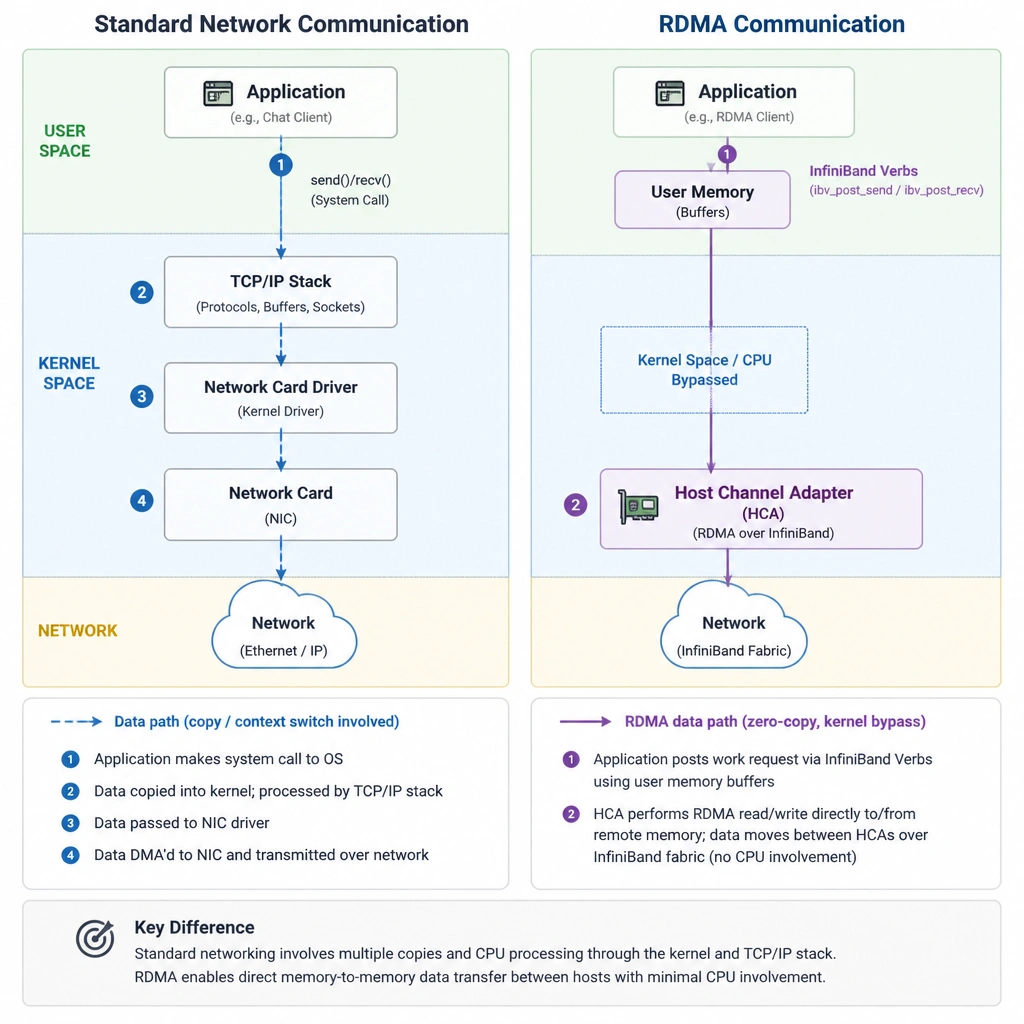
Think of it like this: if you want to send a letter, you can go through the post office, get it sorted, and wait days—that's your traditional TCP/IP stack with all its CPU overhead. But what if you could just teleport that letter straight onto the recipient's desk? That's Remote Direct Memory Access, or RDMA. In the InfiniBand world, you don't use standard socket calls. Instead, you use what we call "InfiniBand Verbs." This is the low-level API that talks directly to the Host Channel Adapter (HCA) hardware, completely bypassing the operating system kernel. Trust me on this: avoiding that OS kernel transition is exactly how we get sub-microsecond latency and massive throughput in our AI clusters. If your boss walks in and asks why our training jobs are stalled on network overhead, you'd better make sure your software is speaking Verbs to that InfiniBand adapter!
Full explanation below image
Full Explanation
Remote Direct Memory Access (RDMA) is a foundational technology for high-performance computing (HPC) and artificial intelligence (AI) workloads because it enables network adapters to transfer data directly between the memory of two systems without involving the operating system or CPU of either host. In native InfiniBand networks, the software interface used to programmatically interact with the Host Channel Adapter (HCA) and perform RDMA operations is known as InfiniBand Verbs.
InfiniBand Verbs represent the low-level API defined by the InfiniBand Architecture specification. Instead of using standard socket programming (like TCP/IP), which requires kernel transitions, copying data between user space and kernel space, and high CPU utilization, Verbs allow user-space applications to register memory directly with the HCA. The HCA can then read from or write to this memory autonomously.
Let’s analyze the alternatives to understand why they do not fit: - NVMe over Fabrics (NVMe-oF) is a protocol designed to extend NVMe commands across a network fabric (such as InfiniBand, RoCE, or Fibre Channel). While NVMe-oF utilizes RDMA to transfer block storage data efficiently, it is a consumer of RDMA capabilities rather than the technology that defines or provides the low-level RDMA hardware API. - TCP/IP is a traditional transport and network protocol suite. It operates with substantial software overhead because data must pass through the operating system's network stack, which requires CPU cycles for packet processing, routing, and buffer copying. TCP/IP does not natively support RDMA. - Ethernet, in its standard form, is a link-layer protocol that does not support RDMA. While extensions like RoCE (RDMA over Converged Ethernet) exist to run RDMA on Ethernet physical layers, standard Ethernet itself is not responsible for providing the InfiniBand RDMA software interface.