
In a high-performance AI cluster containing multiple NVIDIA DGX systems, which network infrastructure is dedicated to administrative control, remote console access, and hardware monitoring?
Select an answer to reveal the explanation.
Short Explanation and Infographic
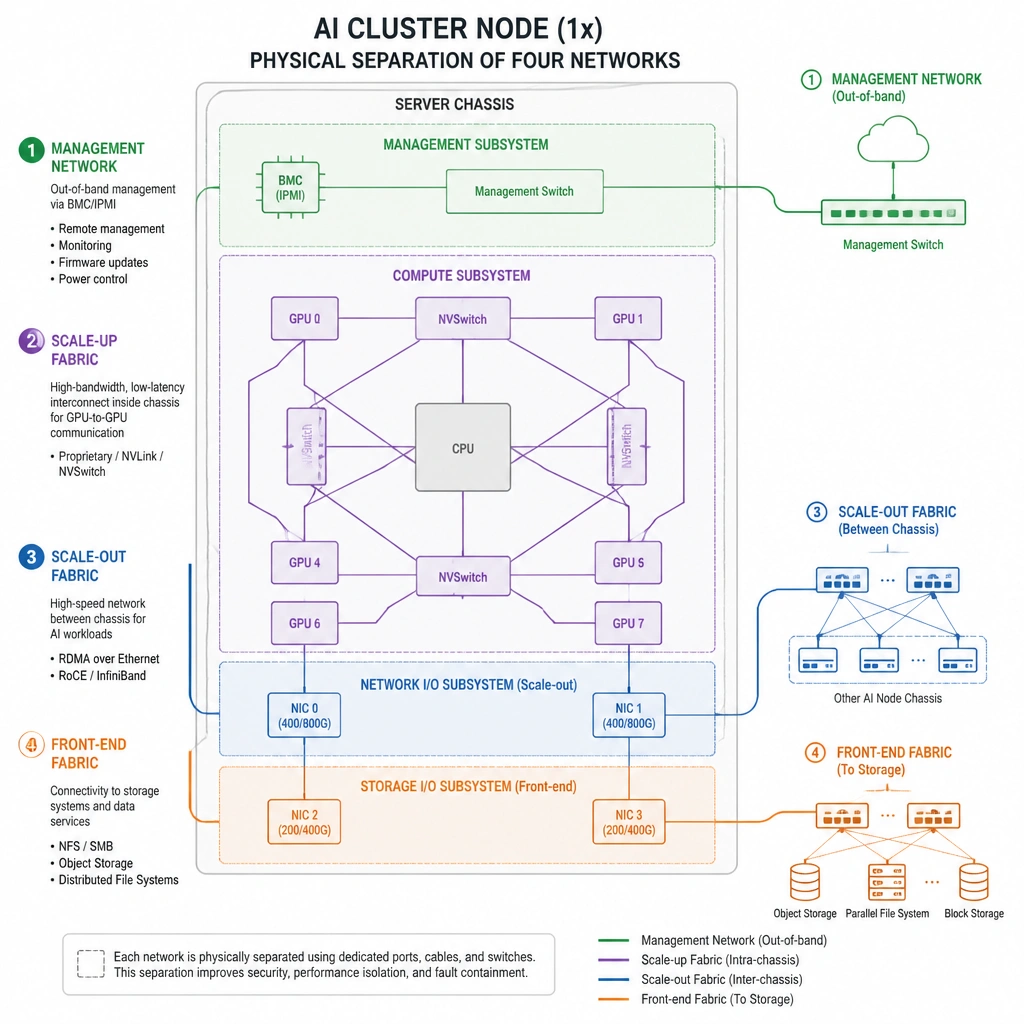
Here's the deal: a high-performance AI cluster has several distinct traffic lanes, and you do not want them getting in each other's way. When you're running a massive training job, the GPUs are screaming at each other over the Scale-up fabric (inside the server) and the Scale-out fabric (between servers). Meanwhile, you've got large datasets streaming in from storage on the Front-end fabric. So, where does administrative traffic go? You run a separate, dedicated Management Network! This is an out-of-band network—usually standard Gigabit Ethernet—that connects to the Baseboard Management Controller (BMC) or IPMI ports on your servers. It allows you to monitor hardware health, push software updates, and log in remotely even if the primary data fabrics are completely saturated or down. Keeping management out-of-band is a networking gold standard. Remember this division of labor for the exam!
Full explanation below image
Full Explanation
Modern AI supercomputing clusters require a segmented network architecture to handle different traffic profiles and ensure deterministic performance. These networks are typically divided into four distinct fabrics:
1. Management Network (Option C): A dedicated, out-of-band (OOB) network, typically built on standard 1GbE or 10GbE Ethernet. It is used exclusively for administrative tasks, system health monitoring (via SNMP or Prometheus), firmware updates, remote console access (KVM over IP), and out-of-band management via the Baseboard Management Controller (BMC) or IPMI. By isolating administrative traffic, network administrators can maintain control of the cluster even during network congestion or fabric failure on the data paths.
2. Scale-up Fabric (Option B): The high-bandwidth interconnect inside a single server chassis (such as NVLink on NVIDIA DGX nodes) that allows GPUs to share memory and communicate at ultra-high speeds, effectively acting as a single large GPU accelerator.
3. Scale-out Fabric (Option A): The high-performance inter-node cluster interconnect (typically InfiniBand or RoCE) that connects GPUs across different physical server chassis. This fabric handles collective communication patterns (like All-Reduce) during distributed AI training.
4. Front-end Fabric (Option D): The network (often high-speed Ethernet) that connects the server nodes to external systems, client users, and high-performance storage arrays (such as NFS or GPFS storage) for data ingestion.