
When transitioning a deep learning model from an experimental development sandbox to a production-grade, scale-out enterprise environment, which operational strategy is most critical for long-term success?
Select an answer to reveal the explanation.
Short Explanation and Infographic
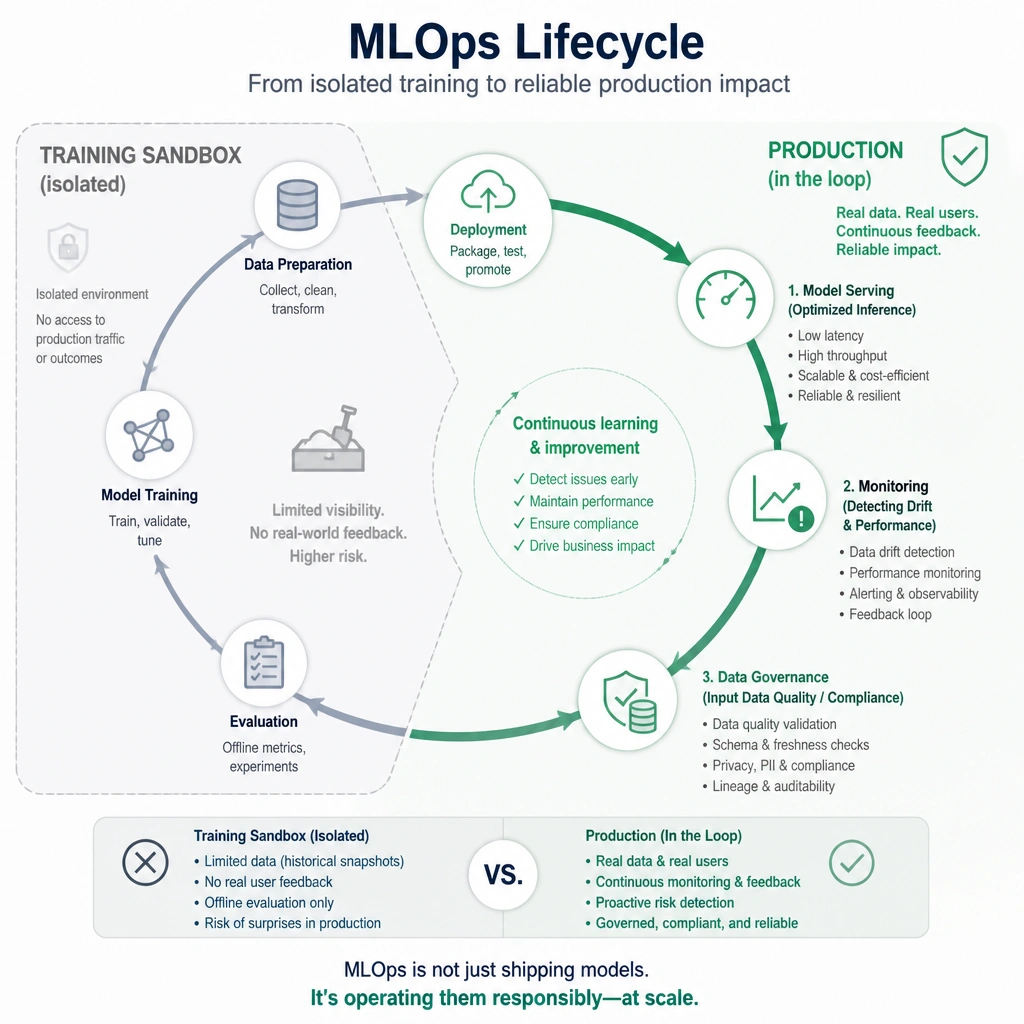
Here's the deal: building a model in a notebook is the easy part. Moving it to production and scaling it to millions of users is where the real work begins. You can't just care about training accuracy anymore. You need optimized serving software (like Triton) to run inference fast, you need robust monitoring to catch model drift, and you need strict data governance to stay compliant. If you ignore these things, your model will slow down, drift, or break, and you won't even know it because you didn't set up logging! Focus on the production lifecycle, not just training. Let's keep rolling.
Full explanation below image
Full Explanation
Deploying and scaling deep learning models in production requires a transition from model development (which focuses on training accuracy) to machine learning operations (MLOps). The operational strategy must address reliability, latency, throughput, compliance, and long-term maintenance. This includes implementing optimized serving infrastructure (e.g., NVIDIA Triton Inference Server) to maximize GPU utilization, robust monitoring/logging to detect model drift and latency spikes, and comprehensive data governance to ensure quality, privacy, and regulatory compliance.
Why the other options are incorrect: - Focusing solely on offline training accuracy while ignoring inference latency leads to models that are too slow or expensive to run in real-time production. - Eliminating logging and monitoring makes it impossible to troubleshoot failures, detect input data drift, or audit model decisions. - Workstation-class hardware is not designed for the high-availability, redundancy, thermal management, or scale-out requirements of enterprise production data centers.