
An AI startup has fluctuating workloads: they require hundreds of GPUs during monthly model retraining but only a few GPUs for daily testing and inference. Which advantage of cloud-based GPU infrastructure makes it more suitable for this business model than purchasing on-premises hardware?
Select an answer to reveal the explanation.
Short Explanation and Infographic
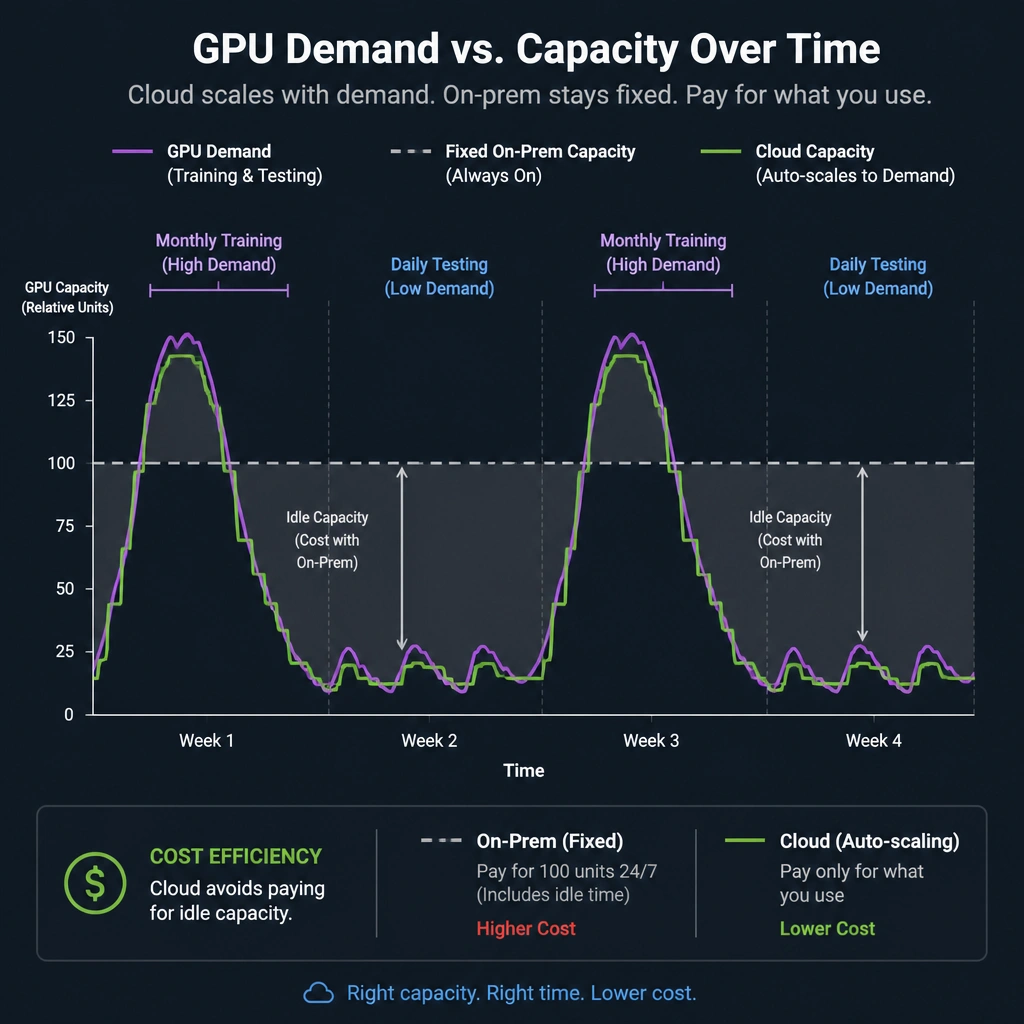
Imagine your boss walks in and says, 'Hey, we need to train a new model this weekend, so I need 200 GPUs. But on Monday, we'll only need 2.' If you bought those 200 GPUs for on-premises, they'd sit there gathering dust and costing you a fortune during the week. That's why cloud GPU infrastructure is so awesome. It gives you elasticity—you spin up 200 GPUs for the weekend, pay for what you use, and shut them down when you're done. You can't do that with physical hardware in your own server room. Sure, cloud providers secure their end, but security is a shared responsibility, and physical latency is usually higher in the cloud. Stick with elasticity as the big cloud benefit.
Full explanation below image
Full Explanation
Cloud GPU infrastructure provides significant advantages for machine learning projects characterized by highly variable or seasonal computational demands. The primary benefit is elasticity (on-demand scalability). This allows organizations to provision large GPU clusters dynamically for computationally intensive tasks—such as training large models—and then scale down or decommission those resources when the workload decreases, matching operational expenses directly to utilization.
Let's review the distractors: - No cloud provider can guarantee the elimination of all security vulnerabilities; security in the cloud operates under a shared responsibility model where the customer is still responsible for securing their applications and data. - On-premises infrastructure typically offers lower network latency because the compute resources and data storage are physically co-located on the local high-speed network. - Cloud providers do not have exclusive access to hardware before it is manufactured. While they may receive large allocations, GPUs are released to OEMs and enterprise customers concurrently, and physical production timelines apply to all.