
When designing a high-performance network fabric for distributed AI training clusters, which five technical characteristics of InfiniBand make it superior to traditional standard Ethernet networks? (Choose five)
Select all correct answers, then click Submit.
Short Explanation and Infographic
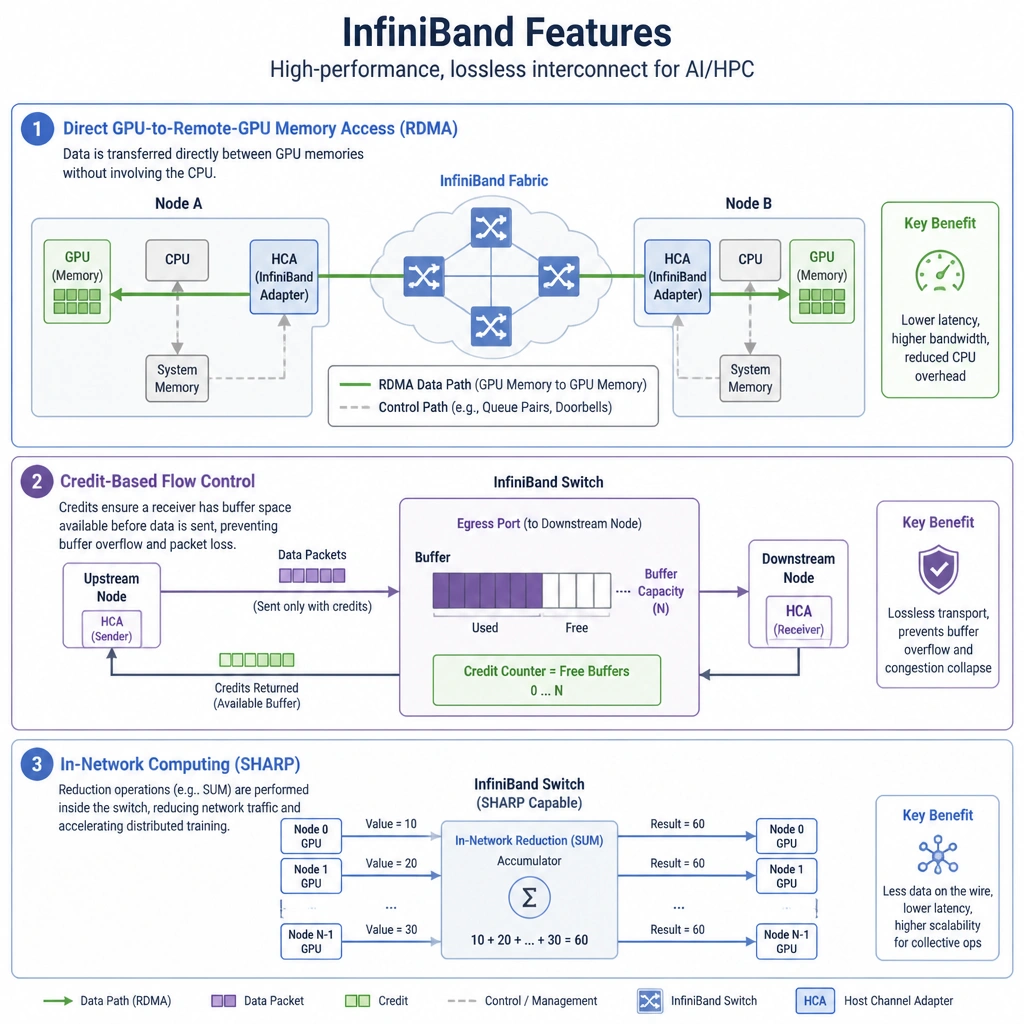
Think of traditional Ethernet like a busy highway system with traffic lights and merge lanes—sometimes packets get dropped, and you have to retransmit them, which is a killer for AI performance. InfiniBand is like a dedicated high-speed rail line. It's built from the ground up to be lossless (no dropped packets!), uses RDMA to let GPUs write directly to each other's memory without bugging the CPU, and even offloads math calculations to the network switches themselves using in-network computing. The only thing InfiniBand isn't is high latency—in fact, it's famous for ultra-low latency! If you see any option suggesting InfiniBand is high latency, run the other way!
Full explanation below image
Full Explanation
InfiniBand is the dominant interconnect fabric used in high-performance computing (HPC) and large-scale AI training clusters because it resolves the performance bottlenecks associated with traditional TCP/IP over Ethernet.
The five key technical characteristics that enable this performance are: 1. Switched Fabric Architecture (A): InfiniBand uses a switched fabric topology where devices connect via dedicated point-to-point links. This allows for massive scaling, predictable routing, and isolated fault domains. 2. Lossless Fabric (B): Unlike Ethernet, which relies on TCP to detect and retransmit dropped packets, InfiniBand employs hardware-level, credit-based flow control. A sending port will only transmit data if the receiving port has buffer space, ensuring zero packet loss due to buffer overflows. 3. Native RDMA (D): Remote Direct Memory Access allows a GPU or CPU to read and write directly to the memory of a remote node without involving either host's operating system kernel or CPU. This bypasses the software stack, drastically reducing latency and CPU overhead. 4. Quality of Service (E): InfiniBand provides robust QoS mechanisms, enabling administrators to segregate and prioritize different types of traffic (e.g., storage vs. compute synchronization) to prevent slow-receiver blockages. 5. In-Network Computing (F): NVIDIA Mellanox InfiniBand uses technologies like SHARP (Scalable Hierarchical Aggregation and Reduction Protocol) to offload collective operations (such as AllReduce, commonly used in distributed training) from the GPUs to the network switches, reducing data traffic.
Distractor C is incorrect because InfiniBand is designed specifically for ultra-low latency (often in the sub-microsecond range), not high latency.