
Which of the following statements represents a common misconception about the primary function of NVIDIA's NVLink technology in AI and HPC clusters?
Select an answer to reveal the explanation.
Short Explanation and Infographic
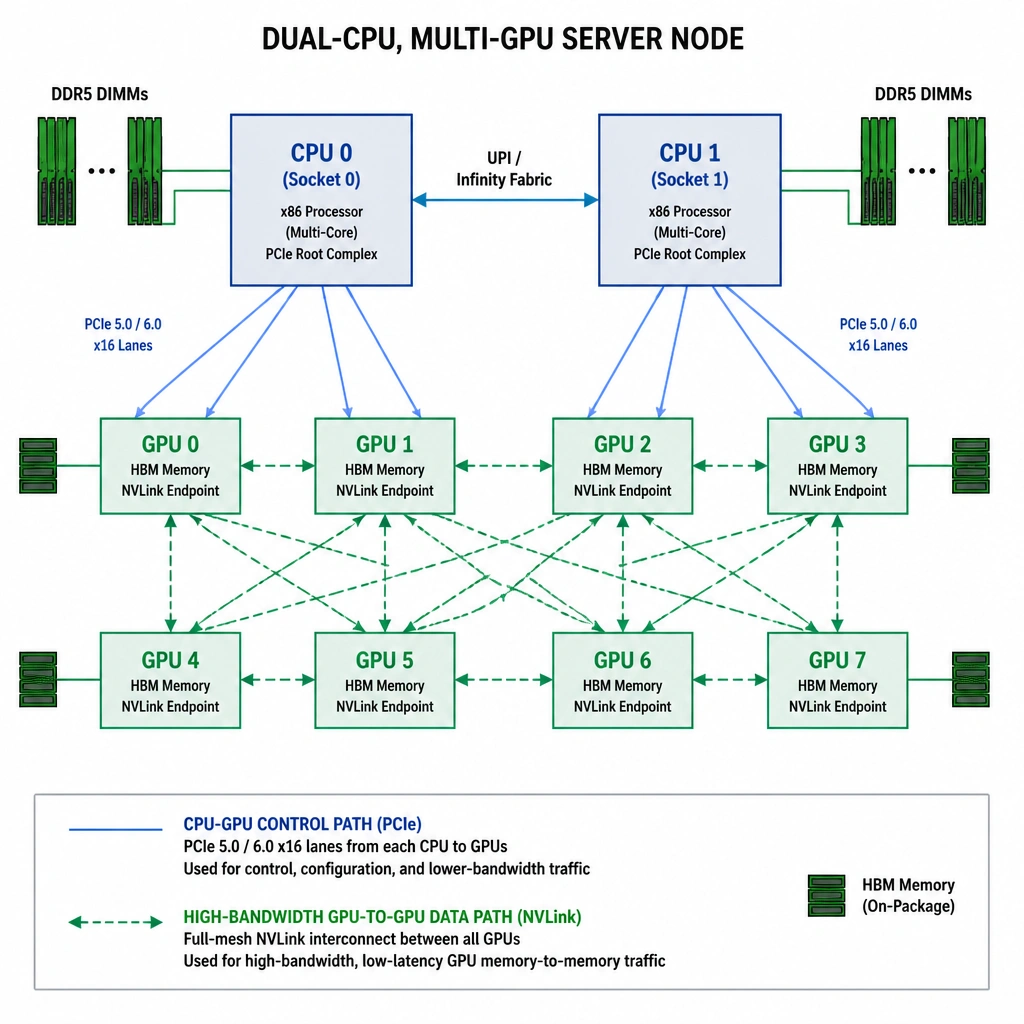
Alright, pay close attention here because this one bites people all the time. NVLink is a fantastic technology, but don't confuse what it does! Its main job—its bread and butter—is connecting GPU to GPU. When you've got an 8-GPU system running training, those GPUs need to talk to each other fast, without waiting for the host CPU to route traffic over the slower PCIe bus. So NVLink connects them directly. While there are some CPUs (like NVIDIA's Grace CPU) that can use NVLink to talk to GPUs, that's not its primary purpose across the industry where Intel and AMD CPUs still talk to GPUs over PCIe. Remember, NVLink is about GPU-to-GPU speed!
Full explanation below image
Full Explanation
NVIDIA NVLink is a high-bandwidth, bidirectional, serial communication link designed to solve the data transfer bottleneck in multi-GPU systems. Understanding its primary architectural role is essential for design decisions in AI infrastructure: - Correct Answer (C): The statement that NVLink's primary purpose is CPU-to-GPU communication is a misconception. In the vast majority of server architectures (using standard x86 CPUs from Intel or AMD), the connection between the host CPU and the GPU accelerators is handled by the PCIe (Peripheral Component Interconnect Express) bus. NVLink's primary design goal is to establish ultra-high-speed, direct GPU-to-GPU connections. While NVIDIA's proprietary Grace CPU uses NVLink (specifically NVLink-C2C) to connect to Hopper/Blackwell GPUs, this is a specialized platform integration rather than the standard industry-wide role of NVLink. - Option A is a true statement: NVLink is a proprietary technology developed by NVIDIA, designed specifically to interconnect NVIDIA GPUs (and select NVIDIA CPUs) rather than generic accelerators. - Option B is a true statement: NVLink supports memory pooling and hardware-based cache coherency, allowing developers to treat the memory of multiple GPUs as a single, unified address space. - Option D is a true statement: NVLink provides data transfer rates (up to 900 GB/s per GPU in Hopper architectures) that are orders of magnitude faster than standard PCIe Gen 5 slots, which top out at 128 GB/s bidirectional bandwidth.