
An infrastructure engineer is evaluating interconnect options for a massive multi-node GPU cluster to run distributed deep learning training. Which of the following are native architectural features and technical characteristics of InfiniBand that make it the preferred choice over standard Ethernet for HPC and AI environments? (Select all that apply)
Select all correct answers, then click Submit.
Short Explanation and Infographic
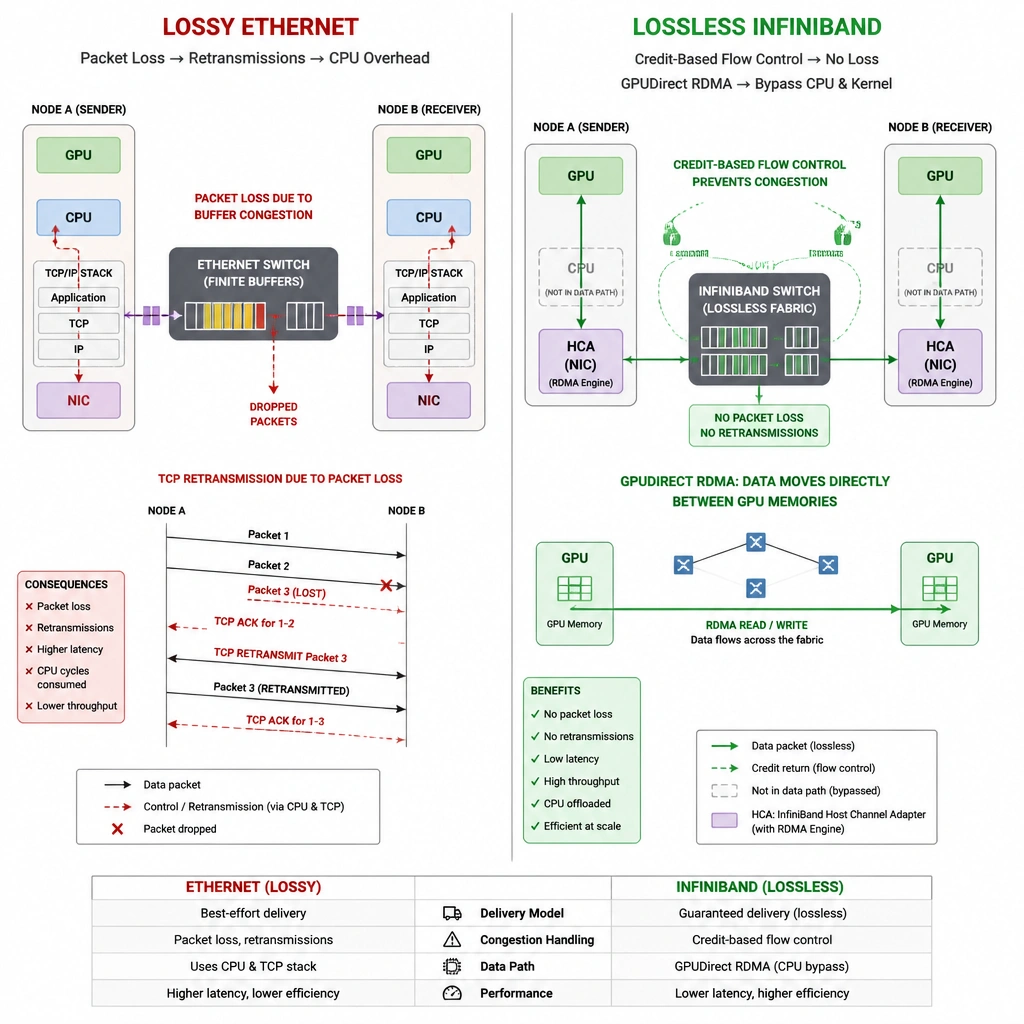
Check this out: when you're training a massive language model across hundreds of GPUs, the biggest bottleneck isn't the GPUs themselves—it's how fast they can talk to each other. Standard Ethernet just doesn't cut it because it's 'lossy'—meaning if congestion hits, packets get dropped, and the TCP window shrinks. Not good! InfiniBand completely solves this. First, it's a lossless fabric. It uses credit-based flow control, which means a sender won't transmit data unless the receiver has buffer space. No dropped packets, ever. Second, it has native RDMA. This is huge because it allows one server to read or write directly from another server's RAM (or VRAM) without bothering either CPU. Third, it's a switched fabric, giving you dedicated point-to-point connections rather than a shared bus. And fourth, its QoS features map traffic to virtual lanes to prioritize critical control messages. Trust me on this: InfiniBand's ultra-low latency and lossless design are what make multi-node AI training possible. Let's keep rolling!
Full explanation below image
Full Explanation
InfiniBand is a high-performance, low-latency, switched-fabric interconnect technology widely utilized in High-Performance Computing (HPC) and enterprise artificial intelligence clusters. Its design addresses the specific network bottlenecks encountered during distributed AI training (such as All-Reduce operations). Key architectural features include: 1. Lossless Fabric: Unlike standard Ethernet, which allows packet loss and relies on upper-layer protocols (like TCP) to retransmit dropped packets, InfiniBand is natively lossless. It achieves this using a credit-based link-level flow control mechanism. A sending port must receive a 'credit' from the receiving port—indicating available buffer space—before transmitting a packet. This prevents buffer overrun and eliminates packet drops due to congestion. 2. Native RDMA: Remote Direct Memory Access allows data transfer directly from the memory of one host to the memory of another without involving the operating system kernel or CPU of either host. In AI workloads, GPUDirect RDMA enables direct memory-to-memory transfers between GPUs across different nodes, significantly reducing latency and CPU overhead. 3. Switched Fabric Architecture: InfiniBand utilizes a switched fabric topology where devices connect via point-to-point links through switches. This allows simultaneous, non-blocking communication paths between multiple node pairs, scaling bandwidth dynamically, unlike legacy shared-bus architectures. 4. Quality of Service (QoS): InfiniBand supports Service Levels (SL) mapped to Virtual Lanes (VL) within the same physical link, allowing critical control or synchronization traffic to bypass bulk data transfers.
Let's examine why the incorrect options are wrong: - Option D: InfiniBand uses a switched fabric topology, not a bus-based architecture. A bus-based architecture shares a single medium and suffers from collision overhead and severe bandwidth bottlenecks as node counts increase. - Option F: InfiniBand is engineered for ultra-low latency (typically sub-microsecond to low single-digit microseconds) and high throughput, which is the exact opposite of a high-latency design.