
When organizing the architectural layers of an enterprise AI stack, which diagrammatic nesting correctly represents the relationship between Artificial Intelligence (AI), Machine Learning (ML), Generative AI (GenAI), and Large Language Models (LLMs)?
Select an answer to reveal the explanation.
Short Explanation and Infographic
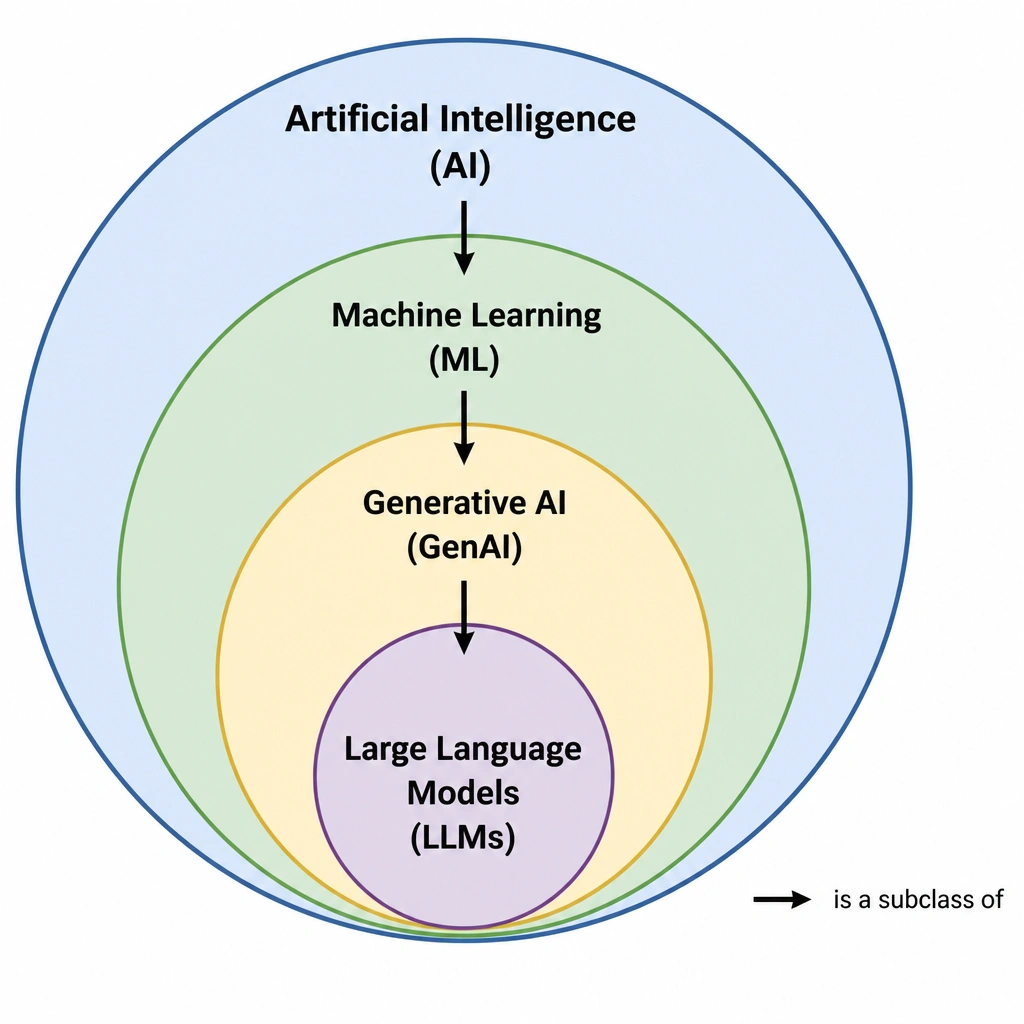
Alright, third time's a charm! The exam writers love testing this classification because people constantly mix them up in meetings. Let's use a physical workspace analogy to lock this in. Think of AI as the entire office building. Machine Learning is the development lab inside that building. Generative AI is the specific workbench where you create new prototypes. And Large Language Models? They're the specialized text-generation tools sitting on that workbench. That means LLMs are nested inside GenAI, which is nested inside ML, which is nested inside AI. Got it? Sweet. Let's keep rolling.
Full explanation below image
Full Explanation
Taxonomically, the field of cognitive computing is structured in nested layers of specialization: - Artificial Intelligence (AI) is the most general domain, referring to machines mimicking human intelligence. - Machine Learning (ML) is a subset of AI where systems use data to train statistical models to make predictions or decisions. - Generative AI (GenAI) is a specialized sub-discipline of ML that focuses on training neural networks to generate new content, such as synthetic images, text, and sound. - Large Language Models (LLMs) represent a further, text-focused application of Generative AI, relying on multi-billion parameter transformer models. Understanding the structural layers of an AI stack is essential for aligning software engineering and compute infrastructure resources. For example, legacy AI applications might rely on heuristics or decision trees, which require minimal compute. ML applications introducing deep neural networks require GPUs for matrix calculations. GenAI applications escalate compute requirements significantly due to the scale of modern generative architectures (like Diffusion and Transformers). LLMs represent the pinnacle of this escalation, requiring massive multi-GPU distributed clusters for training and inference. Because each step down the hierarchy represents a narrower subset of the parent layer, LLMs are a subset of GenAI, which is a subset of ML, which is a subset of AI. Placing these categories as parallel or inverting the nesting relationship is conceptually incorrect.