
An infrastructure team is planning the resource allocation and network design for an enterprise machine learning platform. To size their GPU clusters correctly, they must analyze the mathematical and data flow differences between training and inference workloads. Which statement best describes the fundamental computational differences between these two phases?
Select an answer to reveal the explanation.
Short Explanation and Infographic
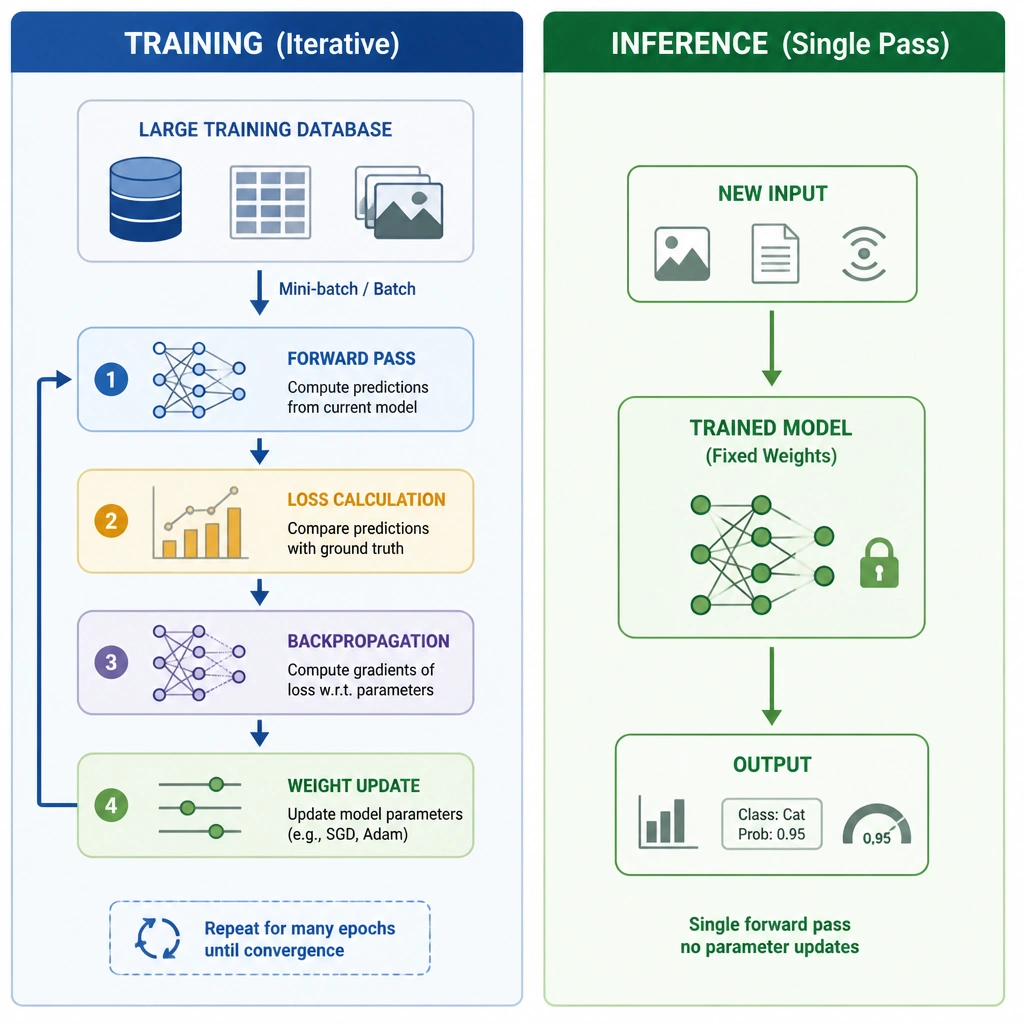
Here's the deal—training and inference are two completely different workloads, and they need different hardware designs. Think of training like studying for a massive certification exam. You have to read the study guide over and over again, check your practice answers, find where you went wrong (that's backpropagation), and adjust your brain's connections (updating the weights). This takes huge GPU clusters and weeks of heavy lifting. Inference is like taking the actual exam. You read the question once, give your answer based on what you already know (a single forward pass), and move on to the next question. There is no backpropagation, no weight updating, and no repeating the process. Knowing this distinction is key because training needs massive parallel compute and NVLink-connected clusters, while inference demands quick response times and can run on smaller, power-efficient GPUs.
Full explanation below image
Full Explanation
The life cycle of a machine learning model is divided into two computationally distinct phases: training and inference. Understanding these differences is critical for designing efficient AI infrastructure.
Training is the phase where a model learns from data. This process is highly compute- and memory-intensive, requiring the system to process large labeled datasets over multiple iterative cycles, known as epochs. During each step of training, the system performs a forward pass to generate predictions, calculates the loss (error) against the ground truth labels, and then performs a backward pass (backpropagation). Backpropagation computes the gradients of the loss function with respect to the model's weights, allowing optimization algorithms (like gradient descent) to update the weights. This cycle repeats millions of times, requiring massive parallel computing power, high-bandwidth inter-GPU communication (like NVLink), and large memory capacities to store intermediate activations.
In contrast, inference is the deployment phase where the pre-trained model is used to make predictions on new, unseen data. The computations during inference are much simpler: the model executes a single forward pass to generate an output. Because the model's weights are static, no loss calculation or backpropagation occurs. This makes inference computationally lighter and faster per sample than training, prioritizing low latency and cost-effectiveness.
Let's analyze the incorrect options: - A is incorrect because inference does not execute backward-pass optimization or feedback loops. - C is incorrect because training is highly parallelized and runs primarily on GPUs, not sequential CPUs. - D is incorrect because training has a far larger memory footprint (to store weights, optimizer states, and activations) than inference, which only needs to load the model weights and a small input batch.