
In distributed AI training clusters that run collective communication operations like AllReduce, nodes must constantly exchange gradients and weight parameters. Which characteristic of Remote Direct Memory Access (RDMA) technology provides the most critical performance benefit for these synchronized operations?
Select an answer to reveal the explanation.
Short Explanation and Infographic
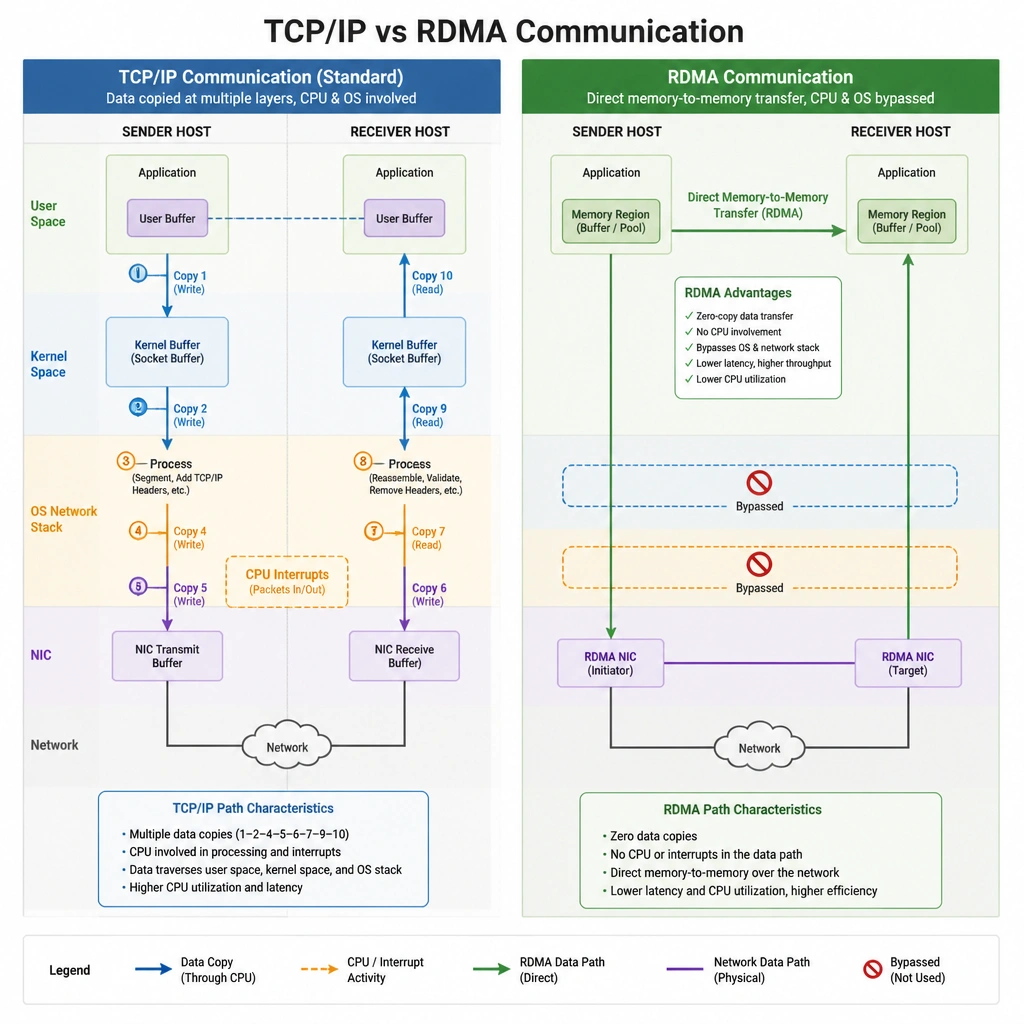
Imagine you want to send a box to your neighbor next door, but the post office rules say you have to mail it to a central depot, have a postal worker log it, inspect it, and then finally deliver it. That's what happens when data goes through the standard operating system kernel and CPU network stack. It's slow and wastes precious CPU cycles! RDMA completely cuts out the middleman. It allows a GPU server to write data directly into the memory of a remote GPU server across the network. Because it bypasses the host CPU and the OS kernel network stack, it slashes latency to almost zero and lets your GPUs synchronize their weights at lightning speed. For collective operations like AllReduce, RDMA is the secret sauce. Got it? Sweet. Let's keep rolling.
Full explanation below image
Full Explanation
Distributed AI training relies on synchronous communication across multiple nodes. As models grow, they are split across several GPUs, which must synchronize their parameter updates at the end of each training step using collective operations like AllReduce. This synchronization requires extremely low latency and high bandwidth to prevent GPUs from sitting idle.
Remote Direct Memory Access (RDMA) is the key technology that solves this bottleneck. The primary advantage of RDMA is its ability to perform direct memory-to-memory data transfers between remote systems. By utilizing dedicated network adapters (such as InfiniBand HCAs or RoCE-enabled Ethernet NICs), RDMA allows data to be read from or written to an application's memory space on a remote node without involving either host's CPU or operating system kernel network stack.
Bypassing the CPU and OS kernel eliminates context switching overhead, reduces memory copying operations, and lowers latency to the sub-microsecond range. This ensures that massive synchronization operations can run at near-wire speeds with minimal CPU resource consumption.
Let's look at why the other options are incorrect: - A is incorrect because, although RDMA can operate within software-defined and virtual networks, this integration is not the primary source of the massive throughput and low latency required by AllReduce workloads. - C is incorrect because RDMA's performance benefits are independent of IPv6. While RoCE can use IPv6 addressing, the protocol version does not drive the hardware-level speed improvements. - D is incorrect because RDMA achieves its performance by bypassing traditional TCP/IP socket processing, not by emulating or wrapping legacy socket layers.