
You are deploying a Kubernetes cluster to handle massive deep learning training workloads, and you decide to install the NVIDIA GPU Operator. Which of the following represent the key advantages of using this operator on your container orchestration platform? (Choose two.)
Select all correct answers, then click Submit.
Short Explanation and Infographic
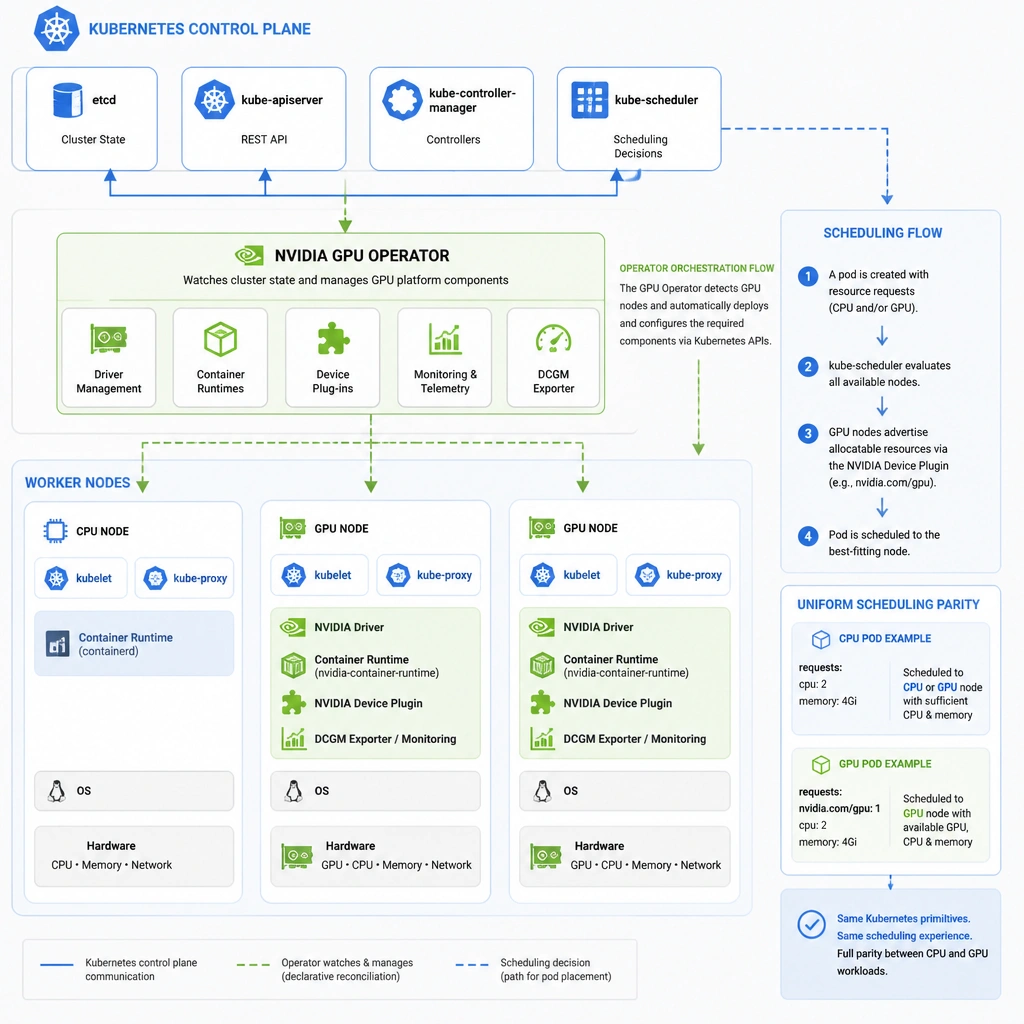
Think of deploying GPUs in Kubernetes without an operator like trying to assemble a high-performance sports car engine with a standard wrench set—it's manual, painful, and guaranteed to break. The NVIDIA GPU Operator is your ultimate mechanic. Instead of manually installing driver kernels, container runtimes, and monitoring tools on every single node, this operator takes care of the whole stack for you automatically! Plus, it bridges the gap so that your GPU nodes look and behave just like standard CPU nodes to the Kubernetes scheduler. That means no more special snowflake configurations just to run a container. Trust me, in production, this saves your sanity. Just remember, it's an infrastructure automation tool—it doesn't write or optimize your code, and it won't train your models for you. Got it? Sweet. Let's keep rolling.
Full explanation below image
Full Explanation
The NVIDIA GPU Operator uses the operator framework pattern in Kubernetes to automate the management of all NVIDIA software components required to run GPU-accelerated applications.
- Why Option B is correct: Managing GPU drivers, the container toolkit, device plug-ins, and monitoring tools manually across a Kubernetes cluster is operationally intensive. The GPU Operator packages these components as standard container images and manages their lifecycle dynamically. When new nodes are added, it automatically detects the hardware, builds the driver container against the host kernel, and prepares the node to run GPU workloads. - Why Option D is correct: Kubernetes natively understands CPU and memory resources. The GPU Operator deploys the NVIDIA Device Plugin, which exposes GPU resources to the Kubernetes API. This enables the scheduler to allocate GPUs just like standard CPU resources, allowing developers to request nvidia.com/gpu in their pod specifications. - Why Option A is incorrect: The GPU Operator is strictly an infrastructure management tool. It does not optimize neural network architectures or tune hyperparameters; those tasks are handled by frameworks like PyTorch or tools like Ray Tune. - Why Option C is incorrect: The operator does not provide machine learning training workflows, job schedulers (like Slurm or Volcano), or model registry features. It simply prepares the underlying container environment to run those tools.
Memory Aid: The GPU Operator is about infrastructure plumbing, not application code. It gets the drivers and runtimes up and running automatically so Kubernetes can schedule jobs on GPUs just as it does on CPUs.