
When optimizing a Large Language Model (LLM) for low-latency inference, which compression technique offers the most effective balance between shrinking model footprint and maintaining high accuracy?
Select an answer to reveal the explanation.
Short Explanation and Infographic
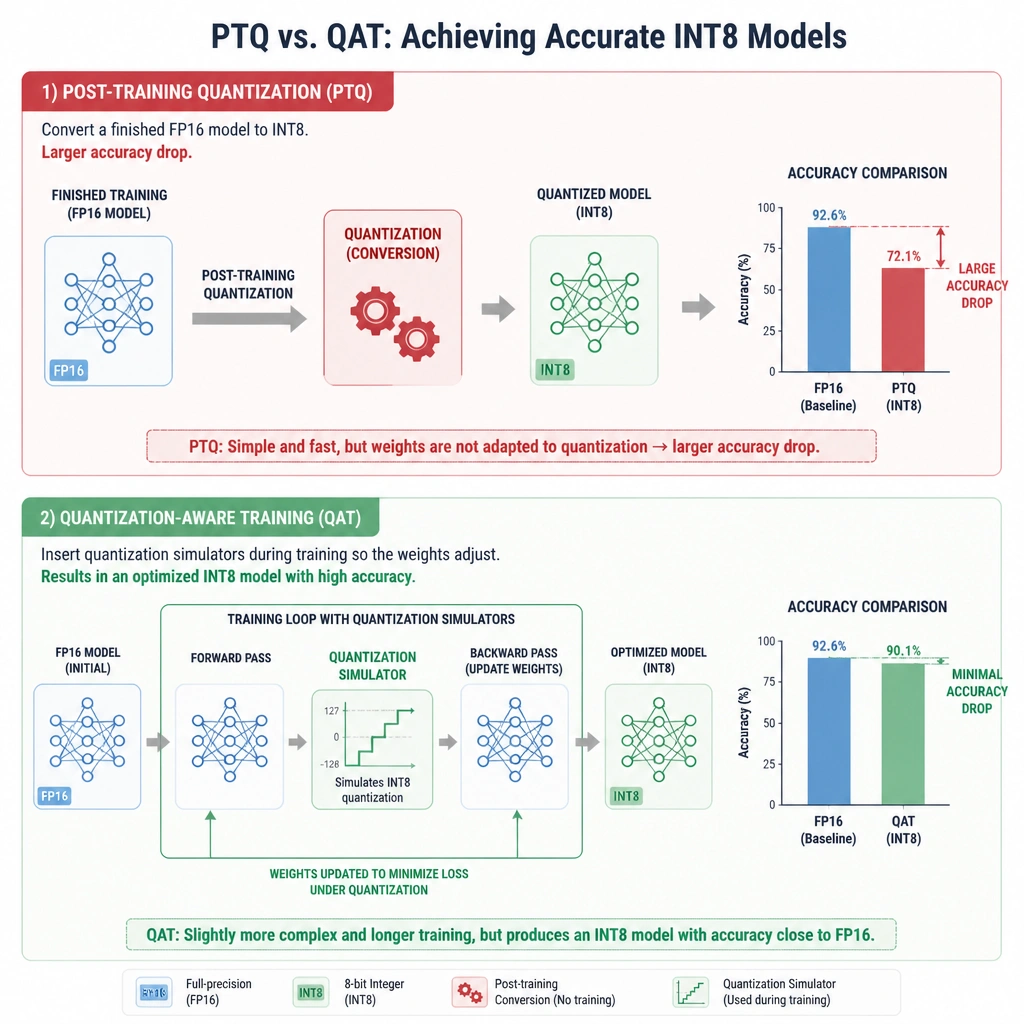
When you train a massive AI model, the weights are usually stored in FP32 (32-bit floating point) or FP16. Those files are huge, and running inference on them is slow and expensive. To fix this, we use quantization, which is like rounding numbers down to smaller data types, like 8-bit integers (INT8). But here's the trap: if you just round the numbers after training is finished (which is called Post-Training Quantization, or PTQ), your model's accuracy can take a serious nosedive, especially if you push it to binary or ternary levels. To solve this, we use Quantization-Aware Training (QAT). During the training process, the system simulates the rounding errors, so the model learns to adapt to the lower precision. When you combine QAT with INT8 precision, you get the absolute sweet spot: your model size drops by 75% and it runs way faster, but you only lose a tiny fraction of accuracy (usually just 1-2%). That's the winning combo.
Full explanation below image
Full Explanation
Quantization is a key model compression technique used to deploy Large Language Models (LLMs) on resource-constrained hardware. It involves converting the model's weights and activations from high-precision floating-point formats (such as FP32 or FP16) to lower-precision formats (such as INT8 or INT4). This reduces memory usage, memory bandwidth pressure, and execution latency. There are two main strategies for quantization: 1. Post-Training Quantization (PTQ): The model is trained in full precision, and quantization is applied directly to the weights afterward. While easy to implement, PTQ can lead to significant accuracy loss, especially when quantizing to very low bit widths (like binary/1-bit or ternary/2-bit precision). 2. Quantization-Aware Training (QAT): The quantization effects are modeled during the training process itself using fake-quantization modules. This allows the model to adjust its weights during backpropagation to compensate for the precision loss.
Among the options, QAT with INT8 precision provides the best balance for LLM optimization: - Accuracy Preservation: By training the model to be robust against precision loss, QAT preserves accuracy far better than PTQ, keeping accuracy drop to an absolute minimum (typically 1-2%). - Hardware Acceleration: Modern GPUs (like NVIDIA Tensor Cores) have hardware support optimized for INT8 math, resulting in a 2x to 4x performance speedup.
Let's analyze the incorrect options: - Binary PTQ (Option A) and Ternary PTQ (Option D) represent extremely low precision levels. Applying them after training (PTQ) causes severe degradation in LLM language generation quality, making the model practically unusable. - Dynamic Quantization (Option C) quantizes activations on-the-fly during inference. This introduces computation overhead during runtime to calculate scale factors, which can degrade inference latency compared to static INT8 quantization.