
In a multi-node distributed AI training cluster, nodes must exchange gradient updates at high speeds. Which NVIDIA technology allows a GPU on one node to write directly to the memory of a GPU on another node via a remote direct memory access (RDMA) network card, completely bypassing the host CPU and system memory?
Select an answer to reveal the explanation.
Short Explanation and Infographic
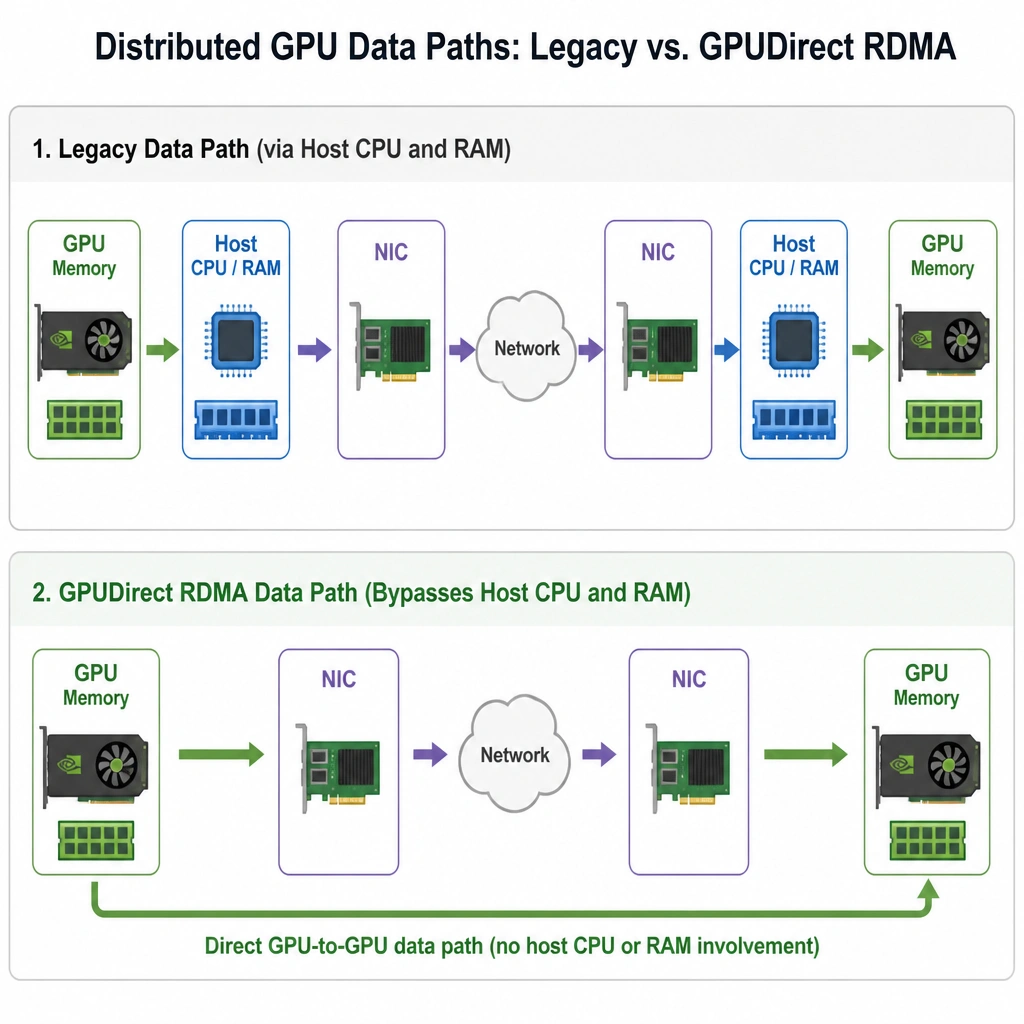
Here's the deal: when you're training massive AI models across a bunch of different servers, network performance is your biggest bottleneck. If a GPU on Server A wants to talk to a GPU on Server B, the old-school way was a total nightmare. The data had to travel from GPU memory, over the PCIe bus to host system memory, let the CPU package it up, send it to the network card, and then do the whole process in reverse on the other side. That's a lot of hops and a massive load on your host CPU! Enter GPUDirect RDMA. This technology is a game-changer. It allows the GPU to talk directly to the RDMA-capable network interface card (like an InfiniBand HCA or RoCE-enabled NIC) right over the PCIe bus. The CPU is completely bypassed, and the data goes straight from GPU memory on one node to GPU memory on the other node. It's like having a dedicated high-speed highway between systems. Now, pay close attention to the other options because Cisco and NVIDIA love to test you on these distinctions. NVLink is super fast, but it's for GPU-to-GPU communication inside the same physical server, not across the network. CUDA Unified Memory creates a single virtual address space so your code can access CPU and GPU memory easily, but it doesn't handle network transfers. GPUDirect Storage (GDS) is all about bypass, but it specifically links your GPU to local or remote storage NVMe drives, not GPU-to-GPU over the network. Remember: network bypass is GPUDirect RDMA!
Full explanation below image
Full Explanation
GPUDirect RDMA (Remote Direct Memory Access) is a key feature of NVIDIA's GPUDirect technology family. It enables a direct path for data exchange between NVIDIA GPUs and third-party peer devices, such as RDMA-capable network interface cards (NICs) and host channel adapters (HCAs), across a distributed network. By utilizing standard PCI Express peer-to-peer (P2P) communication, GPUDirect RDMA eliminates the need to copy data to system memory buffers on the host, avoiding CPU overhead and significantly reducing latency while maximizing network throughput in distributed training workloads (e.g., using frameworks like Megatron-LM or DeepSpeed).
Review of the incorrect options: - NVLink (Option A) is a high-bandwidth, energy-efficient interconnect designed for local GPU-to-GPU or GPU-to-CPU communication within a single node. It does not span across network fabrics between different physical server chassis. - CUDA Unified Memory (Option B) provides a single, unified memory address space accessible by both the CPU and GPU. It simplifies memory management by automatically migrating pages between system memory and GPU VRAM on demand, but it does not facilitate low-latency network communication between distributed systems. - GPUDirect Storage (GDS) (Option C) establishes a direct data path between local or remote NVMe storage and GPU memory. It bypasses the host CPU and system page cache for file I/O, which is distinct from network-based GPUDirect RDMA transfers that connect GPUs on separate nodes.
For distributed AI workloads, GPUDirect RDMA combined with high-speed network interconnects like InfiniBand or RoCE is essential to prevent network communication from bottlenecking GPU compute capabilities.