
You are designing an AI infrastructure cluster and comparing GPU hardware specifications. Which of the following statements is incorrect regarding the technical specifications of the NVIDIA A100 Tensor Core GPU?
Select an answer to reveal the explanation.
Short Explanation and Infographic
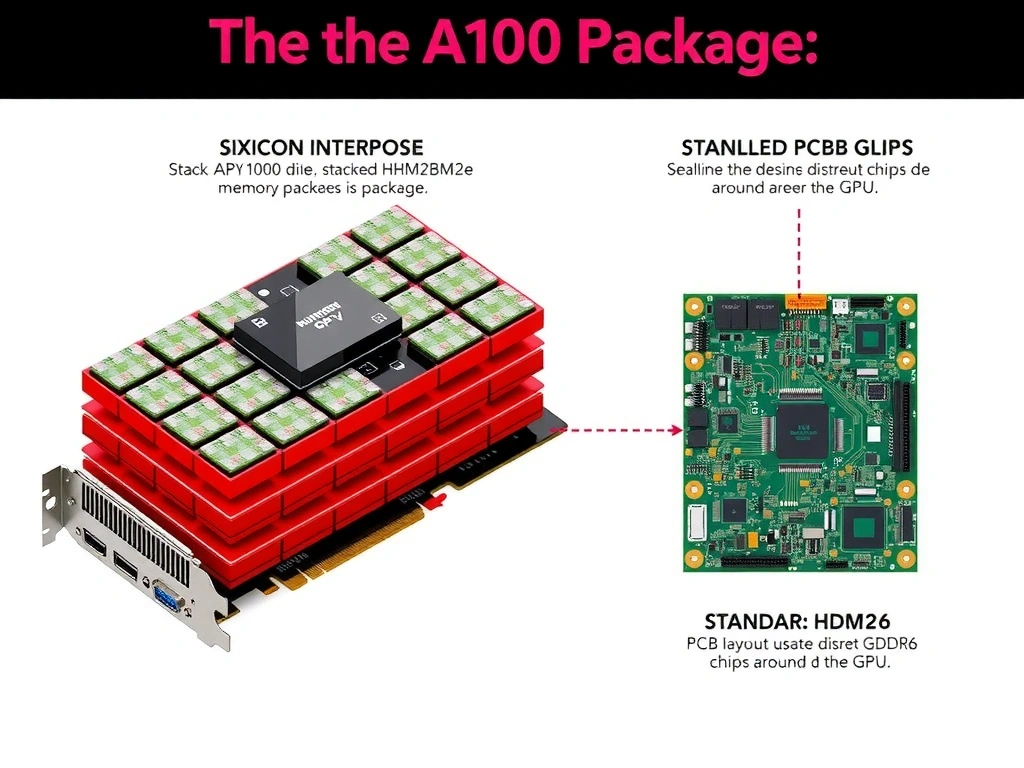
Let's get our hardware specs straight because this bites people all the time. The A100 is a heavy-duty data center GPU. It does not use the standard GDDR6 memory found in consumer graphics cards or low-end accelerators. Instead, it uses HBM2e (High Bandwidth Memory), which stacks memory dies vertically to achieve incredible bandwidth (over 1.5 terabytes per second!) and comes in huge 40GB or 80GB configurations. So, saying the A100 uses GDDR6 and is capped at 24GB is completely wrong.
Full explanation below image
Full Explanation
The incorrect statement is C. The NVIDIA A100 Tensor Core GPU does not use GDDR6 memory, and its memory capacity is not limited to 24GB. The A100 uses High Bandwidth Memory (HBM2 on early 40GB models, and HBM2e on the 80GB models). HBM memory is stacked vertically on the silicon interposer right next to the GPU die, providing a much wider memory bus (up to 5120-bit) and enabling bandwidths of 1.6 TB/s to 2.0 TB/s. The other statements are correct: - Multi-Instance GPU (MIG) (A) is a key feature of the Ampere architecture (A100) that allows a single GPU to be partitioned into up to seven independent GPU instances, providing physical hardware isolation for compute and memory. - Third-generation Tensor Cores (B) introduce TensorFloat-32 (TF32), which enables out-of-the-box speedups for FP32 training workloads without requiring developers to write mixed-precision code. - The 80GB HBM2e configuration (D) is standard for deep learning training clusters.