
When architecting containerized environments to support distributed AI training and model inference, which of the following represent core Kubernetes features that directly benefit your infrastructure operations? (Select all that apply.)
Select all correct answers, then click Submit.
Short Explanation and Infographic
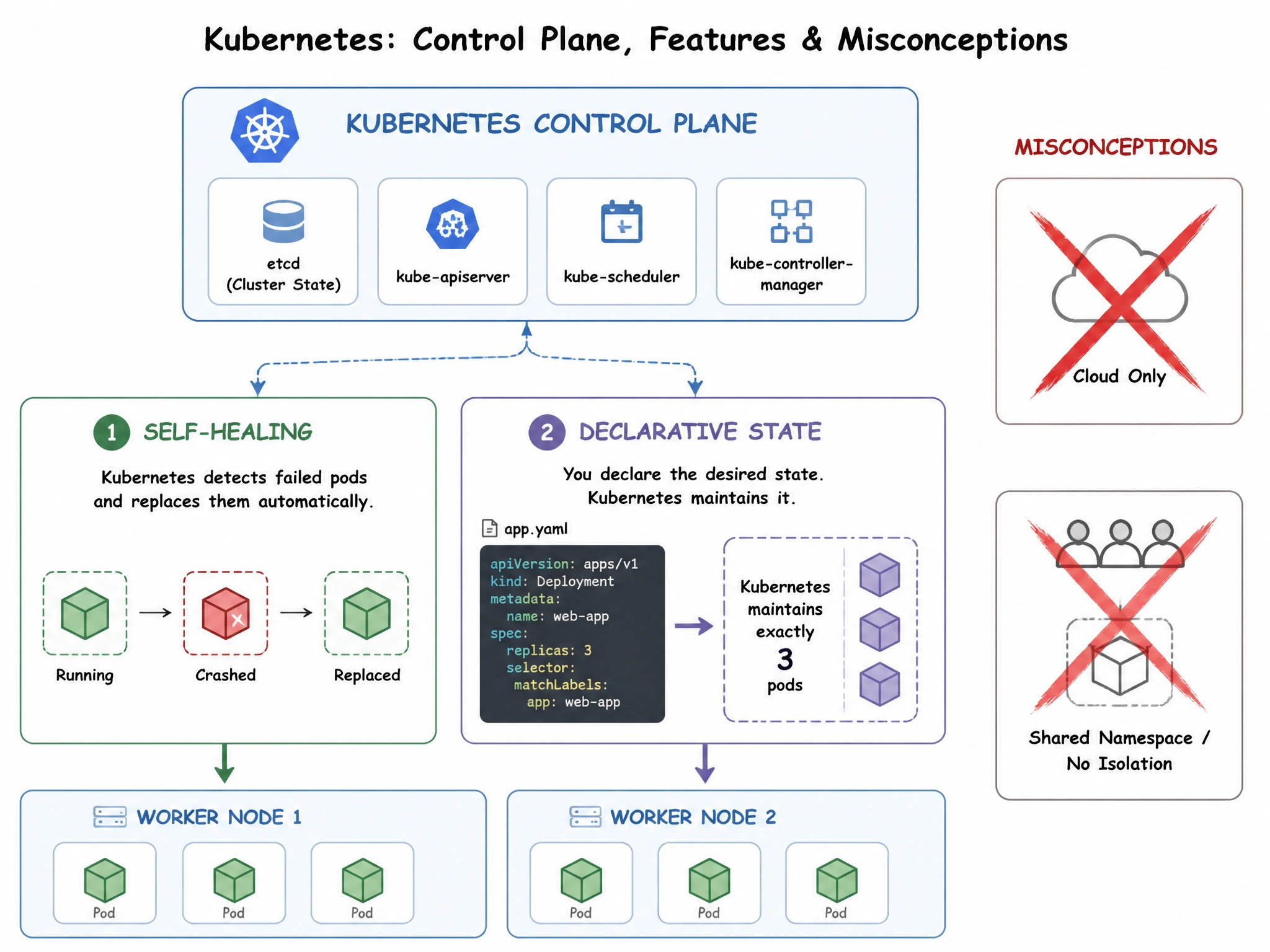
Let's dive in. If you're building a massive containerized network for AI, you want Kubernetes to do the heavy lifting. The cool thing is, Kubernetes uses declarative configuration (Option C), meaning you just write a YAML file describing the desired state and the cluster coordinates it. Plus, it has self-healing (Option E) to restart crashed containers during training runs, and built-in service discovery and load balancing (Option A) to route traffic using DNS or IP addresses. Do not believe the distractors: Kubernetes runs anywhere—cloud or local data centers—and handles persistent storage like a champ (essential for saving your model weights!). It also scales automatically, so you don't have to adjust replicas manually. Got it? Sweet.
Full explanation below image
Full Explanation
Kubernetes provides robust container orchestration features that simplify the management of distributed AI pipelines: 1. Declarative Configuration: Users write YAML or JSON manifests detailing the desired target state of resources. The Kubernetes control plane continuously matches actual cluster conditions to this configuration. 2. Self-Healing: Kubernetes monitors container health and automatically restarts failed containers or reschedules pods from unresponsive nodes to healthy nodes. 3. Service Discovery and Load Balancing: Kubernetes exposes pods using DNS names or single IP addresses, automatically distributing incoming network traffic across replicas.
Conversely, the distractors describe incorrect limitations: - Persistent Storage: Kubernetes supports StatefulSets and Persistent Volumes (PVs), which are critical for stateful AI workloads that require database connections or file checkpoints. Therefore, statement B is false. - Deployment Environments: Kubernetes is environment-agnostic, supporting bare-metal on-premises, hybrid, and public cloud deployments. Therefore, statement D is false. - Auto-scaling: The Horizontal Pod Autoscaler (HPA) and Cluster Autoscaler automate resource scaling based on usage spikes, removing the need for manual intervention. Therefore, statement F is false.