
You are planning a data center deployment and reviewing the specifications of the NVIDIA DGX A100 system to ensure you have enough compute density. How many physical A100 Tensor Core GPUs are built into a standard DGX A100 server?
Select an answer to reveal the explanation.
Short Explanation and Infographic
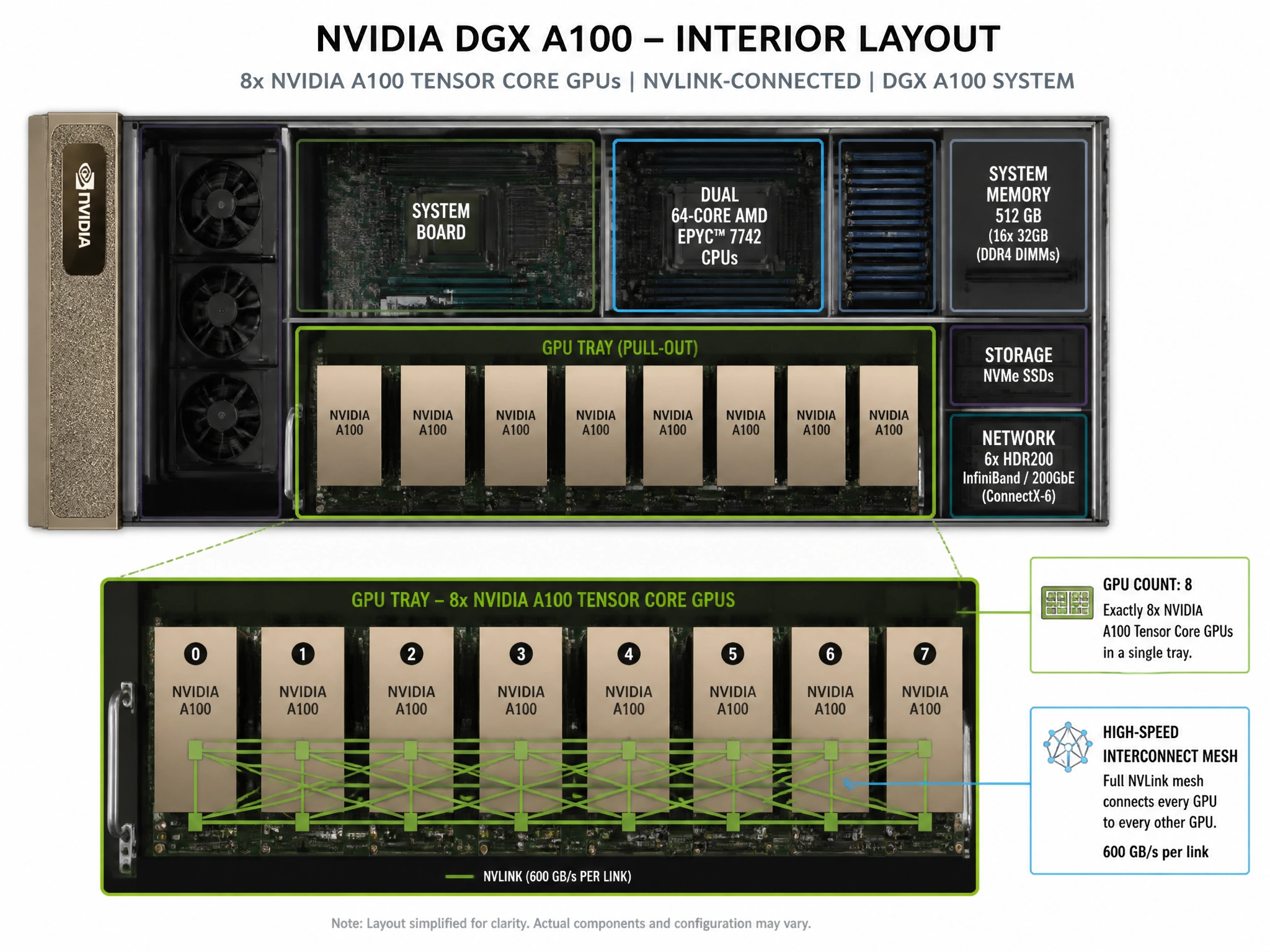
Here's the deal: when you order a standard DGX A100 box, you're getting a serious powerhouse of a server. Under the hood, NVIDIA has packed exactly eight A100 Tensor Core GPUs. Not four, not twelve, and definitely not sixteen. Eight is the magic number here, and they're all linked up via NVLink to act like one giant super-GPU. Make sure you memorize this count, because knowing your hardware specs is a classic exam requirement, and it's the foundation for calculating your total cluster memory and power draw!
Full explanation below image
Full Explanation
The NVIDIA DGX A100 is a foundational building block for AI enterprise infrastructure. A standard DGX A100 system integrates exactly 8 NVIDIA A100 Tensor Core GPUs.
Depending on the specific system configuration, these can be either the 40GB or 80GB high-bandwidth memory (HBM2/HBM2e) variants, providing a total of either 320GB or 640GB of GPU memory per system. The 8 GPUs are interconnected using third-generation NVIDIA NVLink interfaces and NVSwitches, delivering high-bandwidth, low-latency communication (up to 4.8 TB/s of bidirectional bandwidth) across all GPUs inside the chassis.
When studying for the exam and designing data center infrastructure, remember: - A standard DGX A100 has 8 GPUs. - Distractors like 4 or 16 might represent other server architectures or DGX models (for example, the DGX Station A100 has 4 GPUs, and a DGX SuperPOD aggregates multiples of these systems, but the standalone DGX A100 server itself always contains 8). - A count of 12 is not a standard configuration for NVIDIA DGX systems.