
What technical features and architectural components allow InfiniBand fabrics to deliver the low latency and high bisection bandwidth required for AI and deep learning supercomputers? (Select all that apply.)
Select all correct answers, then click Submit.
Short Explanation
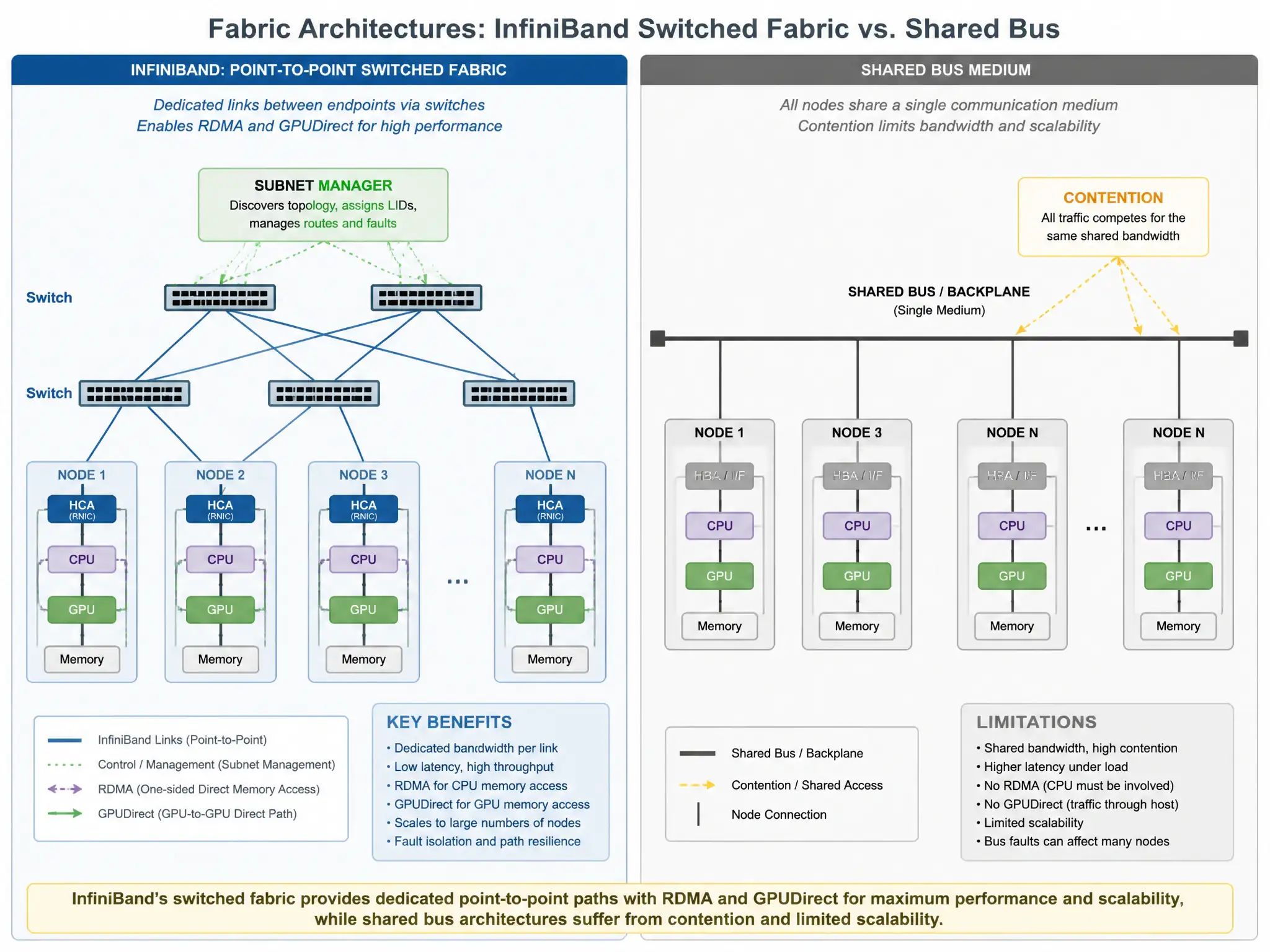
Think of traditional Ethernet like a crowded party where everyone is trying to speak over the same microphone—that's a shared bus, and it's terrible for high-performance computing. InfiniBand gives you a switched fabric with dedicated point-to-point paths, plus RDMA and GPUDirect RDMA so GPUs and memory can talk directly without CPU or kernel overhead. The subnet manager keeps paths and failover under control, and the speeds scale from SDR to NDR.
Full Explanation
InfiniBand is designed from the ground up for low-latency, high-throughput applications in cluster architectures. The switched fabric architecture built around point-to-point serial links uses dedicated paths rather than traditional Ethernet-style shared media, maximizing data isolation, throughput, and scalability. The subnet manager architecture functions as the control plane, handling topology discovery, configuring routing tables, and executing rapid, automatic path failovers. Remote Direct Memory Access (RDMA) capabilities bypass the local CPU and OS kernel, enabling direct memory writes and reads between hosts to eliminate context-switching latency. GPUDirect RDMA technology enables direct peer-to-peer GPU memory transfers across nodes via PCIe-to-network paths, eliminating the need to copy data to system RAM first. Standardized support for scalable transmission rates spans from Single Data Rate (SDR) at 10 Gbps up to Next Data Rate (NDR) at 800 Gbps per link. The bus-based shared medium design that mimics legacy copper Ethernet systems is incorrect because InfiniBand uses a point-to-point switched fabric architecture, not a shared-bus or shared-medium topology.