
Which industry trends are major drivers for the evolution of modern AI infrastructure design and deployment models? (Select all that apply.)
Select all correct answers, then click Submit.
Short Explanation
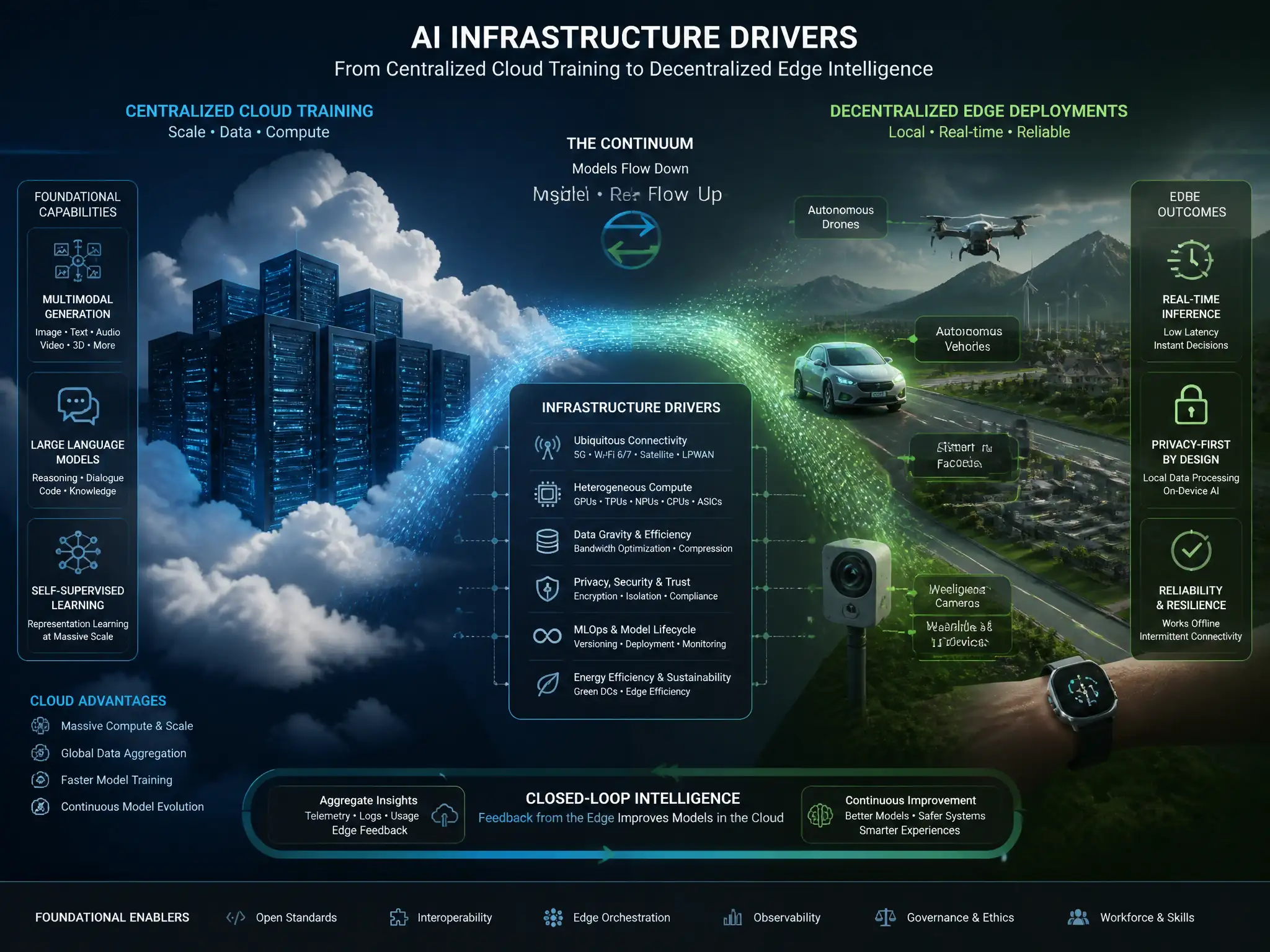
You’re seeing AI infrastructure evolve because self-supervised learning, huge context-aware NLP, multimodal generative AI, and edge AI all push memory, compute, and deployment models harder than ever. Don’t buy the hype that software tricks remove GPUs or that edge replaces the cloud—they still need serious hardware and hybrid architectures.
Full Explanation
Modern AI infrastructure planning is driven by shifting model architectures and deployment paradigms. Self-supervised learning uses raw unlabeled data to pretrain models, reducing reliance on manually labeled training data while requiring large-scale computing clusters to process massive uncurated datasets before fine-tuning. Large-scale context-aware NLP models, such as large transformer networks, require vast computational and memory footprints to manage context-rich, long-form sequences. The expansion of generative AI into multimodal domains generates media formats like video, synthetic voice, high-fidelity audio, and 3D graphics, demanding extreme parallel processing power for training and inference. The growth of edge AI and on-device execution shifts workloads closer to the user to reduce latency and protect sensitive data locally, driving the deployment of heterogeneous edge accelerators. The claim that automated feature extraction frameworks completely remove the need for GPU accelerators is wrong because automated feature engineering is a software-level pipeline step that optimizes data preparation but does not eliminate the need for high-performance training accelerators. The claim that there is a complete industry-wide migration from cloud architectures to standalone edge hardware is also wrong because edge computing complements cloud-based resources in a hybrid model rather than replacing centralized data centers, which are still required to train large models.