
You're explaining to a non-technical stakeholder why GPUs are so different from CPUs in AI workloads. What's the fundamental architectural difference that makes GPUs powerful for deep learning?
Select an answer to reveal the explanation.
Short Explanation and Infographic
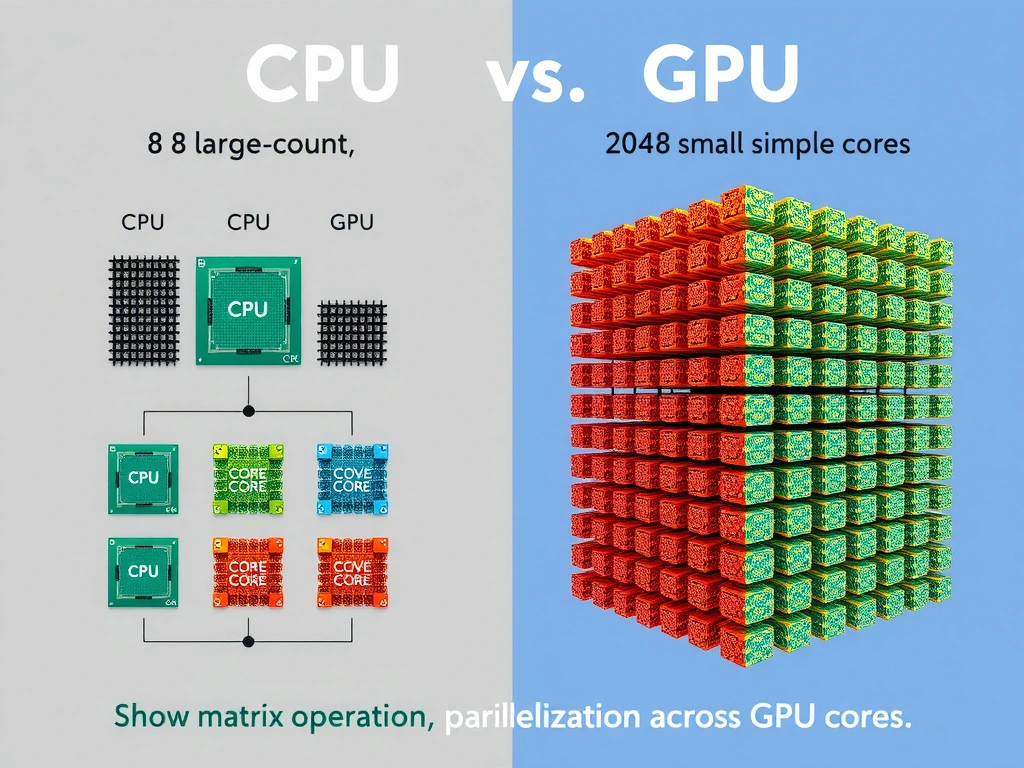
The core difference is parallel architecture. GPUs have thousands of simple cores that can execute instructions in parallel. CPUs have far fewer, more complex cores optimized for sequential execution. This makes GPUs perfect for deep learning's massively parallel matrix operations.
Full explanation below image
Full Explanation
CPU vs. GPU architecture is a fundamental concept in AI infrastructure. A CPU (Central Processing Unit) is designed for sequential tasks with complex logic. It has a few cores (2–64 in modern systems) that are highly sophisticated, capable of complex instruction execution, branch prediction, and out-of-order execution. Each core is "smart" but there aren't many of them. GPUs (Graphics Processing Units) take the opposite approach: thousands of simple cores working in parallel. Each core is "less smart" (can execute simpler instructions), but the sheer number of cores enables massive parallelism. Deep learning computations are highly parallel. Training a neural network involves thousands of matrix multiplications and element-wise operations happening simultaneously. GPUs excel at this. They can split a large matrix operation across thousands of cores, each computing a small piece in parallel. A CPU trying the same operation has to serialize (do it sequentially with a few cores), which is orders of magnitude slower. This isn't a result of clock speed or bandwidth alone; it's architectural. The question tests whether you understand why GPUs are fundamentally suited to AI workloads.