
You're deciding whether to implement RoCE (RDMA over Converged Ethernet) in your AI cluster's network, and you want to know the scenario where it delivers the most benefit. When is RoCE most valuable?
Select an answer to reveal the explanation.
Short Explanation and Infographic
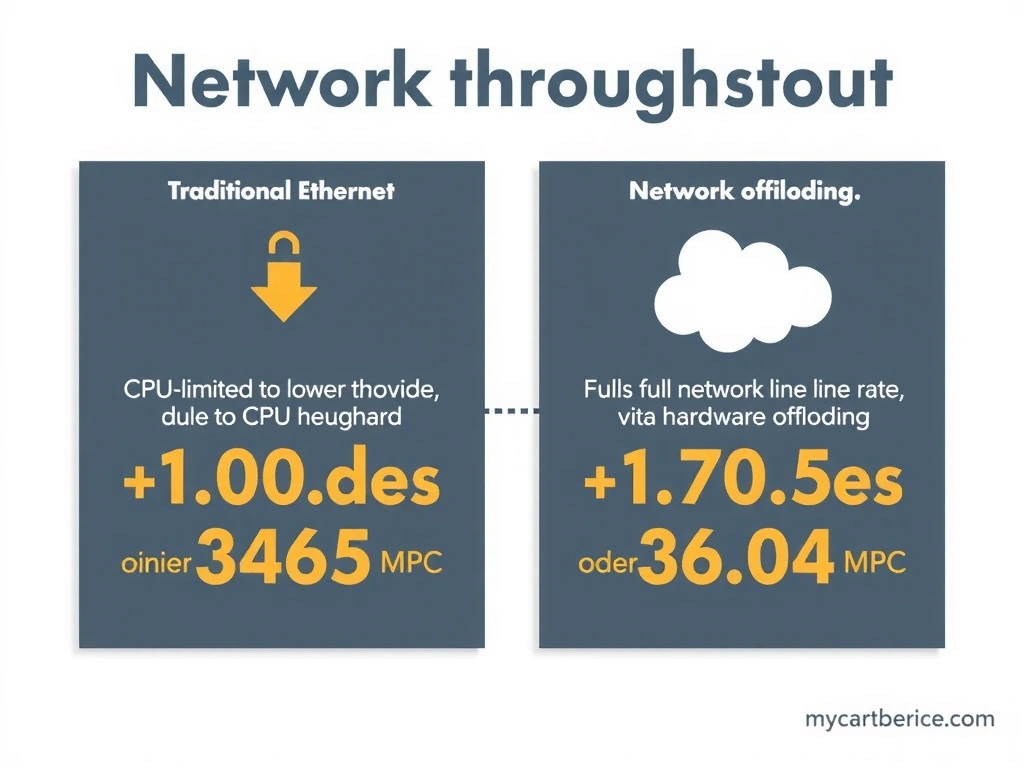
RoCE's main benefit is offloading data transfers from the CPU to the NIC. If CPU utilization is the bottleneck preventing you from using full network bandwidth, RoCE reduces CPU overhead and lets the network run faster. High packet loss means network issues that RoCE won't fix. Storage traffic doesn't benefit much. Single-node workloads don't need RoCE.
Full explanation below image
Full Explanation
RoCE (RDMA over Converged Ethernet) brings RDMA capabilities to Ethernet networks. The key benefit is CPU offloading: the network interface card handles memory transfers directly, bypassing the CPU. This is most valuable when the CPU would otherwise be the bottleneck. Picture this: you're transferring data between GPU nodes for distributed training. Without RDMA, the CPU orchestrates each transfer, and at high speeds, the CPU saturates (maybe it's limited to 40 Gbps of data movement due to CPU overhead). The network is capable of 100 Gbps, but the CPU can't keep up. With RoCE, the NIC handles the transfer autonomously, and you can actually use the full network bandwidth. RoCE doesn't help with: high packet loss (that's a network hardware/configuration issue), storage traffic (which is typically sequential and doesn't suffer from CPU overhead the same way), or single-node workloads (which don't need inter-node communication). The question tests whether you understand RDMA's value proposition: CPU offloading for network bottleneck scenarios.