
You're tuning inference performance for large language models running on NVIDIA GPUs in production, and you need to reduce latency and increase throughput. Which component is most critical for this optimization work?
Select an answer to reveal the explanation.
Short Explanation and Infographic
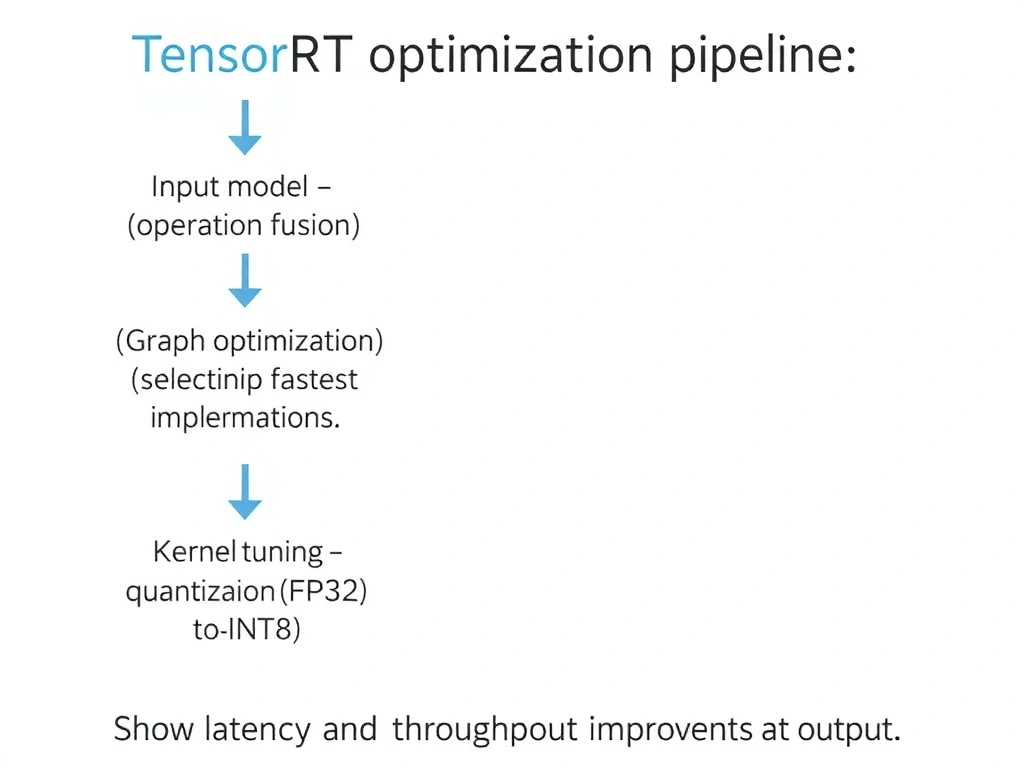
TensorRT is NVIDIA's inference optimization library. It optimizes model graphs (fusing operations, reducing memory footprint), applies quantization (using lower precision like INT8 instead of FP32), and targets NVIDIA hardware. This directly improves inference speed and latency. RAM, CPU cores, and storage are secondary for inference optimization.
Full explanation below image
Full Explanation
TensorRT is a critical tool for inference optimization on NVIDIA GPUs. It takes a trained model and applies various optimizations to reduce latency and improve throughput. Graph optimization fuses multiple operations into single kernels (e.g., convolution + activation becomes one kernel). Kernel tuning tests multiple implementations of each operation and selects the fastest. Quantization converts FP32 (32-bit floating point) to INT8 (8-bit integer), reducing memory footprint and computational requirements. The latency and throughput improvements are dramatic — 2–10x speedups are common. Now, why are the other options insufficient? More RAM helps with model sizes and batch sizes, but if you're already running inference, RAM usually isn't the bottleneck. More CPU cores don't help inference on GPUs — the GPU is doing the heavy lifting, not the CPU. Faster storage (NVMe) helps with model loading and batch prefetching, but inference latency is dominated by GPU computation, not I/O. TensorRT directly addresses the GPU inference bottleneck.