
Your team is building a pipeline that trains models using PyTorch and TensorFlow. To prevent data loading and preprocessing from bottlenecking the training, you need a GPU-accelerated data pipeline that can preprocess input data on the GPU and hand it off natively to both deep learning frameworks. Which NVIDIA tool meets this requirement?
Select an answer to reveal the explanation.
Short Explanation
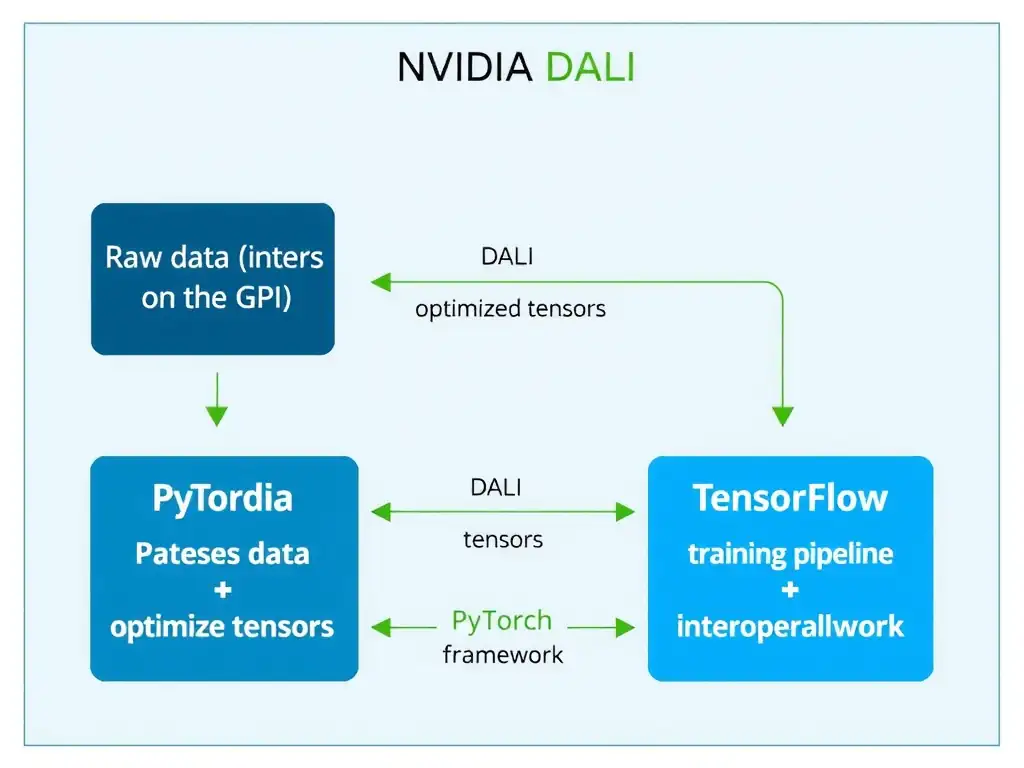
If you're training models in PyTorch and TensorFlow, you don't want CPU data prep starving your GPUs. NVIDIA DALI runs decoding, resizing, cropping, and normalization on the GPU, then hands native tensors straight to both frameworks. That keeps your pipeline fast without rewriting it for each tool.
Full Explanation
NVIDIA DALI (Data Loading and Augmentation Library) is a specialized library designed to accelerate data preprocessing pipelines for deep learning applications. In many training pipelines, the CPU becomes a bottleneck due to tasks like decoding, resizing, cropping, and normalizing input datasets. DALI offloads these data augmentation and preprocessing steps directly to the GPU. Crucially, it provides framework-independent execution, allowing developers to define a single pipeline that outputs native tensors for PyTorch, TensorFlow, MXNet, and PaddlePaddle, ensuring high performance and cross-compatibility.
Let's examine why the other NVIDIA tools are not correct: - NVIDIA TensorRT is an SDK for high-performance deep learning inference. It optimizes trained models for deployment by performing layer fusion, precision calibration (INT8/FP16), and kernel tuning. It is not designed for data loading or preprocessing. - NVIDIA cuDNN is a GPU-accelerated library of primitives for deep neural networks. It provides highly tuned implementations for routines like convolution, pooling, and activation functions used during model execution, not for loading external data. - NVIDIA Nsight Compute is an interactive kernel profiler for CUDA applications. It provides detailed performance metrics and debugging advice for GPU kernels but plays no role in dataset ingestion or preprocessing.
By standardizing on DALI, teams can build highly optimized, portable data pipelines that scale across multi-GPU setups without being bottlenecked by CPU processing limits.