
A multi-tenant GPU cluster frequently suffers from scheduling delays where smaller, critical model training jobs are delayed or evicted because larger research jobs have consumed all available capacity. Which administrative control should you implement to resolve this resource hogging?
Select an answer to reveal the explanation.
Short Explanation
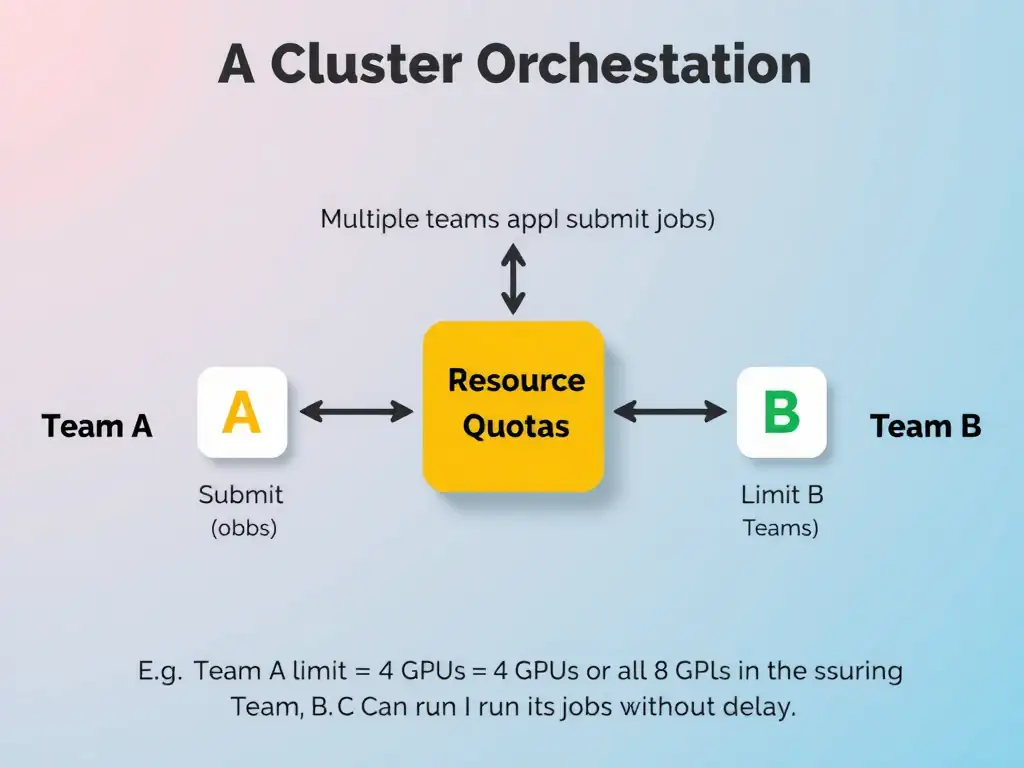
Here's the deal: if you run a shared GPU cluster without boundaries, one massive job can consume every accelerator and leave critical training stuck. You don't fix that by buying more GPUs forever; you define and enforce strict resource quotas and limits for each user group or tenant. That keeps one team from hogging the playground and keeps your model pipeline running smoothly.
Full Explanation
In multi-tenant AI cluster environments, resource contention is inevitable if scheduling is left unmanaged. Defining and enforcing strict resource quotas and limits for each user group or tenant is the administrative control that resolves this resource hogging. Resource quotas are administrative constraints enforced by cluster orchestrators (such as Kubernetes or Slurm) that limit the total amount of compute (CPU/GPU) and memory a specific namespace, user, or project can consume. By enforcing these boundaries, you prevent any single tenant from launching massive jobs that starve other pipelines of resources, thereby guaranteeing fair share distribution and preventing unexpected scheduling delays or evictions.
Why other approaches are less effective: - Disabling job preemption policies entirely within the cluster orchestrator can result in deadlock or extreme queue wait times. If a low-priority job starts running and cannot be preempted, a critical high-priority model update will be blocked indefinitely until the lower-priority job finishes. - Scaling out the hardware footprint by purchasing additional GPU accelerators is an expensive operational fix that does not address the root behavioral issue. Without quotas, the new capacity will eventually be saturated by larger workloads, recreating the original bottleneck. - Manually elevating the priority class of every delayed training job leads to priority inflation. If every user or delayed job is promoted to high priority, the scheduling queue loses its ordering logic, rendering priority levels useless.
Implementing quotas, combined with resource requests and limits, allows cluster administrators to run high-density environments while maintaining predictable service levels for critical production pipelines.