
An image classification model deployed on a shared NVIDIA T4 GPU exhibits highly erratic latency, with response times spiking during periods of high general system activity. How can you stabilize the inference latency to ensure predictable execution times?
Select an answer to reveal the explanation.
Short Explanation
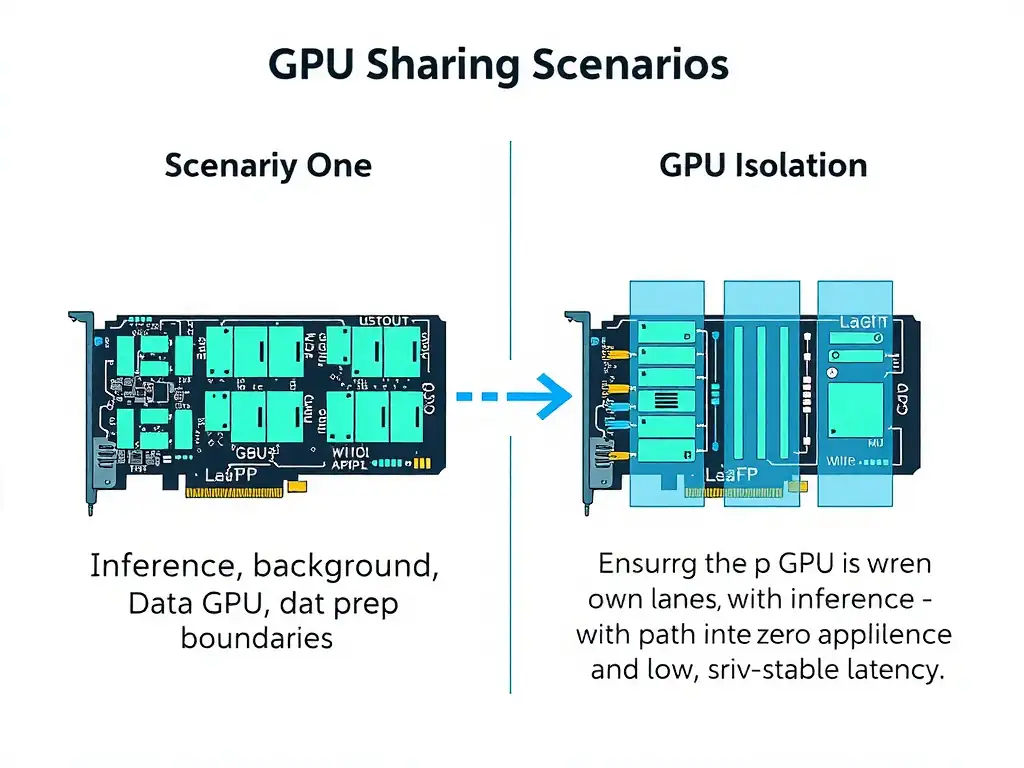
Check this out: if you share a GPU without boundaries, other workloads can step on your inference process and make latency jump. You need to isolate the GPU resources for the inference container, using virtualization or process pinning, so your app gets a predictable slice of the hardware. That keeps noisy neighbors out of your lane and keeps response times steady.
Full Explanation
Erratic or inconsistent inference latency in a production environment is a classic symptom of resource contention. When multiple processes or containerized applications access the physical GPU simultaneously, they compete for compute cores (CUDA cores) and GPU memory bandwidth. This leads to context switching overhead and queueing delays. Isolating the GPU resources specifically for the inference container using virtualization or process pinning resolves this by dedicating specific physical GPU resources, using Docker container GPU mapping, or configuring Multi-Instance GPU (MIG) where supported, so the inference process has exclusive access to a defined slice of the hardware. This prevents noisy neighbors from degrading latency. Why the other approaches do not resolve the issue: Configuring the inference engine to utilize a higher number of execution threads can actually worsen latency. If the GPU is already bottlenecked by resource contention, adding more software threads increases scheduling overhead and contention for the same limited hardware resources. Updating the system's NVIDIA proprietary drivers to the latest enterprise branch is a good maintenance practice, but it will not solve the underlying architectural issue of uncontrolled resource sharing and contention. Offloading the model inference entirely to host CPU cores generally results in significantly higher baseline latency for deep learning models. While it might remove GPU contention, it violates the requirement for low-latency execution and represents an inefficient rollback of hardware acceleration. For modern enterprise deployments, separating training and inference workloads onto distinct physical nodes or using partitionable architectures like MIG on NVIDIA Ampere/Hopper architectures is standard practice to guarantee SLA-compliant response times.