
An infrastructure team wants to analyze how hardware parameters like GPU memory capacity, NVLink bandwidth, and tensor core count collectively impact AI model training throughput and final loss. Which analytical approach will allow them to quantify the individual and combined influence of these hardware variables on model performance?
Select an answer to reveal the explanation.
Short Explanation
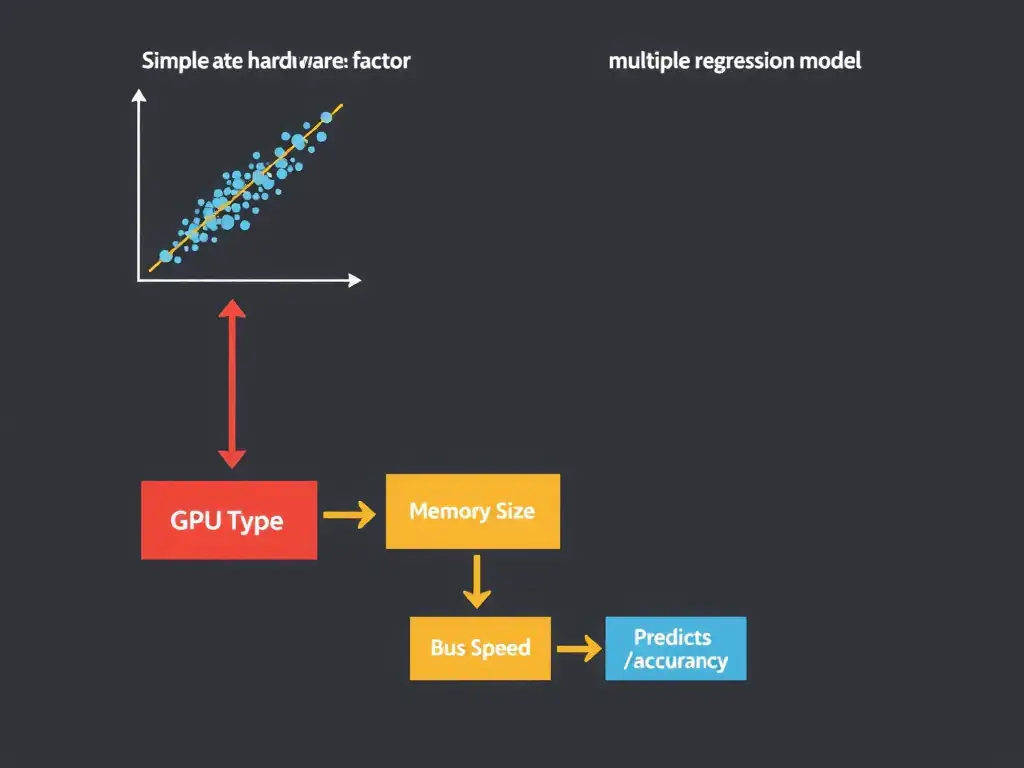
If you're trying to figure out how GPU memory, NVLink bandwidth, and tensor core count all affect training throughput and loss, you can't just look at one chart. Multiple regression analysis takes those hardware specs as independent variables and shows how each one contributes while accounting for the others. That's how you quantify what actually moves the needle, got it?
Full Explanation
To analyze the impact of multiple independent variables, such as GPU memory capacity, NVLink or interconnect bandwidth, tensor core count, and processor type, on dependent variables such as training throughput, final loss, or model accuracy simultaneously, multiple regression analysis is the most appropriate statistical method. Unlike simple bivariate visualizations or pairwise correlation tools, regression analysis constructs a mathematical model that quantifies the relationship between all inputs and the output. This allows engineers to determine not only whether a relationship exists but also the magnitude and statistical significance of each hardware factor's contribution while controlling for other variables.
Mapping hardware parameters against training throughput using individual bivariate scatter plots is useful for viewing the relationship between exactly two continuous variables, such as memory size versus throughput. It fails to show how other variables, like interconnect speed, might be confounding the results or working in tandem with the primary variable.
Generating a clustered bar chart comparing mean throughput across distinct pre-configured node setups displays aggregate performance across discrete hardware groups. While helpful for basic comparisons of fixed node configurations, it does not provide a predictive mathematical relationship or quantify the individual sensitivity of continuous variables like bandwidth or memory.
Constructing a correlation matrix heatmap representing only the pairwise relationship between PCIe speed and epoch training time only illustrates pairwise, linear relationships. It cannot isolate the collective or combined influence of multiple variables on a target metric, nor does it establish a predictive model.
In AI infrastructure design, utilizing regression models helps optimize hardware spend by revealing bottlenecks. For example, it can help determine if increasing GPU memory is more cost-effective for a specific workload than upgrading from PCIe Gen4 to Gen5. Thus, regression analysis provides a comprehensive, multidimensional view necessary for complex systems.