
Which architectural characteristic explains why graphics processing units (GPUs) outperform central processing units (CPUs) when executing deep learning training algorithms?
Select an answer to reveal the explanation.
Short Explanation
Deep learning training is mostly giant matrix math, so you need thousands of small cores doing many operations at once. GPUs give you that parallel horsepower, while CPUs would grind through the work sequentially. Don't be fooled by cooling or power claims—GPUs are power hogs and need serious cooling.
Full Explanation
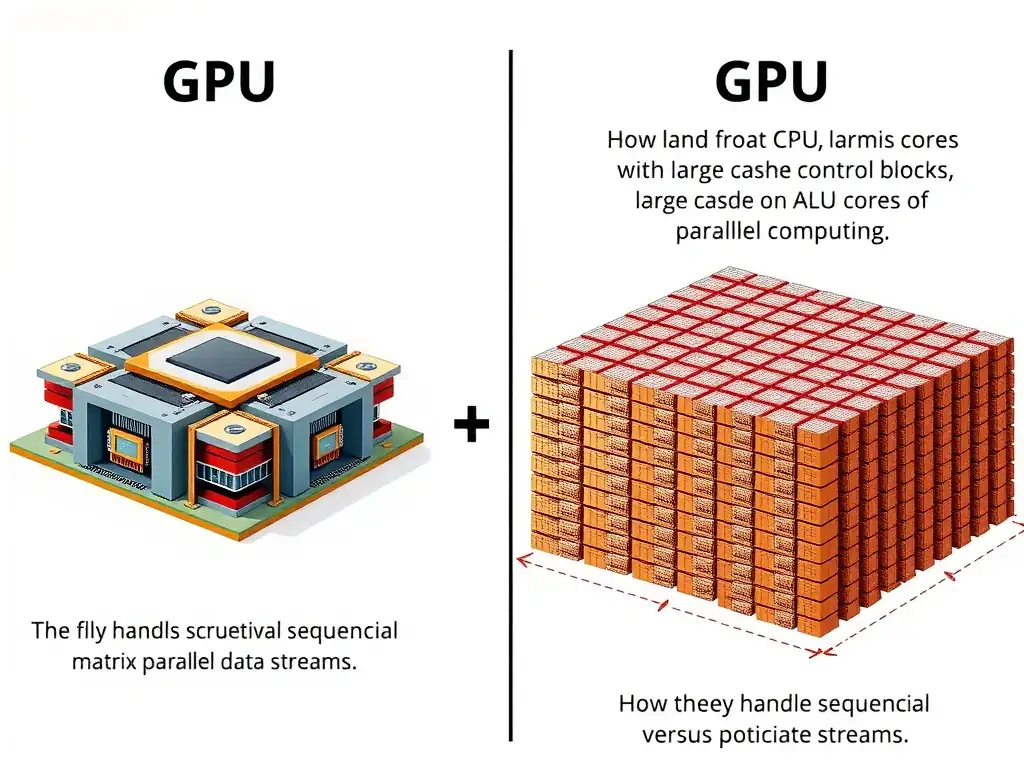
The fundamental difference between CPUs and GPUs lies in their design philosophies. The CPU is designed for low-latency sequential processing. It contains few highly optimized cores with large cache memories, designed to handle complex control flow and execute instructions one after another at high clock speeds. This makes CPUs excellent for general-purpose operating system tasks and sequential algorithms. In contrast, the GPU is built for high-throughput parallel processing. Deep learning workloads, particularly neural network training and inference, consist primarily of matrix multiplications and vector additions. These operations can be decomposed into millions of independent mathematical operations that can run simultaneously. The GPU architecture dedicates the majority of its silicon area to Arithmetic Logic Units organized into thousands of small, simple cores. This allows the GPU to process massive datasets in parallel using Single Instruction, Multiple Data and Single Instruction, Multiple Threads execution models, accelerating matrix math by orders of magnitude compared to the CPU. Reviewing the distractors: the claim that GPUs use a highly sequential architecture with significantly higher clock frequencies is wrong because high clock speeds are characteristic of CPUs, not GPUs. CPU cores typically run at 3-5 GHz, whereas GPU cores operate at lower clock speeds, typically 1.2-2 GHz, but compensate with massive parallelism. The claim that GPUs operate at much lower operating temperatures and eliminate the need for complex cooling systems is wrong because cooling complexity is actually higher for GPUs. High-end enterprise GPUs generate substantial heat, up to 700W+ TDP per GPU, and require advanced cooling systems such as liquid cooling or high-airflow designs rather than being easier to cool. The claim that GPUs have simpler instruction sets that consume much less power than CPU cores during heavy workloads is wrong because power consumption is significantly higher for GPU accelerators compared to standard CPUs. The simpler core design does not offset the aggregate power draw of thousands of active cores and memory traffic. While GPUs are more energy-efficient per floating-point operation due to their parallel efficiency, their absolute power consumption under workload is much higher.