
During the training phase of a deep neural network, a machine learning engineer notices that the training loss and accuracy metrics are exhibiting highly unstable, oscillating patterns from epoch to epoch. Which of the following factors are most likely to introduce this type of performance instability during model training? (Choose two)
Select all correct answers, then click Submit.
Short Explanation
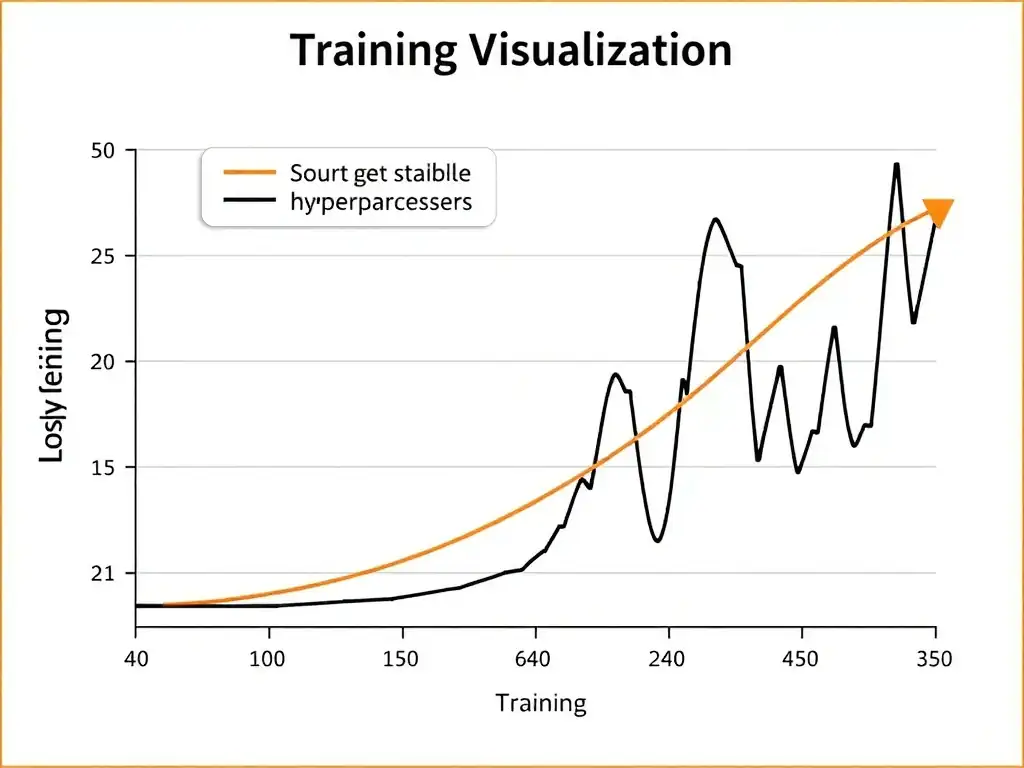
Pay close attention here, because this bites people in the lab all the time. If your loss curve looks like a roller coaster, abrupt or poorly tuned learning-rate changes are likely overshooting the optimum, and inconsistent data preprocessing is feeding the model a moving target. Keep your preprocessing rock-solid and tune your learning rate carefully.
Full Explanation
Unstable training metrics, such as erratic swings in training loss or validation accuracy, indicate that the model is struggling to converge during gradient descent. Identifying the root causes of these fluctuations is critical for successful model training.
- Abrupt or poorly tuned adjustments to the learning rate during active training are a major cause of instability. The learning rate is a hyperparameter that controls how much the model's weights are adjusted in response to the estimated error gradient. If the learning rate is set too high, the optimization algorithm can overshoot the local minima, causing the loss to diverge or oscillate wildly. While learning rate schedules, such as decay or cyclic learning rates, are standard practices, abrupt or excessive changes to the learning rate during training can lead to immediate spikes or drops in performance metrics.
- Inconsistent or varying data preprocessing steps applied to the incoming training batches are another major cause. Machine learning models assume that the training data distribution remains relatively stable. If the preprocessing pipeline is inconsistent, such as varying scaling ranges, inconsistent normalization, or changing augmentation pipelines between batches without control, the model receives inputs with shifting distributions. This forces the model to constantly adjust its weights to conflicting data representations, preventing stable learning and causing metrics to fluctuate.
The other factors do not cause metric fluctuations:
- Enforcing a constant, uniform batch size across all training iterations is incorrect because using a fixed batch size is standard practice and provides a consistent gradient estimation size, which stabilizes the optimization path.
- Shuffling the dataset to ensure a uniform distribution of samples in every epoch is incorrect because ensuring a uniform distribution of data across epochs is a best practice. It prevents the model from learning order-based biases, thereby smoothing convergence rather than causing fluctuations.
- Executing the training loop on a single dedicated GPU without multi-node distribution is incorrect because training on a single GPU does not inherently cause metric instability; it simply limits parallel throughput and execution speed.
Therefore, abrupt or poorly tuned learning-rate adjustments and inconsistent or varying data preprocessing are the primary contributors to training fluctuations.