
A company shares a single Kubernetes GPU cluster among several research groups. Some developers run low-priority, exploratory experiments that can tolerate interruptions, while others run critical production retraining runs with strict deadlines. To optimize cluster efficiency and guarantee that production workloads finish on time without completely shutting out exploratory work, which scheduling strategy should be implemented?
Select an answer to reveal the explanation.
Short Explanation
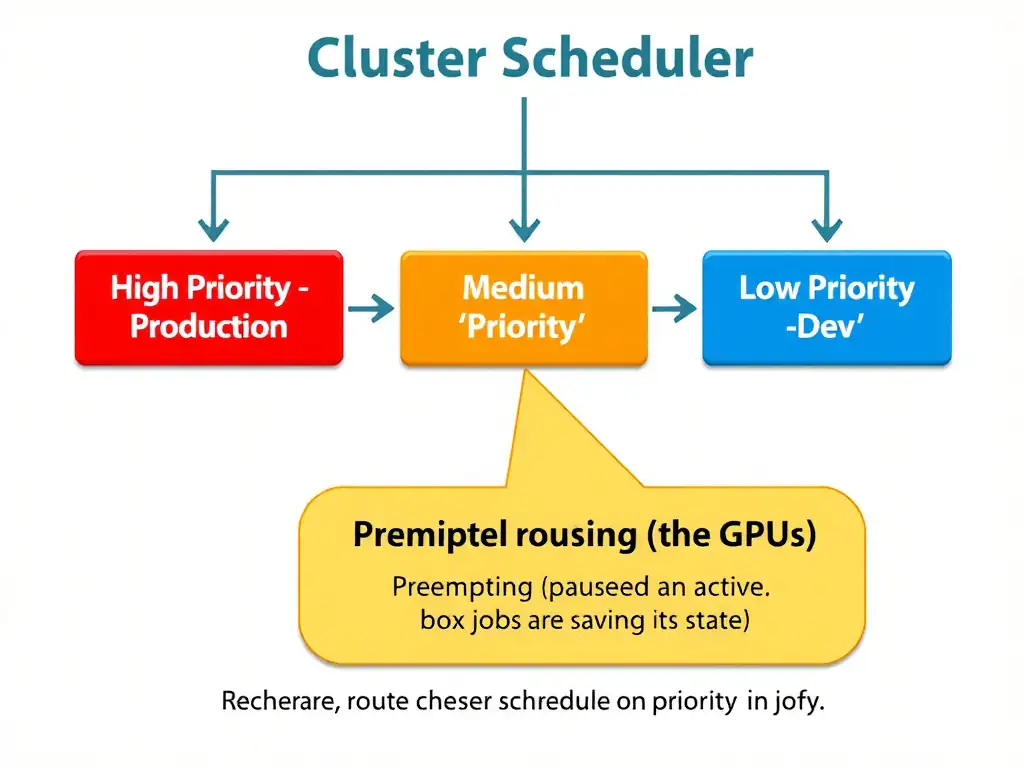
You've got a limited pool of expensive GPUs, and everyone wants them at the same time. Use a priority-based scheduler with preemption rules so critical production runs can pause or throttle low-priority experiments when they need resources. Once the big job finishes, the background work resumes, keeping the cluster busy and deadlines met.
Full Explanation
In shared high-performance computing (HPC) or Kubernetes GPU clusters, resource allocation is a major challenge. Priority-based scheduling with preemption is the industry-standard mechanism to balance resource guarantees with cluster utilization. Under this configuration, workloads are assigned priority levels (e.g., production, development, or batch). When a high-priority job is submitted to the queue, the scheduler determines whether sufficient GPU resources are free. If the cluster is fully occupied, the scheduler preempts (gracefully pauses, throttles, checkpoints, or terminates) running lower-priority jobs, reclaims their GPU resources, and immediately schedules the high-priority task. Once the high-priority job completes, the preempted jobs are automatically resumed, maximizing overall cluster utilization while meeting critical operational deadlines.
The other scheduling methods do not solve the problem. A first-in, first-out (FIFO) queue that locks all GPUs for a single user until their script terminates causes head-of-line blocking; if a long, low-priority job is submitted first, high-priority jobs will sit idle in the queue, missing deadlines. Static equal sharing or fair-share scheduling that guarantees every user gets an identical fraction of GPU resources at all times divides resources equally, preventing a critical workload from scaling across multiple GPUs even if other users are not actively using their shares or if the critical job needs to burst. A randomized resource dispatcher that reassigns GPUs dynamically every few minutes to keep usage statistically uniform would introduce massive instability, cause constant execution interruptions, and result in excessive system overhead from saving and loading checkpoints.