
While neural network algorithms have existed for decades, artificial intelligence has only recently experienced an unprecedented surge in practical capabilities and widespread adoption. What has been the primary technological catalyst that unlocked this modern AI revolution?
Select an answer to reveal the explanation.
Short Explanation
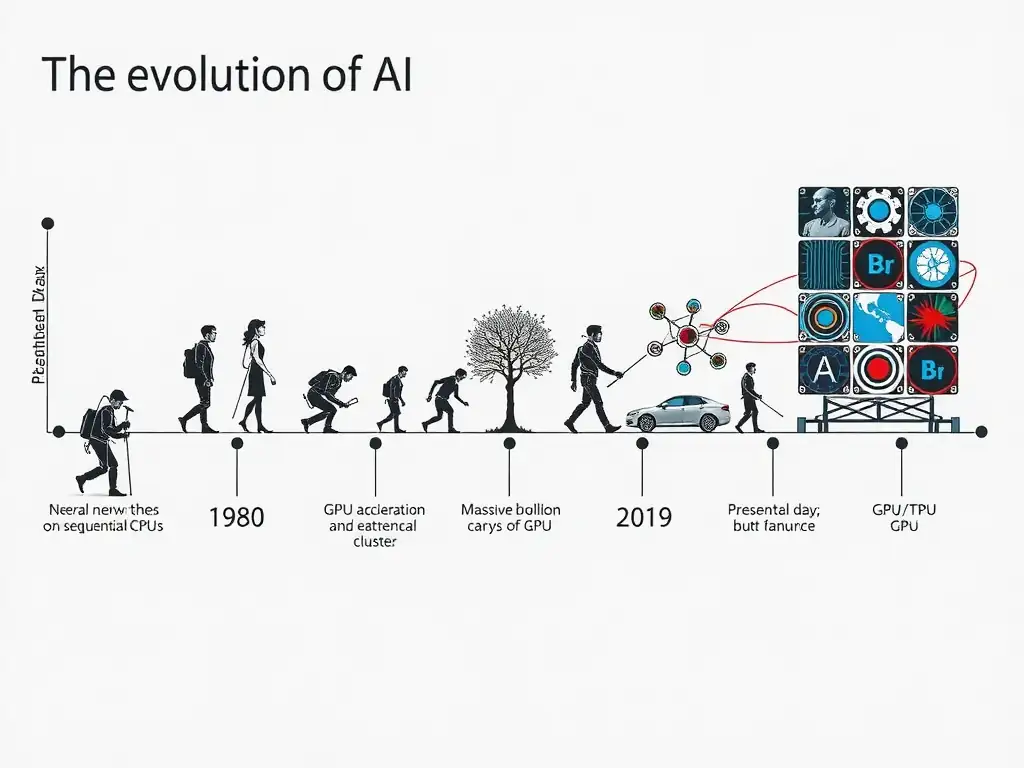
You’ve had the math for decades, but CPUs were too slow. The real unlock was specialized accelerators like GPUs and TPUs, because they handle massive parallel math and turn months-long training into hours. Without that raw throughput, modern AI wouldn’t be practical.
Full Explanation
The modern renaissance of artificial intelligence and deep learning is primarily attributed to the availability of massive computational power. Although the mathematical foundations of neural networks, such as gradient descent and backpropagation, were formulated in the mid-to-late 20th century, practical applications were severely limited by the serial processing nature of Central Processing Units. The primary catalyst that enabled the rapid advancement and commercialization of AI was the development and adoption of specialized, highly parallel hardware accelerators, such as Graphics Processing Units and Tensor Processing Units, capable of handling massive parallel computations.
Deep learning training involves performing millions of matrix multiplications simultaneously. Graphics Processing Units, originally designed for rendering 3D graphics using massive parallel floating-point operations, proved highly suited for these mathematical requirements. The introduction of platforms like NVIDIA's CUDA allowed researchers to leverage Graphics Processing Units for general-purpose computing, reducing model training times from weeks or months to days or hours. This computational leap enabled the training of deep neural networks with billions of parameters.
The other choices are supporting factors, not the primary catalyst. High-level, open-source programming libraries for general software development simplified development, but they are not enough by themselves because they still need underlying hardware to execute the computations. The shift in corporate funding models toward long-term computer science research grants helped support the ecosystem, but funding alone does not create the throughput needed to train modern models. The transition of enterprise databases from relational models to unstructured data lakes made large datasets easier to collect and organize, but it is auxiliary; the physical capability to run deep learning models at scale is entirely dependent on the hardware throughput provided by GPUs and TPUs, making hardware acceleration the true enabler of the modern AI era.