
You are designing an automated MLOps pipeline for a real-time recommendation engine where user behavior data is continuously ingested. To ensure the model remains highly accurate and trained on the latest datasets without wasting expensive GPU compute resources on redundant runs, which pipeline scheduling strategy should you adopt?
Select an answer to reveal the explanation.
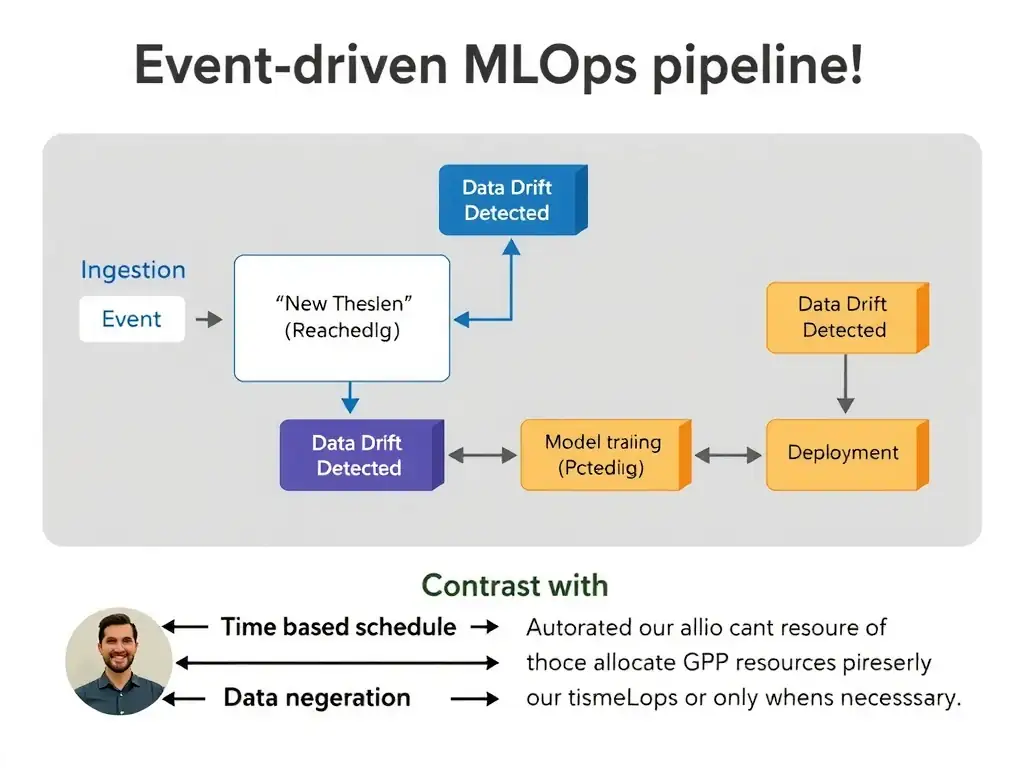
Short Explanation
Your recommendation engine needs to learn when there's actually new data or drift, not on a blind timer. You'll kick off retraining only when ingestion thresholds or change detection fire, so the model stays fresh without burning GPU hours on empty runs. That's the production-grade way to balance accuracy and cost.
Full Explanation
In modern MLOps pipelines, aligning model training with data updates is a critical architectural challenge. The objective is to maintain high model accuracy by retraining on fresh data while optimizing GPU resource consumption and minimizing deployment delay. The most effective approach is the event-driven workflow that automatically kicks off model retraining upon data ingestion thresholds or change detection.
An event-driven architecture triggers the retraining and deployment pipeline automatically in response to specific system events, such as a new dataset reaching a storage bucket, a database trigger indicating that a threshold of new records has been met, or a monitoring service detecting model performance drift. This approach ensures that the model is updated in a timely manner relative to the data influx, preventing the model from becoming stale while avoiding the waste of computational resources on schedules where no new data has been introduced.
Let's examine the drawbacks of the alternative approaches. The strict, time-based cron job every two hours leads to inefficiencies: if no new data has arrived, the pipeline runs redundantly, consuming high-power GPU resources; conversely, if a massive batch of critical data arrives right after a run starts, the model remains stale until the next interval. The static round-robin scheduling protocol across all nodes in the cluster is a CPU/network load-balancing mechanism that determines which node receives a task; it does not address pipeline triggering or data freshness. The manual, weekly release cycle to minimize infrastructure drift is inadequate for environments with frequently updating data, as it guarantees that the model will be out-of-date for most of the week, leading to poor predictions and operational delays.