
When building systems for deep learning, engineers rely on GPUs rather than traditional CPUs to handle the heavy lifting of model training. Which two structural and functional characteristics of GPU architecture make them far superior to CPUs for training large-scale AI models? (Select two)
Select all correct answers, then click Submit.
Short Explanation
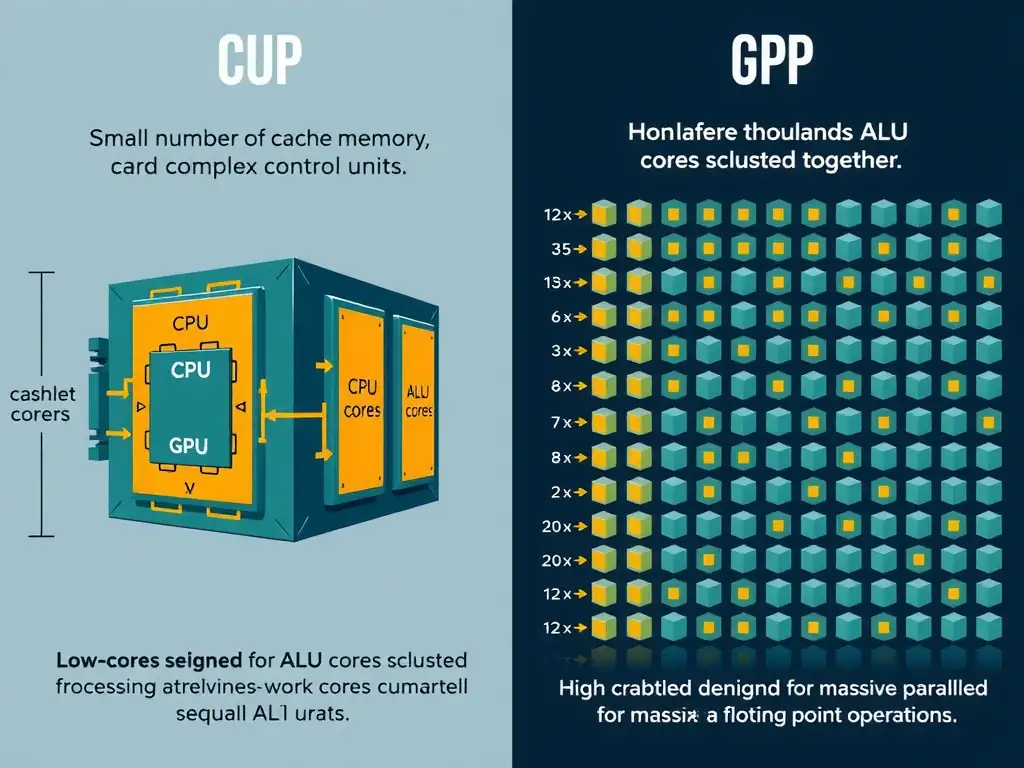
Think of a CPU as one fast delivery van and a GPU as a fleet of thousands of scooters. You need that massive density of simple parallel cores plus hardware built to chew through floating-point math, because deep learning is mostly huge parallel matrix calculations. That's why GPUs win for model training.
Full Explanation
CPUs are latency-optimized processors designed to execute complex sequential tasks quickly, while GPUs are throughput-optimized processors designed to handle massive volumes of simple parallel tasks. The correct GPU characteristics are a high density of specialized parallel cores and architectural optimization for floating-point throughput. A GPU contains thousands of smaller, simpler cores, unlike a modern enterprise CPU with dozens of powerful cores for rapid sequential execution. This core density lets it execute millions of operations simultaneously, matching deep learning matrix multiplication and gradient descent during neural network training. Deep learning also relies on single-precision FP32, half-precision FP16, TensorFloat-32, and Bfloat16, so GPUs use dedicated execution units such as NVIDIA Tensor Cores to deliver teraflops or petaflops. The option about a highly complex general-purpose ISA is wrong because that is a CPU trait: it allows CPUs to run operating systems and manage diverse tasks, but it adds architectural overhead unnecessary and inefficient for repetitive AI math. The option about elevated single-core clock frequencies optimized for sequential execution is wrong because high clocks are typical of CPUs; GPUs actually operate at lower clock speeds per core but compensate with parallel scale. The option about extremely low TDP thresholds under load is wrong because GPUs are efficient per operation under parallel loads but consume significant total power; modern AI GPUs have TDPs exceeding 700 watts. The fragment beginning 'is a CPU characteristic...' is wrong because it is explanatory text, not a GPU characteristic; it repeats the CPU ISA overhead and high-clock facts. The fragment beginning 'are also typical of CPUs...' is wrong because it is explanatory text, not a GPU characteristic; it repeats CPU clock, GPU power, and low TDP facts. The fragment beginning 'compared to CPUs...' is wrong because it is explanatory text, not a GPU characteristic; it repeats the modern AI GPU TDP exceeding 700 watts fact.