
You are hosting several GPU-accelerated virtual machines (VMs) in your private cloud. One VM is running a BERT model but is completing training epochs at half the speed of the other identical VMs, despite having the exact same physical GPU hardware allocated. Which configuration error is most likely preventing the VM from executing workloads directly on the hardware at bare-metal speeds?
Select an answer to reveal the explanation.
Short Explanation
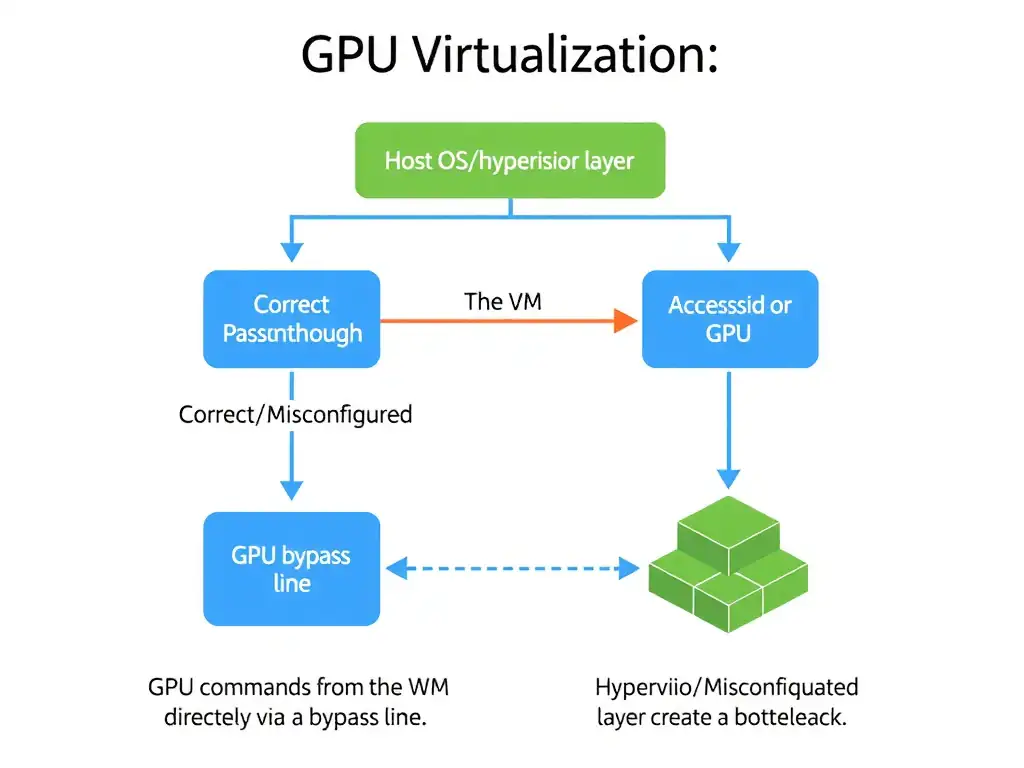
If your GPU-accelerated VM is running half speed despite identical hardware, the hypervisor probably isn't giving it direct PCIe passthrough. Misconfigured passthrough or device translation makes the hypervisor mediate GPU commands, killing bare-metal speed. Fix the passthrough and IOMMU settings so the VM can talk straight to the GPU.
Full Explanation
In virtualized environments, obtaining near-native (bare-metal) GPU performance requires bypassing the virtualization layer as much as possible. This is achieved using PCI Passthrough, also known as Direct Device Assignment, which allows a virtual machine to have exclusive, direct access to a physical PCIe device such as a GPU. If the virtualization hypervisor is using misconfigured GPU passthrough or device translation settings, the virtual machine may suffer from high hypervisor intervention overhead during memory copies and kernel launches, or it might fall back to software-emulated rendering, severely limiting performance. Proper configuration requires enabling IOMMU (Intel VT-d or AMD-Vi) in the BIOS/UEFI, configuring the hypervisor to release the GPU, and binding the guest VM to the physical PCIe address. An incorrect version of the PyTorch framework typically causes compatibility errors or execution crashes rather than a consistent 50% performance drop. Allocating an insufficient amount of virtual disk space would cause write failures or swapping rather than slow GPU execution. Network congestion on the physical host server's management interface affects remote administration but does not impact local GPU computation. Thus, misconfigured hypervisor passthrough or device translation settings are the root cause of the performance bottleneck.