
When designing hardware infrastructure for enterprise artificial intelligence, how do the memory (VRAM/RAM) and storage capacity demands of the model training phase compare to the model deployment (inference) phase?
Select an answer to reveal the explanation.
Short Explanation
Here's the deal: training is the heavy lift because you have to keep large batches, optimizer states, and intermediate activations in memory. Inference is lighter because you mostly load the final weights and run a forward pass. Keep that distinction clear, because it dictates what hardware you buy.
Full Explanation
The resource footprints of machine learning models differ drastically between the training phase and the inference phase.
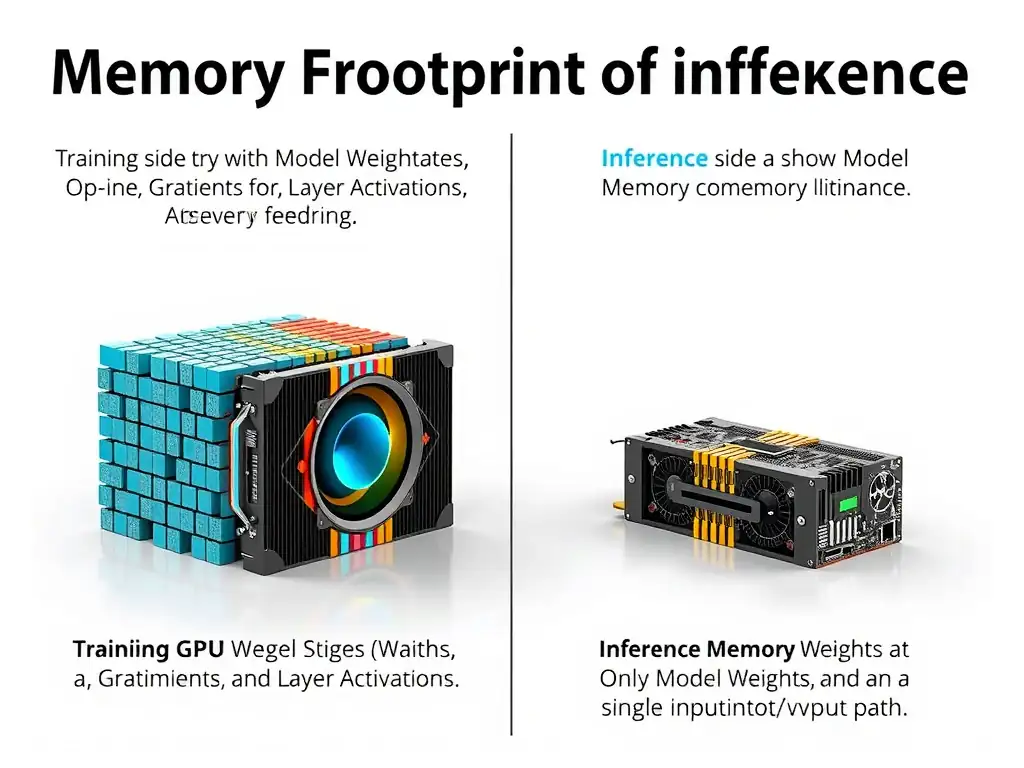
During the training phase, the system must keep several large components in memory simultaneously: 1. Model Parameters (Weights): The actual parameters being optimized. 2. Gradients: The derivatives calculated during backpropagation, which are of equal size to the model parameters. 3. Optimizer States: Popular optimizers like Adam maintain moving averages of gradients (first and second moments), requiring twice the memory of the model parameters. 4. Activation States: During the forward pass, intermediate activation outputs for every layer must be saved in memory so they can be referenced during the backward pass (backpropagation). 5. Large Datasets/Batches: Large batches of input data are loaded into memory to maximize GPU tensor core utilization.
Consequently, training requires high-bandwidth VRAM (often spread across multiple GPUs) and large, high-throughput storage (SSDs/NVMe) to hold raw training datasets.
Conversely, during the inference phase, the model is read-only. The system only needs to load the final static model weights and store the activations for a single forward pass (which are immediately discarded). No gradients or optimizer states are stored, meaning inference memory consumption is a fraction of what is required for training.
Let's review the distractors: The claim that training and inference have virtually identical memory and storage requirements because they use the same weights and tensor configurations is incorrect because training requires storing gradients, activations, and optimizer states that are absent during inference.
The claim that inference requires significantly higher memory capacity than training to support the concurrent execution of multiple model pipelines is incorrect because, while concurrent inference pipelines exist, they scale horizontally and do not individually exceed the memory requirements of the training environment.
The claim that training is primarily compute-bound and requires minimal VRAM, whereas inference is highly memory-bound and demands massive storage capacity, is incorrect because training is highly VRAM-intensive due to activation storage and optimizer states; it is not 'minimal VRAM.'