
You are designing an automation system for a multi-stage machine learning pipeline. The pipeline must ingest raw data, preprocess it, train three separate models in parallel, validate their results, and finally deploy the best-performing model to production. Which orchestration method is best suited for defining and executing this sequence of jobs based on their dependencies?
Select an answer to reveal the explanation.
Short Explanation
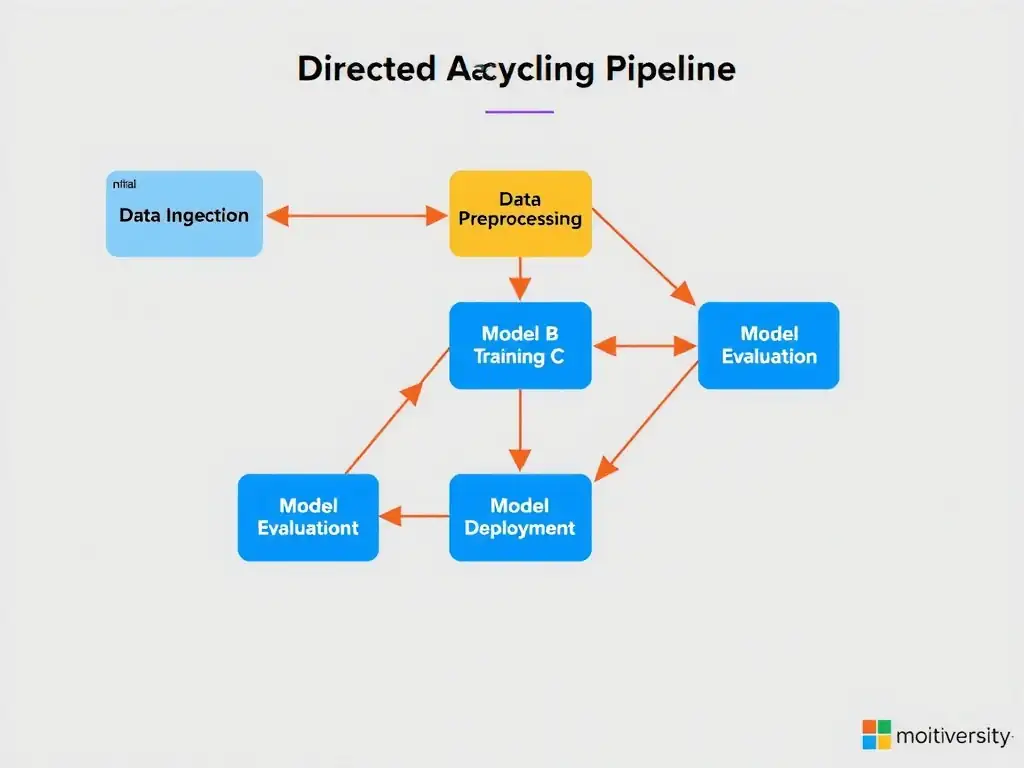
Think of your pipeline like building a house: you can't put the roof on until you've built the walls, and you can't build the walls until you've poured the foundation. You can't validate a model until it's finished training, but you can train three different models in parallel once preprocessing is done. DAG-based workflow orchestration maps that exact sequence, runs parallel tasks, and retries failed steps, so it's the best way to keep your sanity in complex enterprise workflows.
Full Explanation
In modern machine learning operations (MLOps), workflows are composed of multiple interdependent tasks. For example, feature engineering must complete before model training begins, and model evaluation must occur before deployment. At the same time, independent tasks, such as training different model variants or performing hyperparameter tuning, can run concurrently to optimize resource utilization.
The Directed Acyclic Graph (DAG) is a mathematical representation of a finite set of tasks connected by directed edges, with no loops or cycles. DAG-based workflow orchestration, using tools like Apache Airflow, Kubeflow Pipelines, or Prefect, is the industry standard for executing these pipelines because: 1. Dependency Management: It guarantees that tasks are only executed after their upstream dependencies have successfully completed. 2. Parallelism: It automatically identifies independent paths in the graph and runs them in parallel across available compute resources, like GPU nodes. 3. Failure Recovery: It allows for granular retries of specific failed nodes in the graph without needing to rerun the entire pipeline from scratch.
The incorrect approaches do not fit this pipeline. The FIFO queue that processes tasks in the exact chronological order they were submitted is unsuitable because it executes tasks strictly in the order they are received. It cannot handle complex branch dependencies or parallel executions, leading to resource bottlenecks. The round-robin scheduler that allocates fixed CPU slices to all pipeline tasks concurrently distributes resource slices evenly over time. It is designed for operating system process scheduling, not for managing multi-step workflows with strict sequential data dependencies. The manual operator-controlled checklist executed via command-line scripts does not scale. It is highly prone to human error, lacks automated monitoring and retry mechanisms, and fails to optimize GPU hardware utilization.