
You are building an accelerated data science pipeline and need to run heavy ETL (Extract, Transform, Load) tasks—such as loading, filtering, and joining large tabular datasets. Which library in the NVIDIA RAPIDS suite should you import to run these DataFrame operations directly on the GPU using a Pandas-like API?
Select an answer to reveal the explanation.
Short Explanation
If Pandas is crawling on huge tabular ETL, you want cuDF. It gives you a Pandas-like API but pushes joins, filters, and group-bys onto the GPU, so you can chew through big DataFrames way faster.
Full Explanation
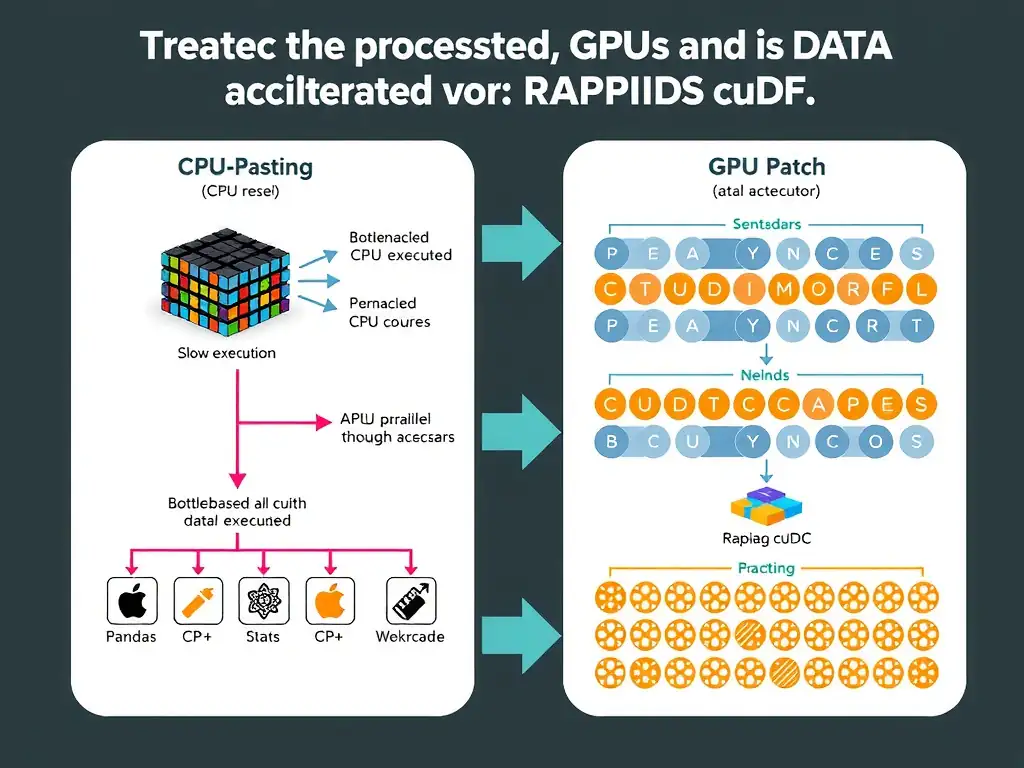
NVIDIA RAPIDS is an open-source suite of software libraries built on CUDA that allows users to run end-to-end data science and analytics pipelines entirely on GPUs. In traditional data science workflows, data preprocessing and ETL tasks are heavily bottlenecked by CPU processing speeds. Libraries like Pandas are single-threaded and bound by CPU memory bandwidth.
Within the RAPIDS ecosystem, cuDF is the GPU-accelerated DataFrame library designed to solve this bottleneck. It provides a Pandas-like API, allowing data scientists to easily transition their code. Under the hood, cuDF leverages Apache Arrow columnar memory format and uses GPU parallelism to accelerate operations such as joins, merges, group-bys, and filters. By running these operations on GPU cores, data processing is completed significantly faster, freeing up resources and reducing pipeline latency.
The other choices are incorrect. The cuDNN choice, CUDA Deep Neural Network library, is a GPU-accelerated library for deep neural network primitives. It is used for tasks like forward and backward passes in neural networks, not for tabular data manipulation. The CuPy choice is an open-source array library accelerated with NVIDIA CUDA. While it is excellent for matrix computations and replaces NumPy on the GPU, it does not provide the high-level DataFrame abstractions or tabular data utilities that cuDF offers. The Pandas with native CPU-based multithreading enabled choice cannot leverage the parallel architecture of GPUs. Even with CPU multithreading enabled, it cannot match the massive throughput and performance gains achieved by offloading DataFrame operations to a GPU using cuDF.