
You are comparing two machine learning models for an image classification task where the classes are highly imbalanced (e.g., detecting rare medical conditions). Model Alpha has an accuracy of 83% and an F1 score of 0.91. Model Beta has an accuracy of 89% and an F1 score of 0.84. If your goal is to select a model that maintains the best balance between precision and recall under class imbalance, which model should you choose?
Select an answer to reveal the explanation.
Short Explanation
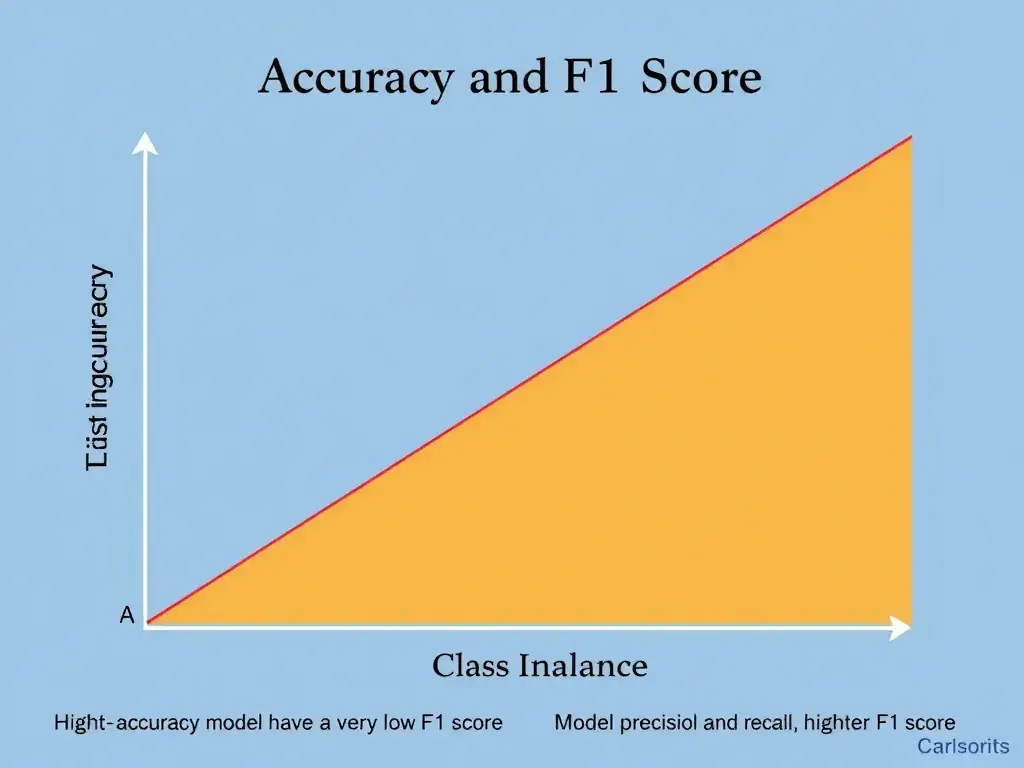
In imbalanced data, accuracy can lie. You want the model with the higher F1 score, because it balances precision and recall better. That's Model Alpha here.
Full Explanation
When evaluating classification models, relying solely on accuracy can be highly misleading, especially in the presence of class imbalance. Accuracy measures the ratio of correct predictions to total predictions. In a dataset where one class dominates, a naive model can achieve high accuracy by simply predicting the majority class, while failing entirely on the minority class.
To address this, data scientists use the F1 score, which is the harmonic mean of precision and recall. Precision (positive predictive value) measures the accuracy of positive predictions, while recall (sensitivity) measures the model's ability to find all positive instances. The F1 score reaches its best value at 1 (perfect precision and recall) and worst at 0. Model Alpha has an F1 score of 0.91, which is higher than Model Beta's F1 score of 0.84. This indicates that Model Alpha achieves a better balance between precision and recall, making it more robust and reliable for class-imbalanced datasets, despite its lower overall accuracy of 83%.
The choice of Model Beta because its higher accuracy indicates superior generalization across the entire dataset is incorrect because higher accuracy does not guarantee superior generalization, especially when class imbalance is present. The choice of Model Beta because accuracy is always the most reliable metric regardless of class distribution is incorrect because accuracy is not always more reliable; in fact, for imbalanced datasets, it is often a misleading metric. The choice of Model Alpha because an F1 score of 0.91 guarantees that there are zero false negatives in the predictions is incorrect because an F1 score of 0.91 is not perfect, which would be 1.0, and does not guarantee zero false negatives. Perfect recall of 1.0 is required for zero false negatives.